

 Español
 Català
 Deutsch
 Français
 Português
 Italiano
 Nederlands
 Polski
What the base covers according to its README
The module's README opens with the frameworks it deals with. It lists Directive (EU) 2023/970, on pay transparency, and Real Decreto 902/2020, on Spanish pay equity. It then adds three national frameworks, each marked as coming through an extension: the German Entgelttransparenzgesetz (_de extension), the French Index Égalité Professionnelle (_fr extension) and the Italian Rapporto Biennale (_it extension). The directive and the Spanish decree carry no such mark.
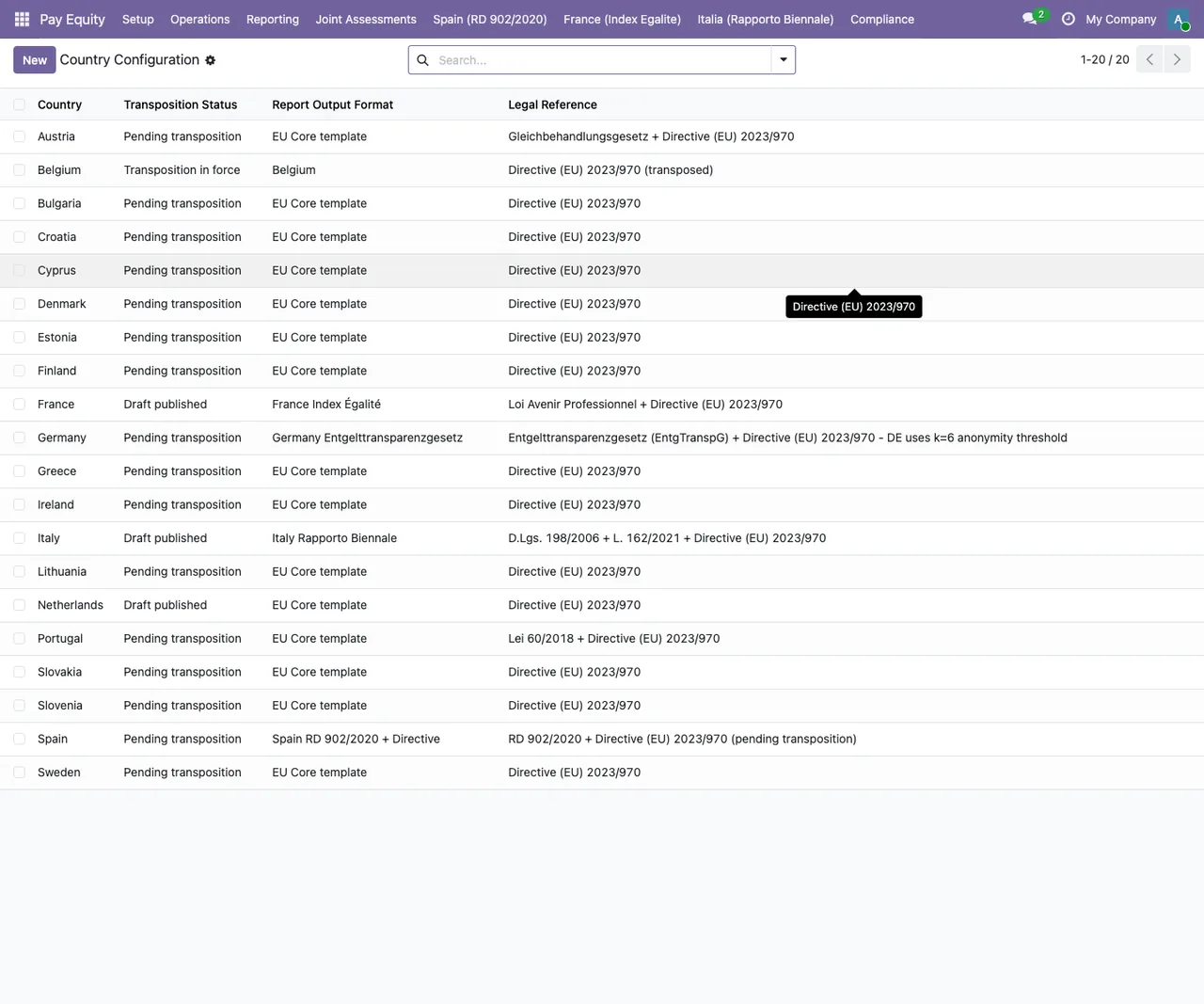
Within the base, the README describes these models:
paytrans.worker.category: equal value work category, which the README links to Art. 4.paytrans.job.evaluation: job evaluation system using the EIGE methodology.paytrans.evaluation.factorandpaytrans.factor.level: the EIGE factors and levels.paytrans.job.score: job scoring per evaluation system.paytrans.pay.criteria: accessible pay-setting criteria, linked to Art. 6.paytrans.country.config: per-country threshold and format configuration.paytrans.access.log: immutable GDPR audit log.paytrans.audit.mixin: abstract audit trail mixin inherited by the domain models.
What it adds to standard Odoo models
The module also extends records you already have in Odoo. According to the README:
res.company: pay equity configuration (k-anonymity threshold and DPO user).hr.employee: worker category, exclusion flags and last notification date.hr.contract: Art. 3 pay components (basic annual or hourly, variable and benefits).hr.job: salary range, currency, period and collective agreement.hr.applicant: an Art. 5(2) audit sentinel.
Who sees what
The module defines four security groups:
group_paytrans_user: employee access, portal only.group_paytrans_workers_rep: workers' representative.group_paytrans_manager: HR or legal manager.group_paytrans_admin: full administrator.
What it does not cover or handles elsewhere
- Other countries. For Germany, France and Italy the README points to the
_de,_frand_itextensions. - Migrations. The Odoo Apps listing says they do not take care of migrating your database to a new Odoo version.
- Third-party costs. You contract and pay for your account on each platform, Odoo and your hosting yourself.
- Other points in that same list on the listing: customising the module or custom development, configuring the module for you, importing historical data and support for modules that are not FlexigoTech's. If you are counting on any of these, ask before you buy.
As part of the service, the listing names monitoring of the module's sources, with alerts and the calendar of their deadlines; monitoring of the module's health in your database, with alerts; support with the first response within 1 working day; and the service on the staging and test copies of your database.
The module costs €9 excluding VAT on Odoo Apps for Odoo 19.0, a one-off payment per version, and on the Odoo App Store each Odoo version is bought there. The local service costs €29/month or €290/year excluding VAT (Pro: €58/month or €580/year); without a subscription, or with the service suspended, whatever the subscription provides stops and your data stays in your Odoo.
A worked example: a factory on Odoo 19 weighing it up
Example Illustrative case: the company and its figures are made up to explain the flow.
Cerámicas Albada is a made-up tile manufacturer in Castellón that already runs Odoo 19 with employees, contracts and recruitment. Nuria, its people manager, has to decide whether the module suits them.
First, the version and the framework
Nuria checks that her Odoo is 19, the version the module is published for on Odoo Apps. As the whole workforce is in Spain, she looks for Real Decreto 902/2020 and Directive (EU) 2023/970 in the README and sees that neither carries the extension mark. She does not need the German, French or Italian pieces.
Next, a test copy
She asks for it to be installed first on a test copy of her database, which the listing includes in the service. There she goes through the app's lists.
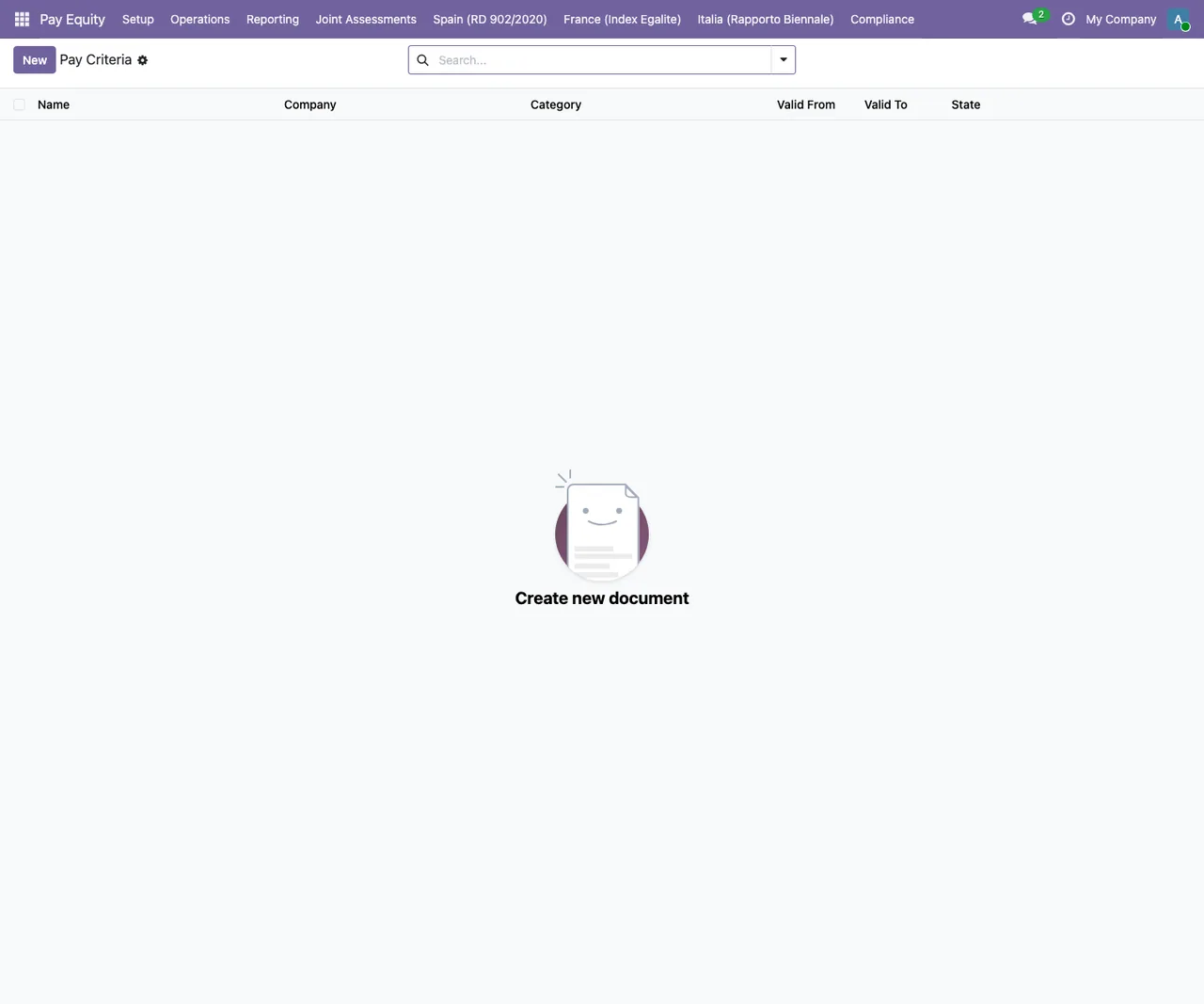
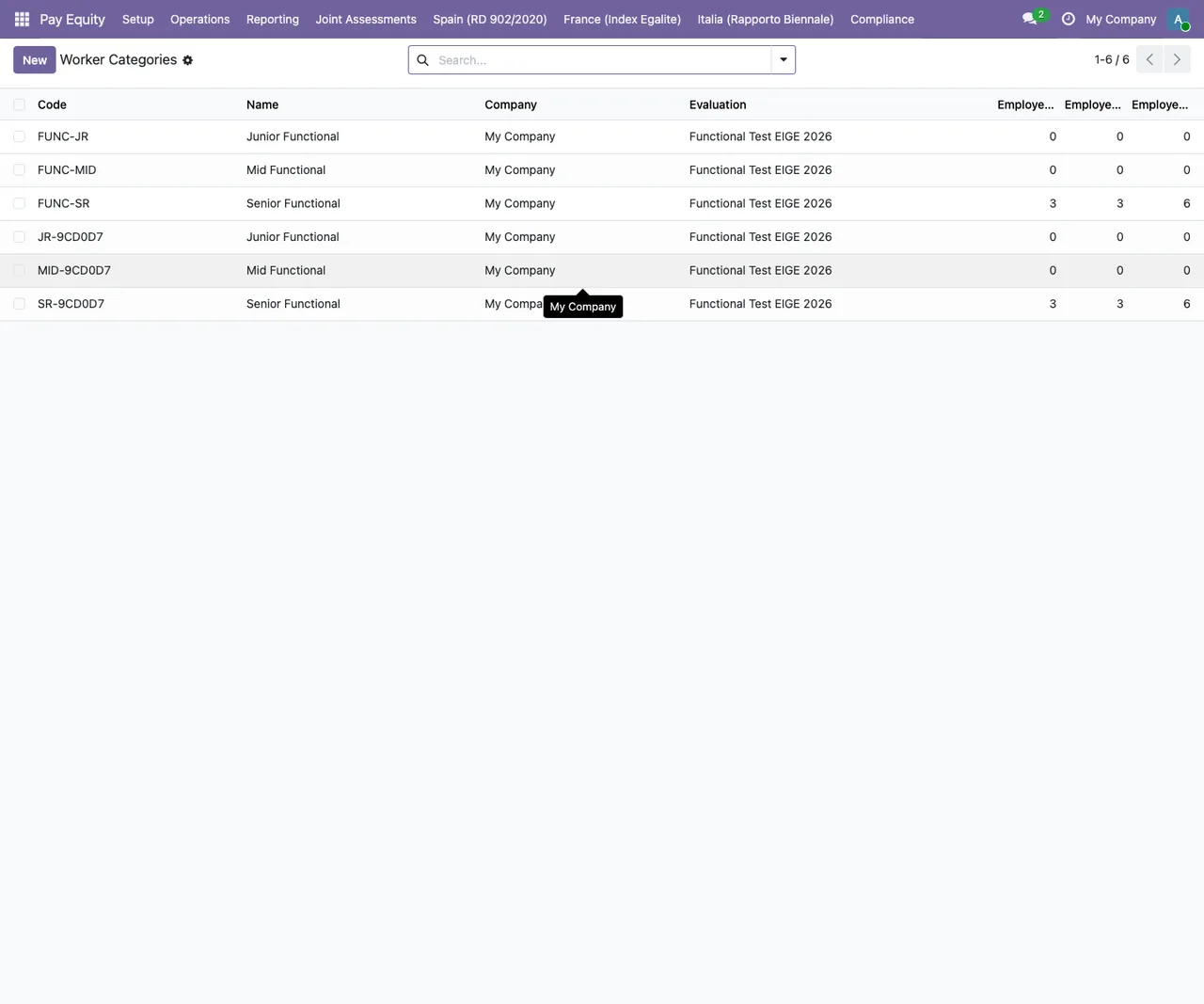
The pay criteria list is empty. Nuria decides her team will draft those criteria before opening anything up to staff.
Then, who gets in and with which permission
She gives group_paytrans_manager to herself and the legal adviser, group_paytrans_workers_rep to the works council representative and group_paytrans_admin to the IT lead. Staff stay in group_paytrans_user, with portal-only access. On the company record she sets the k-anonymity threshold and which user acts as DPO.
Finally, what falls outside
She wants to load pay components from older contracts. Since importing historical data appears in the listing alongside migrations, she asks first and considers commissioning it as custom work.
What to take from the example when deciding
- If your Odoo is 19, you can try it now; if you are on another version, it is not currently published for it on Odoo Apps.
- If you have staff in Germany, France or Italy, you also need the extension the README names for each country.
- If you want it set up for you with historical data loaded, that is not among what the listing describes as the service: treat it as an implementation.
- If you plan to change Odoo version soon, bear in mind the listing says they do not migrate your database.
- If you are concerned about who sees pay data, review the four groups, the k-anonymity threshold and the immutable GDPR audit log.
What to have ready before installing
- Odoo 19 and a test copy of your database.
- Who will be the DPO user and what k-anonymity threshold you want for the company.
- Who reviews salary range, currency, period and collective agreement on job positions.
- Who reviews basic annual or hourly pay, variable pay and benefits on contracts.
- Which people go into each of the four security groups.
- Your Odoo account and hosting, which you contract and pay for yourself.
To see the menus and what a record goes through, carry on with how the module works inside; if you already have it on test, the list of error messages and warnings will help.
How FlexigoTech can help
FlexigoTech implements Odoo and builds custom connectors and integrations. If you need someone to prepare company, job and contract data, or to adapt the module to your case, it can be scoped as an implementation or development project. The module and its service are on the Odoo Apps listing.
Keep reading
Checked in the module's source code (version 19.0) and the linked sources
Sources
- Module source code: flexigobe_pay_equity_base 19.0 (68808faf): README.md
- Module source code: flexigobe_pay_equity_base 19.0 (68808faf): static/description/index.html
- apps.odoo.com/apps/modules/19.0/flexigobe_pay_equity_base
- flexigotech.com/en/services.html
- flexigotech.com/precios.html