

 Español
 Català
 Deutsch
 Français
 Português
 Italiano
 Nederlands
 Polski
The data at a glance
Eurostat's survey on the use of enterprise resource planning (ERP) software covers companies with at least 10 persons employed, counting employees and self-employed people. These are the 2025 percentages:
| Group of companies | Used an ERP in 2025 |
|---|---|
| All in the EU (10 or more persons) | 46.45% |
| Small (10-49 persons) | 41.08% |
| Large (250 or more persons) | 88.71% |
| Information and communication | 61.28% |
| Manufacturing | 57.62% |
| Wholesale and retail trade | 53.77% |
| Accommodation and food services | 26.69% |
| Spain | 60.38% |
| Denmark | 66.25% |
| Croatia | 21.89% |
Two useful readings. Spain is above 60%, like Denmark and Belgium. And in wholesale and retail trade more than half already use one, 53.77%. If you sell products and your company has more than 10 people, more than half of your sector already works with one.

What counts as an ERP
Eurostat describes an ERP as software delivered in modules, which can cover planning, purchasing, marketing, sales, customer relations, finance and human resources. And it calls internal integration the electronic and automatic sharing of information between a company's areas, either with several applications hooked to a common database or with a single modular ERP.
So the underlying question is whether your data moves from one area to another on its own, or someone moves it by hand. An online shop with an invoicing program and a stock spreadsheet has three places that do not talk to each other.
What size are you?
For the EU, under Recommendation 2003/361, a micro company has fewer than 10 employees and up to €2 million in turnover or balance sheet; a small one, fewer than 50 employees and up to €10 million; and an SME in general, fewer than 250 employees and a turnover of up to €50 million or a balance sheet of up to €43 million.
Eurostat's survey starts at small companies. If you are a micro company, the figures above do not describe you yet, but they do show what companies of the size you are aiming for are doing.
How to decide in your case
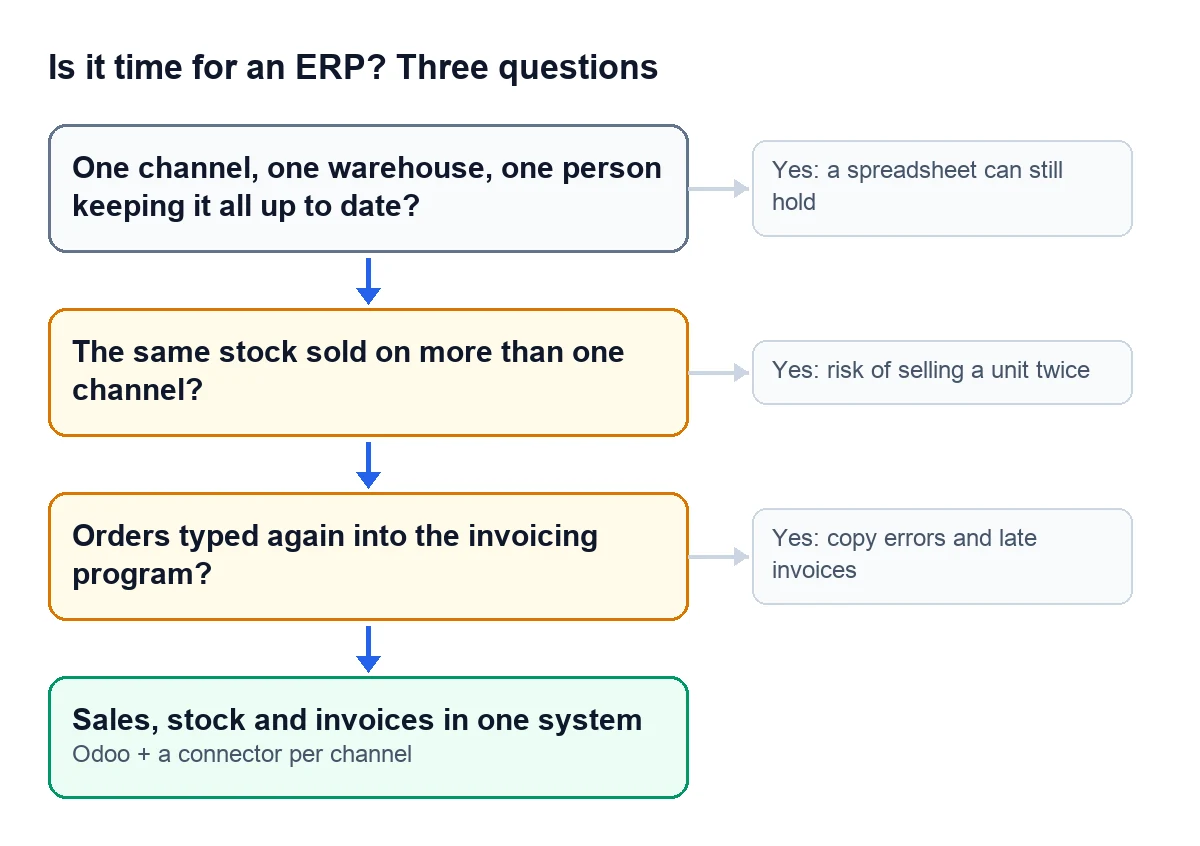
It already pays off if any of these sound familiar:
- You sell the same stock on more than one channel. That is the case we describe in inventory in Excel.
- You copy marketplace orders by hand into your invoicing program.
- Several people touch the same data and nobody knows which version is right.
- Your invoicing spreadsheet already works out books or summaries with macros.
You can wait if you sell on a single channel, with a short catalogue, and the same person keeps everything up to date. With or without an ERP, the Spanish Commercial Code asks for orderly accounts that let you follow your operations in chronological order, and for books, correspondence, documents and receipts to be kept for six years. If that is already hard with loose spreadsheets, it is one more sign.
If you sell on several marketplaces through ChannelEngine
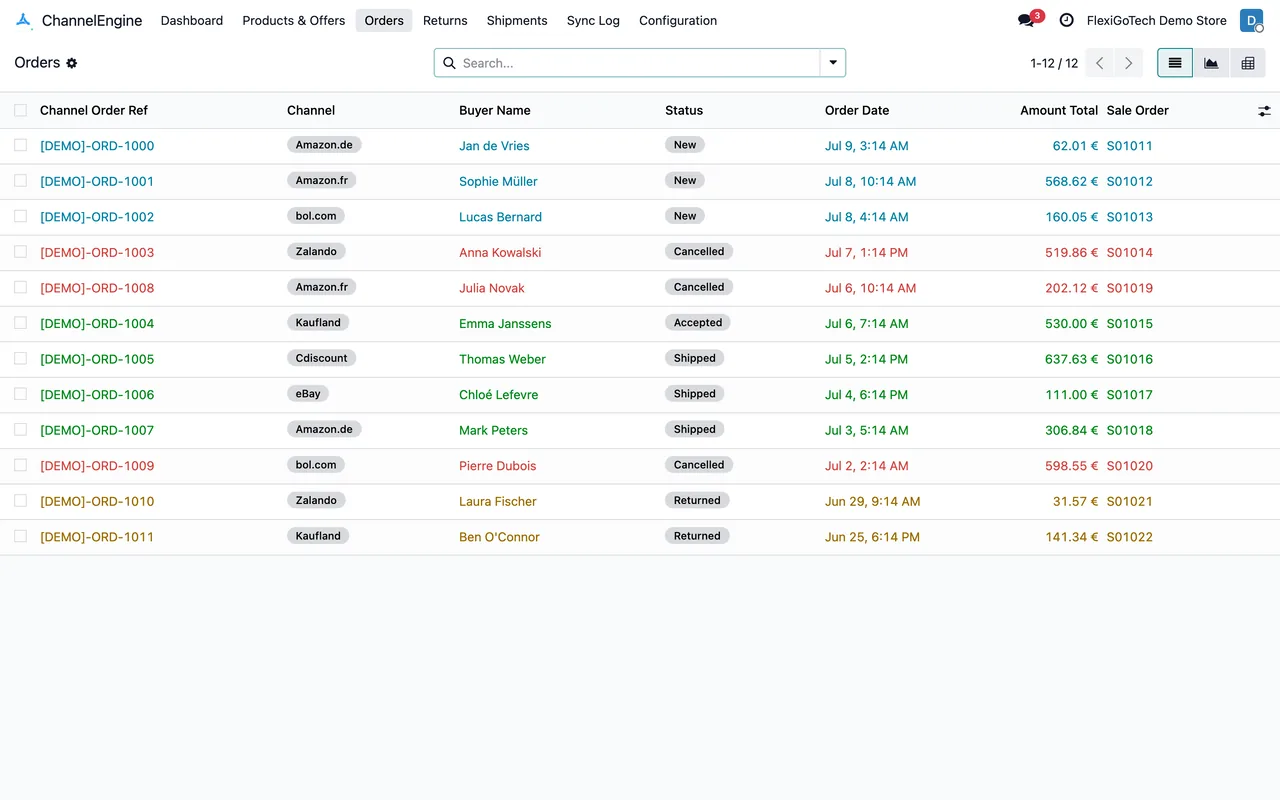
With Odoo and our connector, the orders from all your ChannelEngine channels land in the same system where you run your warehouse and your invoices. Its scheduled tasks are active from installation:
- Every 15 minutes it brings each account's new orders into Odoo, stores them and confirms to ChannelEngine that it has them.
- Every 30 minutes it sends the pending prices and stock.
- Every 15 minutes it sends shipments and their tracking details to ChannelEngine.
- Every 2 hours it imports returns.
How we set it up
At FlexigoTech we implement Odoo 17, 18, 19 or 20 with our connectors, for the size your company is today. Odoo Online does not accept third-party modules, so we work on Odoo.sh or on your own server. The Connector plan starts at €49 a month, VAT excluded. If the way you work needs a piece that does not exist yet, we build it to measure: we analyse the case for free and give you a closed price before we write any code.
Write to comercial@flexigobe.com, leave your details on our contact page or book a call.
Keep reading
Checked in the connector's source code (version 17.0, 18.0, 19.0 and 20.0) and the linked sources
Sources
- ec.europa.eu/eurostat/statistics-explained/index.php?title=E-business_integration
- single-market-economy.ec.europa.eu/smes/sme-fundamentals/sme-definition_en
- www.boe.es/buscar/act.php?id=BOE-A-1885-6627
- Module source code: flexigobe_channelengine_connector · 17.0 3539f39 · 18.0 9b7b833 · 19.0 f06bb2b · 20.0 6032191: data/channelengine_cron.xml (mismos nombres, intervalos y activas en las cuatro); models/channelengine_order.py (_cron_import_orders, _import_new_orders)
- flexigotech.com/precios.html
- flexigotech.com/services/desarrollo-a-medida.html
- flexigotech.com/en/services.html