

 Polski
Who must use KSeF, and from when
Legal form does not matter. The obligation covers companies, sole traders, local government units and VAT-exempt taxpayers when they invoice other taxpayers. Invoices to public bodies (B2G) also go through KSeF.
| Who | Issuing invoices in KSeF | Source |
|---|---|---|
| 2024 sales above PLN 200 million (VAT included) | since 1 February 2026 | MF: scope of mandatory KSeF |
| All other taxpayers | since 1 April 2026 | MF: scope of mandatory KSeF |
| Invoiced sales up to PLN 10,000 gross a month | from 1 January 2027; until the end of 2026 they may invoice outside KSeF | MF: rollout stages |
| Cash-register invoices and receipts with the buyer's NIP up to PLN 450 | from 1 January 2027, when the buyer is a taxpayer | MF: legal basis |
| Invoices to consumers (B2C) | optional | MF: questions and answers |
| Foreign company with no seat and no fixed establishment in Poland | not required, may use it voluntarily | MF: questions and answers |
| Receiving invoices from Polish sellers | every taxpayer since 1 February 2026 | MF: questions and answers |
The PLN 10,000 limit is monthly and gross, and it counts only invoices that would otherwise have to go through KSeF. Consumer invoices, cash-register invoices and receipts with a NIP up to PLN 450 do not count. Once a month goes over the limit, the invoice that crossed it and every later invoice must be issued in KSeF, even if a later month falls below PLN 10,000 again.
If your company is not Polish
A foreign company registered for VAT in Poland does not have to issue invoices in KSeF when it has no seat and no fixed establishment in Poland, or when its Polish fixed establishment takes no part in the sale. It may still use KSeF voluntarily. A Polish subsidiary is a Polish taxpayer and follows the table above.
If you buy from a Polish supplier and have no Polish NIP, you cannot log in to KSeF. The supplier still issues the invoice in KSeF and sends it to you the way you agreed, for example as a PDF by email, with a QR code that lets you check the invoice in the system. Invoices you receive from suppliers outside Poland are not reported in KSeF.
What changes on 1 January 2027
- The transition ends: sales up to PLN 10,000 a month must also be invoiced in KSeF.
- Invoices for sales recorded on a cash register go through KSeF when the buyer is a taxpayer.
- The penalties in Article 106ni of the Polish VAT Act apply. In 2026 no penalties are imposed for mistakes in using KSeF.
- Payments between active VAT taxpayers, and split payments, must quote the invoice's KSeF number or a collective identifier. The Ministry of Finance says it does not plan to postpone this.
Penalties
From 1 January 2027 the head of the tax office can impose a fine of up to 100% of the VAT shown on an invoice issued outside KSeF. When the invoice shows no VAT, the fine is up to 18.7% of the invoice total. The same applies to an offline invoice that does not follow the official template and to one not sent to KSeF on time. The fine is due within 14 days of the decision. The amounts come from Article 106ni, added by the Act of 16 June 2023 (Journal of Laws 2023 item 1598); the start date comes from the Act of 5 August 2025 (Journal of Laws 2025 item 1203).
How invoices work in KSeF
Online, an invoice counts as issued on the day it is sent to KSeF, as long as that day matches the date in field P_1. It counts as received on the day KSeF assigns its KSeF number, and the buyer does not have to accept it. The file is XML in the FA(3) logical structure, which replaced FA(2) on 1 February 2026. You do not need paid software: the Ministry offers the free KSeF Taxpayer Application and, since 1 February 2026, the KSeF mobile app.
When KSeF or your connection is down, you can issue the invoice outside KSeF and send it later. In offline24 mode, for example without internet, it must reach KSeF by the next working day after issue. During unavailability announced by the Ministry the deadline is the next working day after it ends, and during an announced failure, 7 working days after the failure ends.
Access: ZAW-FA, token and certificate
A sole trader logs in personally. A company with a qualified electronic seal that carries its NIP uses KSeF through default owner rights. A company without such a seal files the ZAW-FA notification with its tax office to name the first person who may use KSeF. Invoicing software connects with a KSeF token or a KSeF certificate; we compare them in token, certificate or Trusted Profile.
KSeF in Odoo
Odoo Community has its own KSeF module, l10n_pl_edi, in versions 18, 19 and 20. It sends invoices to KSeF and fetches their status. Odoo 17 has no such module.
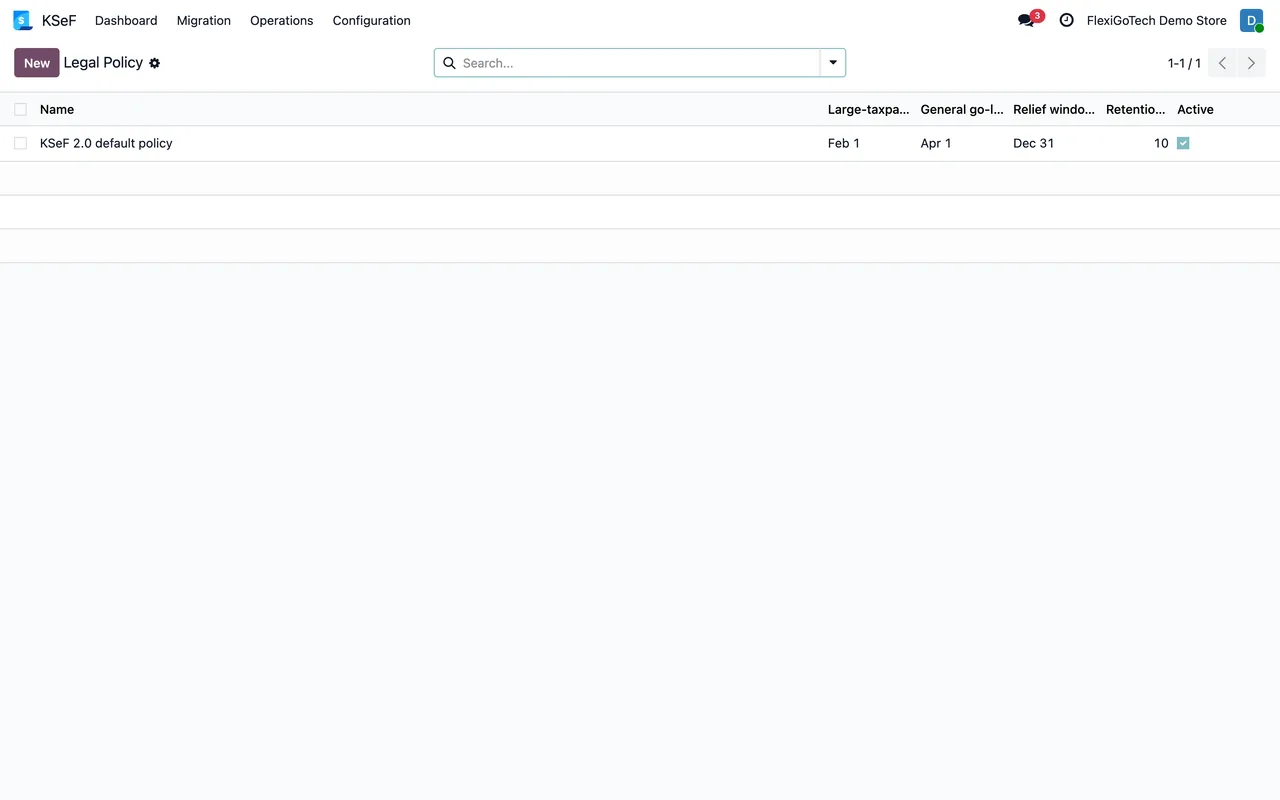
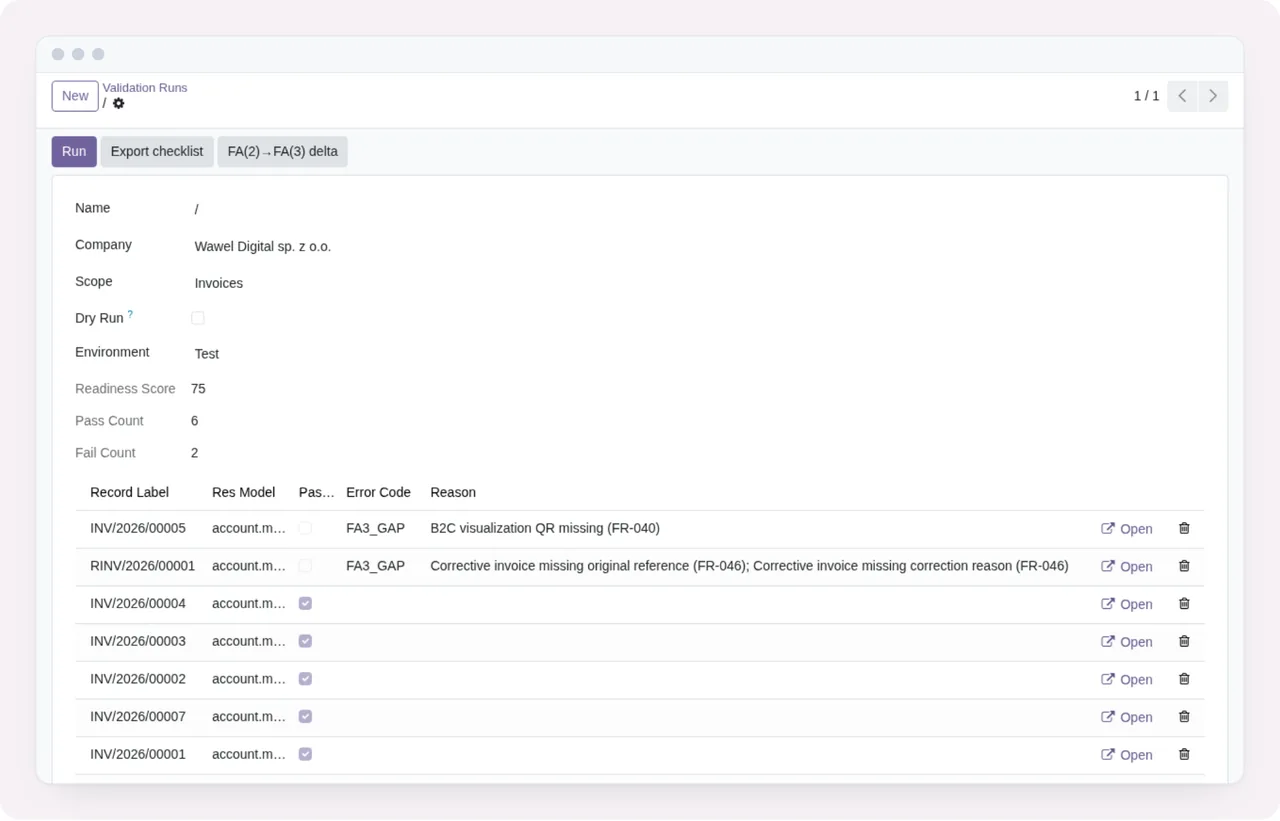
Our module, KSeF 2.0 Validator Odoo, does not send invoices and does not connect to KSeF. It checks each invoice before l10n_pl_edi sends it:
- it validates the invoice's FA(3) file against the Ministry of Finance schema in FlexigoTech Cloud and keeps the result and messages on the invoice;
- it checks the buyer's NIP or EU VAT number, invoice lines and correction data, and keeps a register of your KSeF certificates and tokens that warns you before one expires;
- it keeps offline24, unavailability and failure invoices in a queue with the sending deadline counted in Polish working days;
- on Odoo 18, 19 and 20 it follows the KSeF status and number that l10n_pl_edi leaves on the invoice. On Odoo 17 it checks and lists invoices, and you send them outside Odoo.
It runs on Odoo 17, 18, 19 and 20, on Odoo.sh or your own server, not on Odoo Online. It costs €9 on Odoo Apps, licensed per Odoo version, and needs a FlexigoTech Cloud subscription: from €29 a month or €290 a year, VAT excluded, with 14 days free. The subscription comes with a free trial, no card required. The module's full automated test suite passed with no failures on Odoo.sh on 15 November 2026 in all four versions. Version differences are in KSeF in Odoo 17, 18, 19 and 20 and the preparation steps in the KSeF 2.0 timeline.
Frequently asked questions
Does KSeF apply to foreign companies?
Only if they have a seat or a fixed establishment in Poland that takes part in the sale. A foreign company that is only registered for VAT in Poland does not have to issue invoices in KSeF, though it may choose to.
How does a foreign buyer receive a KSeF invoice?
Outside KSeF, the way buyer and seller agree, for example a PDF by email. The invoice carries a QR code that leads to the invoice in KSeF.
Do invoices to consumers have to go through KSeF?
No. Issuing consumer (B2C) invoices in KSeF is optional.
When do KSeF penalties start?
On 1 January 2027. During 2026 the Ministry of Finance does not impose penalties for mistakes in using KSeF.
Is KSeF the same as KSeF 2.0?
Yes. KSeF 2.0 is the version of the system that has been in production since 1 February 2026, when version 1.0 was switched off.
Legal basis and date checked
We checked every date, threshold and penalty on 17 November 2026 on the Ministry of Finance site (ksef.podatki.gov.pl) and in the Journal of Laws (Dziennik Ustaw): the Act of 5 August 2025 (Dz.U. 2025 item 1203), the Act of 16 June 2023 (Dz.U. 2023 item 1598), the regulation on using KSeF (Dz.U. 2025 item 1815) and the regulation on cases with no obligation to issue structured invoices (Dz.U. 2025 item 1740). The full list of sources is at the bottom of the page.
Keep reading
Checked in the module's source code (version 17.0, 18.0, 19.0 and 20.0) and the linked sources
Sources
- ksef.podatki.gov.pl/pytania-i-odpowiedzi-ksef-20/
- ksef.podatki.gov.pl/informacje-ogolne-ksef-20/zakres-obowiazkowego-ksef/
- ksef.podatki.gov.pl/etapy-wdrozenia-ksef/
- ksef.podatki.gov.pl/informacje-ogolne-ksef-20/podstawy-prawne-oraz-kluczowe-terminy/
- dziennikustaw.gov.pl/DU/2023/1598
- dziennikustaw.gov.pl/DU/2025/1203
- ksef.podatki.gov.pl/wyjasnienia/co-warto-wiedziec-przed-startem-ii-etapu-wdrozenia-krajowe
- dziennikustaw.gov.pl/DU/2025/1815
- dziennikustaw.gov.pl/DU/2025/1740
- ksef.podatki.gov.pl/informacje-ogolne-ksef-20/faktura-ustrukturyzowana-i-struktura-logiczn
- ksef.podatki.gov.pl/informacje-ogolne-ksef-20/struktura-logiczna-fa-3/
- Module source code: flexigo_poland_ksef_2_0_e_invoice_connector_and_migrati, __manifest__.py line 13 in 17.0 (a5ba945), 18.0 (cdfae8f), 19.0 (197910f) and 20.0 (3310ca0)
- Module source code: flexigo_poland_ksef_2_0_e_invoice_connector_and_migrati, models/ksef_tools.py line 81, __manifest__.py line 28 in 17.0 (a5ba945), 18.0 (cdfae8f), 19.0 (197910f) and 20.0 (3310ca0)
- apps.odoo.com/apps/modules/20.0/flexigo_poland_ksef_2_0_e_invoice_connector_and_migrati
- github.com/odoo/odoo/tree/18.0/addons/l10n_pl_edi
- Module source code: flexigo_poland_ksef_2_0_e_invoice_connector_and_migrati, __manifest__.py line 20 in 17.0 (a5ba945), 18.0 (cdfae8f), 19.0 (197910f) and 20.0 (3310ca0)
- Module source code: flexigo_poland_ksef_2_0_e_invoice_connector_and_migrati, __manifest__.py line 26 in 17.0 (a5ba945), 18.0 (cdfae8f), 19.0 (197910f) and 20.0 (3310ca0)
- Module source code: flexigo_poland_ksef_2_0_e_invoice_connector_and_migrati, tests/, 17.0 (a5ba945), 18.0 (cdfae8f), 19.0 (197910f) and 20.0 (3310ca0)