

 Español
 Deutsch
The store sells, but the back office cannot keep up
The bottleneck shows up in orders, stock levels, returns and day-to-day reconciliation.
Module for Odoo 17 · 18 · 19
Two-way Shopify–Odoo integration on OAuth and GraphQL: imports orders and customers, syncs products, stock and prices, pushes fulfilment with tracking back to Shopify, handles refunds and returns, and shows your numbers in a BI dashboard. Multi-store, with real-time webhooks.

Real screenshots of every screen, with what each one does.
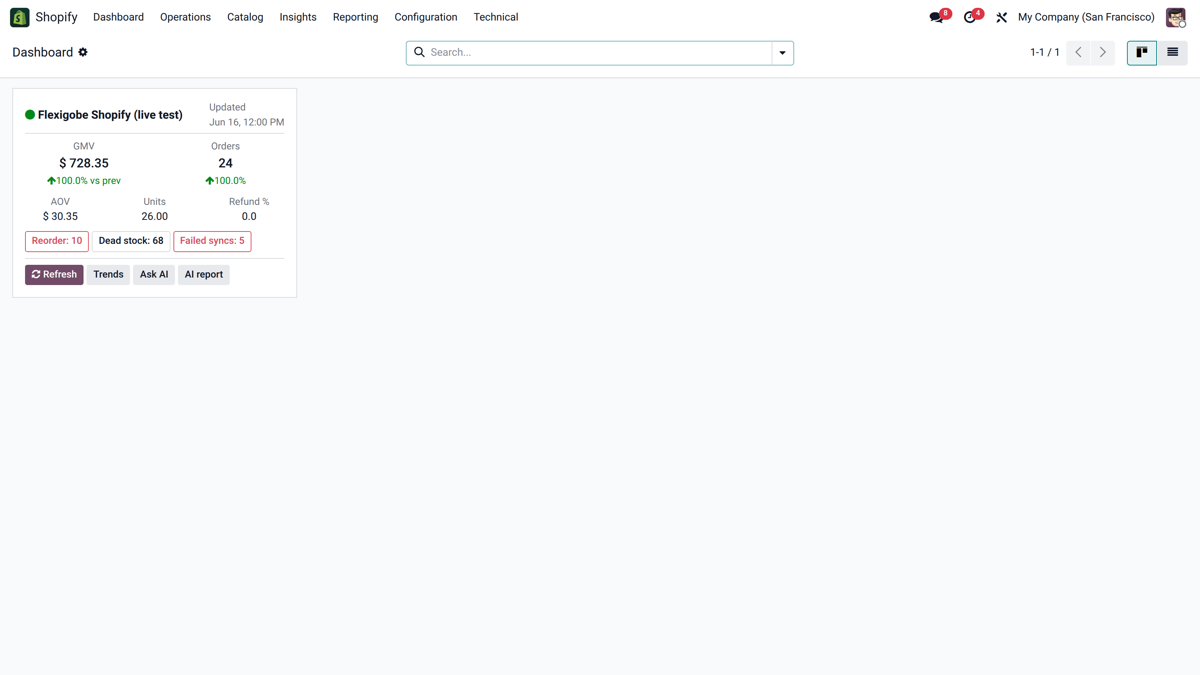
Per-store card with GMV, orders, AOV, trend deltas and reorder plus failed-sync alerts.
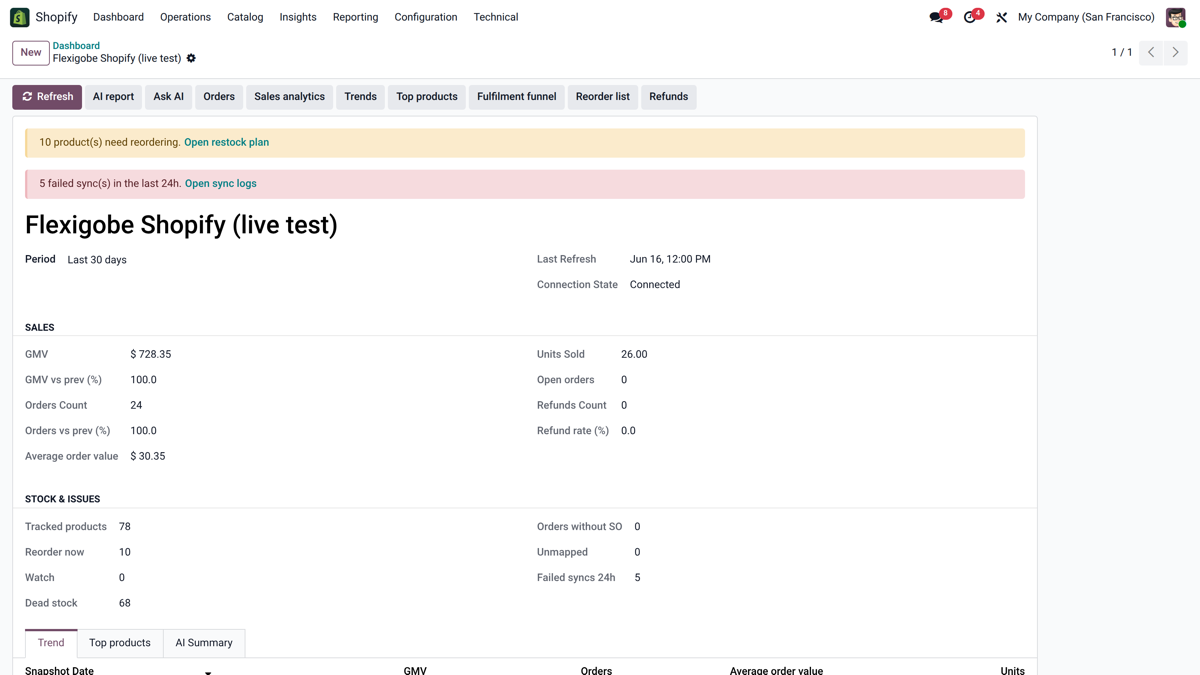
Full form with period selector, sales with deltas and a stock and issues section per store.
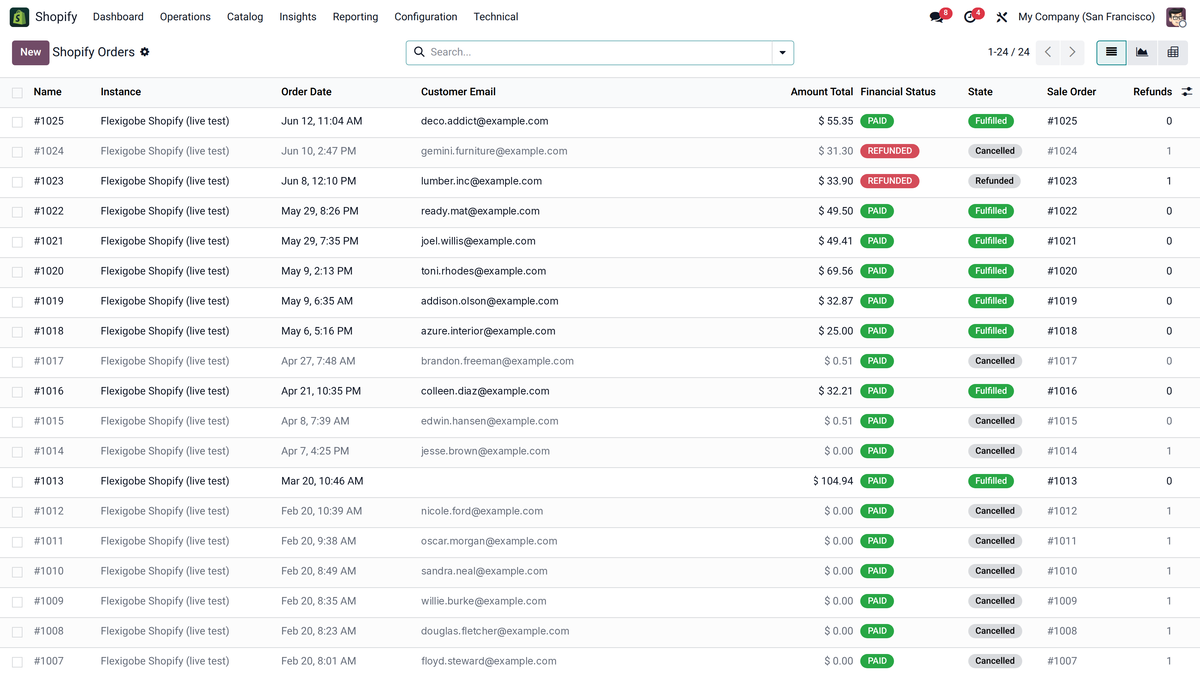
Shopify orders list with financial and fulfillment status, amounts and links to the sale order.
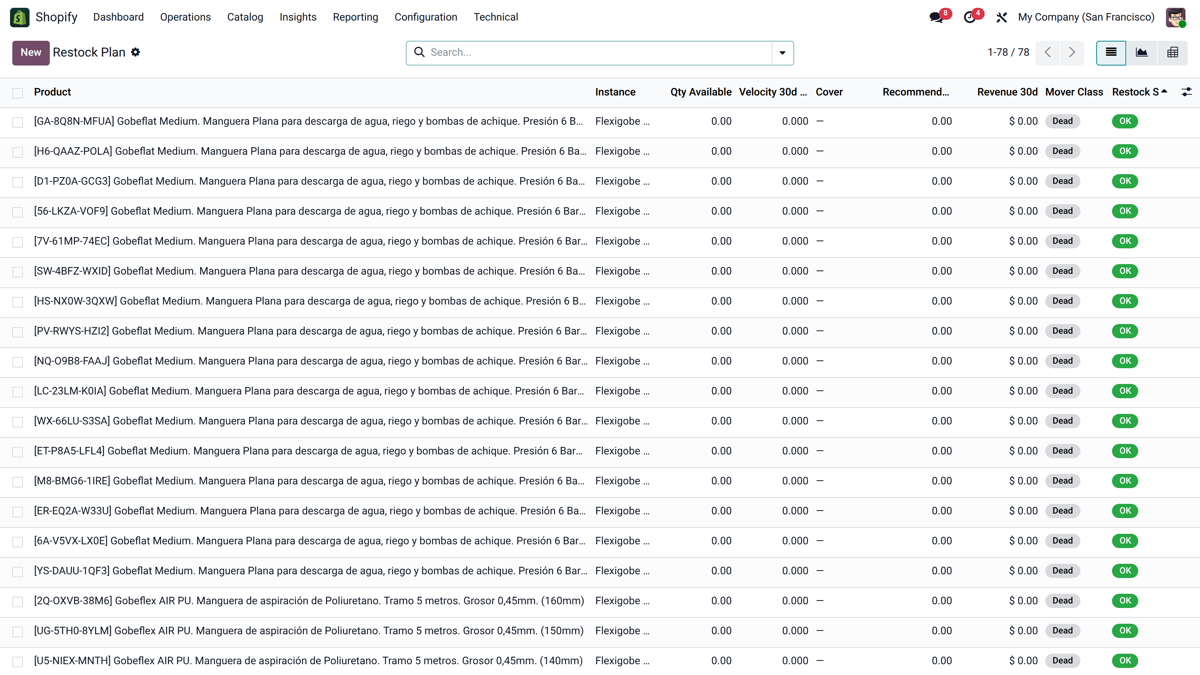
Velocity, days of cover, recommended reorder qty and mover class per product to know what to restock.
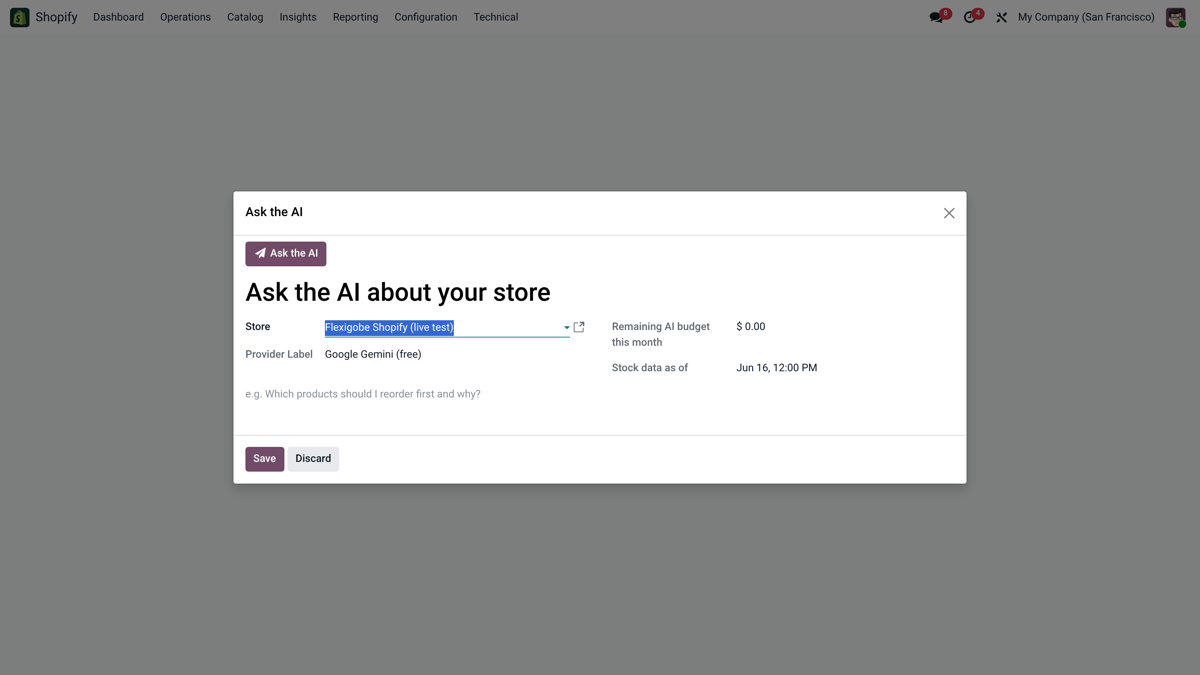
Plain-language questions about your store, with a free provider and a monthly budget cap.
This is not about a list of isolated features. It is about the operational headache that pushes a team to go looking for a real Shopify Odoo integration in the first place.
The bottleneck shows up in orders, stock levels, returns and day-to-day reconciliation.
When Shopify and Odoo do not agree on the same source of truth, you get stock, price and content errors.
If tracking does not originate in Odoo, the team loses traceability and slides back into manual, spreadsheet-driven processes.
Everything in the module is real operational capability: connection, orders, catalog and fulfillment governed from Odoo. No fluff, no empty checkboxes.
One store, one cleanly governed Odoo instance, with proper authentication and operational control.
The real value is landing the sale inside Odoo with as little friction as possible, refunds included.
Especially relevant for catalogs that change often or move fast, where manual sync always falls behind.
The module really comes into its own once it is wired to your carrier and your warehouse.
A native Odoo BI dashboard with per-store KPIs, restock planning, real-time webhooks and an optional weekly AI summary. All without ever leaving Odoo.
GMV, AOV, orders, units and refund rate, each with its delta versus the previous period. KPIs auto-refresh every 4 hours via a scheduled job.
7/30/90-day sales velocity, days of cover and a recommended reorder quantity per product, with a mover class (winner, steady, slow, dead) and a restock state.
The inventory webhook keeps stock near-live between Shopify and Odoo, with asynchronous processing and automatic retries.
A native connection to the Shopify API: refresh tokens, token-expiry handling and back-off on rate limits. No middleware in between.
Off by default. Using free providers (Gemini, Groq) it narrates your numbers over real data, without making anything up, with a hard cost cap.
Reconciles discounts and taxes, including tax-inclusive stores, and handles full or partial refunds with returns created automatically.
The usual pattern is a team that already invoices on Shopify but wrestles with stock changes, rush orders, returns and shipping prep. The right project unifies Shopify with Odoo and gives the back office a far more professional logic.
For a lot of businesses Shopify is the gateway to the project. Then come shipping, Amazon, other marketplaces or a fuller implementation. The connector leaves everything ready so that growth happens inside a single Odoo.
You buy the connector once and own it. No monthly subscription, no per-order fee, no third-party middleware sitting between Shopify and your Odoo.
A single payment for the module. No recurring fees and no surprises down the line.
You get the full Python source under an OPL-1 license per Odoo instance, so your team can read and audit exactly what runs.
Built and tested for Odoo 17, 18 and 19, on both Community and Enterprise. Same-series updates come through the Odoo App Store.
After you buy, you talk to the engineer who built the module by email, with no middlemen and no call centers.
No middleware to host and no monthly platform to babysit. You install the module, connect your store and let Odoo take over the back office.
Install the module on Odoo 17, 18 or 19 and connect your Shopify store over OAuth2, one clean instance per store.
Products, variants, customers, orders and refunds flow into Odoo, while stock levels and prices stay aligned in both directions.
Fulfill orders in Odoo, push tracking back to Shopify, and watch the whole store on a native BI dashboard with a real-time inventory webhook.
Shopify is usually the first integration. These connectors and services are the ones that tend to follow as the business grows.
Yes. The connector is built for variant catalogs and for running more than one Shopify store against the same Odoo, with a separate, well-governed instance per store.
Yes. It runs on both Odoo Community and Enterprise, across Odoo 17, 18 and 19. You do not need the Enterprise edition to use it.
Yes. Fulfillment and tracking are pushed back to Shopify from Odoo, so your warehouse and carrier flow stay in one place. It pairs well with our carrier connectors for delivery labels and tracking numbers.
The full module with source code included, licensed per Odoo instance under OPL-1, for Odoo 17, 18 and 19. No monthly fees and no third-party middleware between Shopify and Odoo.
Yes. You get updates and fixes for the same Odoo series (17, 18 or 19) at no extra cost through the Odoo App Store.
Direct support from the engineer who built the module, by email, with no middlemen and no call centers.
Yes. There is a live demo where you can see the connector running, and you can email us any question before you decide.
If you are already at that point, it makes sense to run orders, stock and logistics from Odoo with an integration that carries the growth instead of holding it back.