

 Español
 Català
 Deutsch
 Français
 Português
 Italiano
 Nederlands
 Polski
What it covers according to its documentation
The module's README sets out what it does in these blocks:
- Packaging where it happens: per sales unit, per grouped pack and per package type (box, pallet).
- A ledger you can audit: built from every done delivery, return, dropship, POS sale and import.
- Declarations: grouped into each scheme's categories and priced with the published tariff.
- Plastic packaging taxes: Spain and the United Kingdom, from the same ledger.
- PPWR readiness: requirements with their article and application date, evaluated per packaging.
- Obligation assessment, registrations and deadlines: where you probably must register.
- Reference data for 79 jurisdictions: including the EU-27, the United Kingdom, Switzerland, Norway and Iceland.
On logistics, the README says the module never blocks it: the ledger is written after _action_done, inside a savepoint.
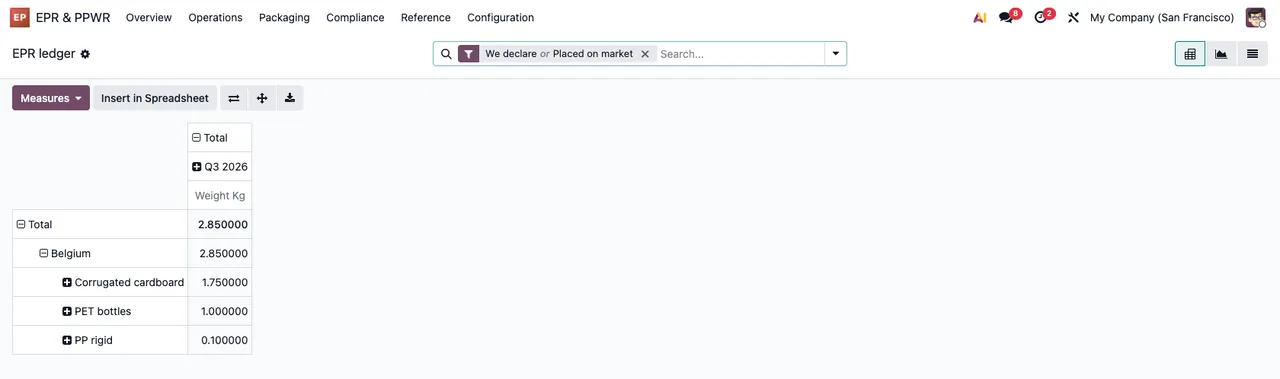
What you see in Odoo after validating a delivery is in EPR > Operations > EPR ledger: the kilograms per material and country.
What depends on FlexigoTech Cloud
This is the part that weighs most in the decision. The Odoo Apps listing marks two functions as FlexigoTech Cloud services that require a subscription: calculating EPR packaging fees and declarations, and keeping fee schedules and PPWR rules current.
Without a subscription, or with the service suspended, whatever the subscription provides stops; your data stays in your Odoo. The listing adds that your data stays yours: you can view and export it at any time. There is a 14-day trial, no card needed.
To connect, you link the database in Settings > FlexigoTech Cloud with the e-mail you bought the module with, and an administrator allows it in Settings > EPR & PPWR > FlexigoTech Cloud. According to the README, only aggregated figures are sent. The listing also sets out this technical data for the service:
- The database identifier (uuid), its address (URL) and the Odoo version.
- The FlexigoTech modules installed, with their version, and whether the database is a neutralised copy (staging or test).
- The company name and the e-mail of the person who accepts, with the date and version of the text accepted.
- A public code to check that requests come from this database, and a proof that it is this database, computed on your server without sending its secret.
- A request for its service permit every 6 hours, and the health of the service: counters and errors (type and code), without the content of your records.
- If you use EPR Data Feed: the names of the data tables your Odoo asks for and the version it already has, and nothing from your records.
Criteria for deciding whether it suits you
Match your situation against what the module's documentation says:
| If your business... | What the documentation says |
|---|---|
| Wants to know in which countries it probably has to register | EPR > Compliance > Obligation assessment shows where you probably need to register, backed by reference data for 79 jurisdictions |
| Declares packaging and wants to calculate it from Odoo | Declarations are grouped into each scheme's categories and priced with the published tariff; the calculation requires a FlexigoTech Cloud subscription |
| Files plastic packaging tax in Spain or the United Kingdom | The module handles it from the same EPR ledger |
| Is getting ready for the PPWR | Requirements with article and application date, evaluated per packaging; the rules are kept current with the subscription |
| Sells through POS, uses dropship or imports goods | Those movements are in the ledger, alongside done deliveries and returns |
| Uses boxes and pallets as well as sales packaging | Packaging is described per sales unit, per grouped pack and per package type |
| Wants to try it before deciding | 14-day trial, no card needed |
| Needs its database migrated to another Odoo version | Not covered: the listing says they do not take care of migrating your database |
If what you are after is fee and declaration calculation, plan for the subscription from day one: without it, that part stops.
What to have ready before installing it
The module works from your packaging information, so it helps to have it to hand before you start:
- A description of your packaging: components with material and weight, recorded in
EPR > Packaging > Packaging items. - The products to link that packaging to (the product's
EPRtab) and your package types. - Any shipping rules you want to add for your shipments.
- The e-mail you bought the module with, and an administrator to allow the FlexigoTech Cloud connection.
With that in place, the README's route continues: you validate a delivery and check the ledger, review the obligation assessment and, in EPR > Operations > Declarations, pick a registration and a period and press Compute. The settings and fields are covered in detail in setting up the module.
Submitted status with an Excel export in the chatter, and the PPWR readiness list grouped by requirement with the issues filter.Odoo versions, price and what is not included
The module is published on Odoo Apps for 17.0, 18.0, 19.0 and 20.0. It costs €9 per Odoo version, one-off payment, excluding VAT, for 17, 18, 19 and 20; the local service costs €29/month or €290/year excluding VAT (Pro: €58/month or €580/year).
With the subscription, the module for new Odoo versions is included if you bought it on flexigotech.com; on the Odoo App Store, each Odoo version is bought there. The listing includes module updates and support with a first response within 1 working day.
The listing explicitly leaves two things out. Migrating your database to a new Odoo version is not something they take care of. And third-party costs are yours: you contract and pay for your account on each platform, Odoo and your hosting yourself.
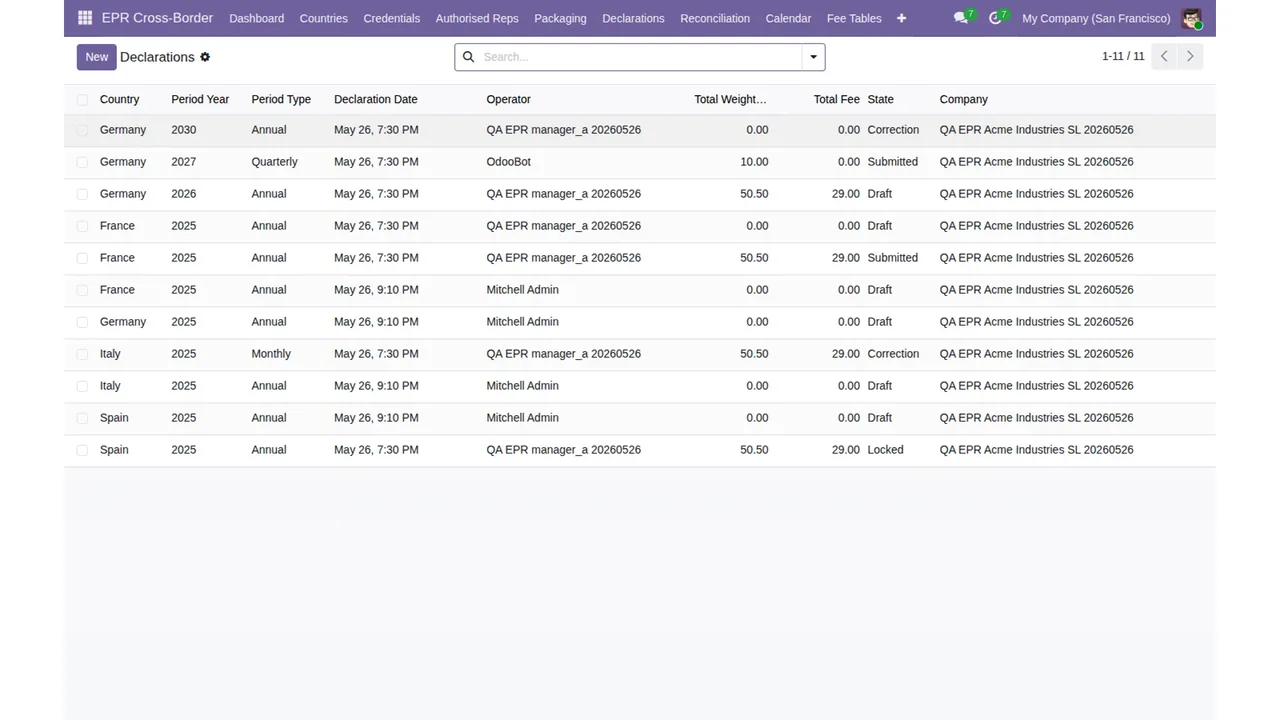
Draft, Submitted, Correction and Locked.How FlexigoTech can help
FlexigoTech implements Odoo 17, 18, 19 and 20 and builds custom connectors and integrations. If you would like to see first which menus it adds and what a record goes through, read how the module works inside. Purchase and subscription are on the module page, and the listing for each version is on Odoo Apps.
Keep reading
Checked in the module's source code (version 20.0) and the linked sources
Sources
- Module source code: flexigo_extended_producer_responsibility_cross_border_p av20epr/20.0 (8a86e540): README.rst
- Module source code: flexigo_extended_producer_responsibility_cross_border_p av20epr/20.0 (8a86e540): static/description/index.html
- apps.odoo.com/apps/modules/20.0/flexigo_extended_producer_responsibility_cross_border_p
- apps.odoo.com/apps/modules/17.0/flexigo_extended_producer_responsibility_cross_border_p
- apps.odoo.com/apps/modules/18.0/flexigo_extended_producer_responsibility_cross_border_p
- apps.odoo.com/apps/modules/19.0/flexigo_extended_producer_responsibility_cross_border_p
- flexigotech.com/en/services.html
- flexigotech.com/precios.html