

 Français
 Nederlands
The fines in the Royal Decree
The amounts come from the Royal Decree of 8 July 2025, which amends Royal Decrees no. 1, 8 and 44 on VAT (Moniteur belge / Belgisch Staatsblad, 14 July 2025, numac 2025005169). Its art. 5 adds a new point to the annex of Royal Decree no. 44, the scale of VAT fines, and art. 6 sets the entry into force at 1 January 2026.
| Offence | Fine |
|---|---|
| First | €1,500 |
| Second | €3,000 |
| Third and each one after | €5,000 |
What exactly is penalised?
Not having the technical means to issue and receive a structured electronic invoice (Royal Decree of 8 July 2025, art. 5). The obligation behind it is art. 53, §2bis of the VAT Code, inserted by art. 3 of the Law of 6 February 2024. Both sides count, so a business needs to be able to send and to receive.
What if the structured invoice is late or wrong?
The art. 5 fine does not cover these cases. The Report to the King of the Royal Decree of 8 July 2025 treats a structured electronic invoice as a kind of invoice, so the fines that already exist for invoices apply, with no new scale. A structured invoice not issued on time falls under point A of heading I of the annex to Royal Decree no. 44. One that breaks another rule, such as the mandatory details or the technical requirements for semantics, syntax and transmission, falls under point B. The proportional fine of art. 70, §2 of the VAT Code can also apply.
When does an offence count as a second one?
Only when it is found at least three months after the previous offence was recorded (Royal Decree of 8 July 2025, art. 5).
Is the tolerance period still running?
No. According to the FPS Finance (notice of 7 April 2026), the general tolerance for the first three months of 2026 is over. The specific tolerance for self-billing, where the customer issues the invoice, ran until 30 June 2026 inclusive and has also ended.
What did the first-quarter tolerance require?
According to the FPS Finance (notice of 18 December 2025), no penalties applied in the first three months of 2026 if the business could show it had taken steps in a timely and reasonable manner. There was no general postponement, and each case was assessed individually. If you relied on that tolerance, keep the evidence of what you did and when.
Can the FPS Finance still decide not to fine me?
Yes, in exceptional circumstances. According to the FPS Finance (notice of 7 April 2026), it can still decide not to impose a fine outside the tolerance framework. This is not automatic: it only follows an individual analysis of the concrete facts of the file. If you think your situation needs that analysis, you submit your case through the FPS Finance contact form.
My customer cannot receive via Peppol. Am I at risk?
According to the FPS Finance (notice of 19 December 2025), when the recipient cannot technically receive structured electronic invoices, the supplier does not have to issue one and may invoice on paper or as a PDF. The supplier still has to issue an invoice, and that invoice is legally valid. The B2B FAQ adds that the customer risks the penalty, and that an invoice sent by an alternative electronic channel needs the customer's agreement on a secure method. The recipient must make the arrangements to receive without delay. The FPS Finance applied this fallback rule from 1 January 2026, and since 20 February 2026 it has been part of art. 53, §2bis of the VAT Code (Law of 10 February 2026, art. 4).
My supplier is not ready. What happens to me?
According to the FPS Finance (B2B FAQ), the supplier risks the penalty. You keep your right to deduct VAT on the invoice issued in an alternative form, such as a PDF or a paper invoice.
I use the small enterprises exemption scheme. Am I exempt from the fines?
Not automatically. According to the FPS Finance (notice of 7 April 2026 and B2B FAQ), businesses under the exemption scheme for small enterprises (turnover up to €25,000) are in principle subject to the obligation.
I only invoice private individuals. Does this concern me?
Your invoices to consumers are outside the obligation. But the FPS Finance (notice of 7 April 2026) says a business that buys from a Belgian VAT-registered supplier must be able to receive structured electronic invoices. The fine in art. 5 covers the means to receive as well.
Are non-established businesses fined?
According to the FPS Finance (notice of 19 December 2025), businesses with neither their seat of economic activity nor a permanent establishment in Belgium are outside the obligation, even when identified for VAT in Belgium. Since 20 February 2026 this is also in the law: art. 4 of the Law of 10 February 2026 took non-established customers out of art. 53, §2bis.
What to keep on file
When a case goes to individual analysis, the facts of the file decide. Keep a dated record of each customer that could not receive, of the alternative invoice you sent, and of the steps you took to get both sides on Peppol. Invoices themselves must be kept for the period set by art. 60 of the VAT Code. For the obligation itself, see the Belgium e-invoicing mandate, and for addressing customers correctly, Peppol ID in Belgium.
How it works in Odoo
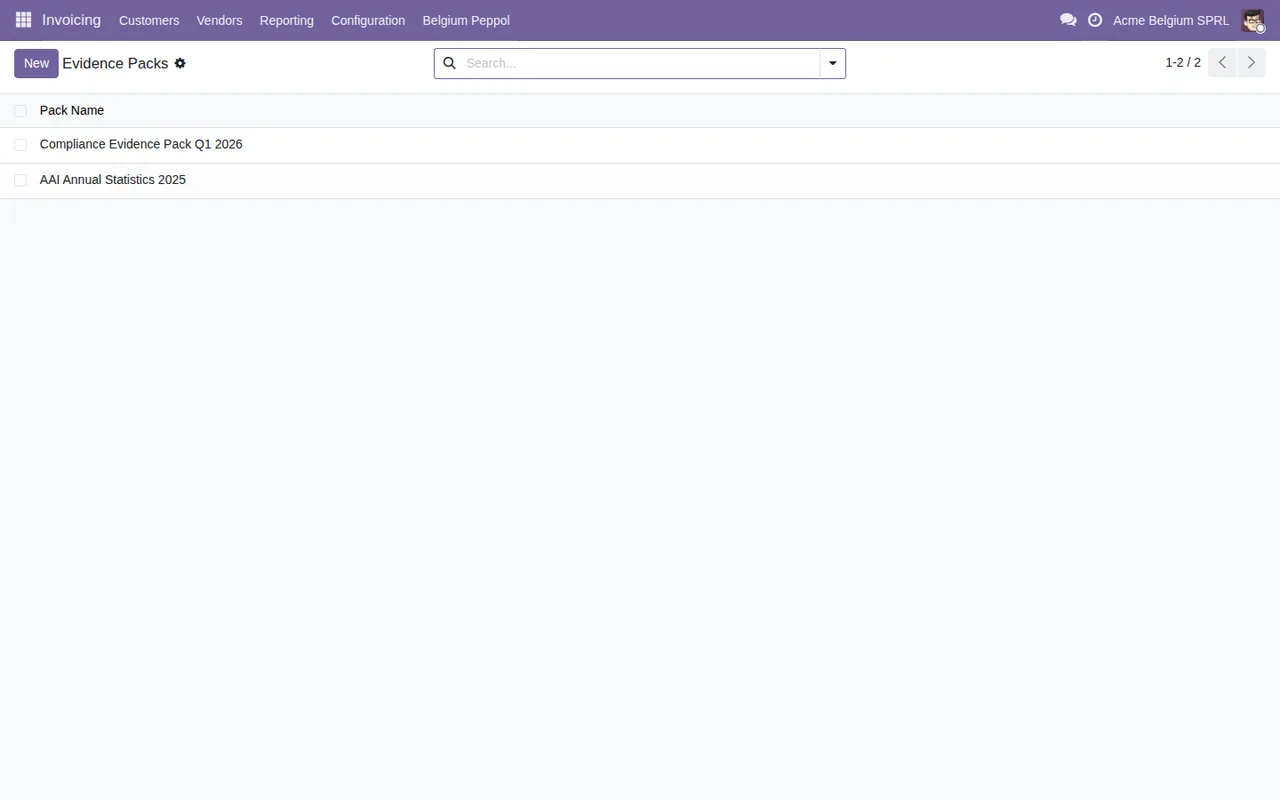
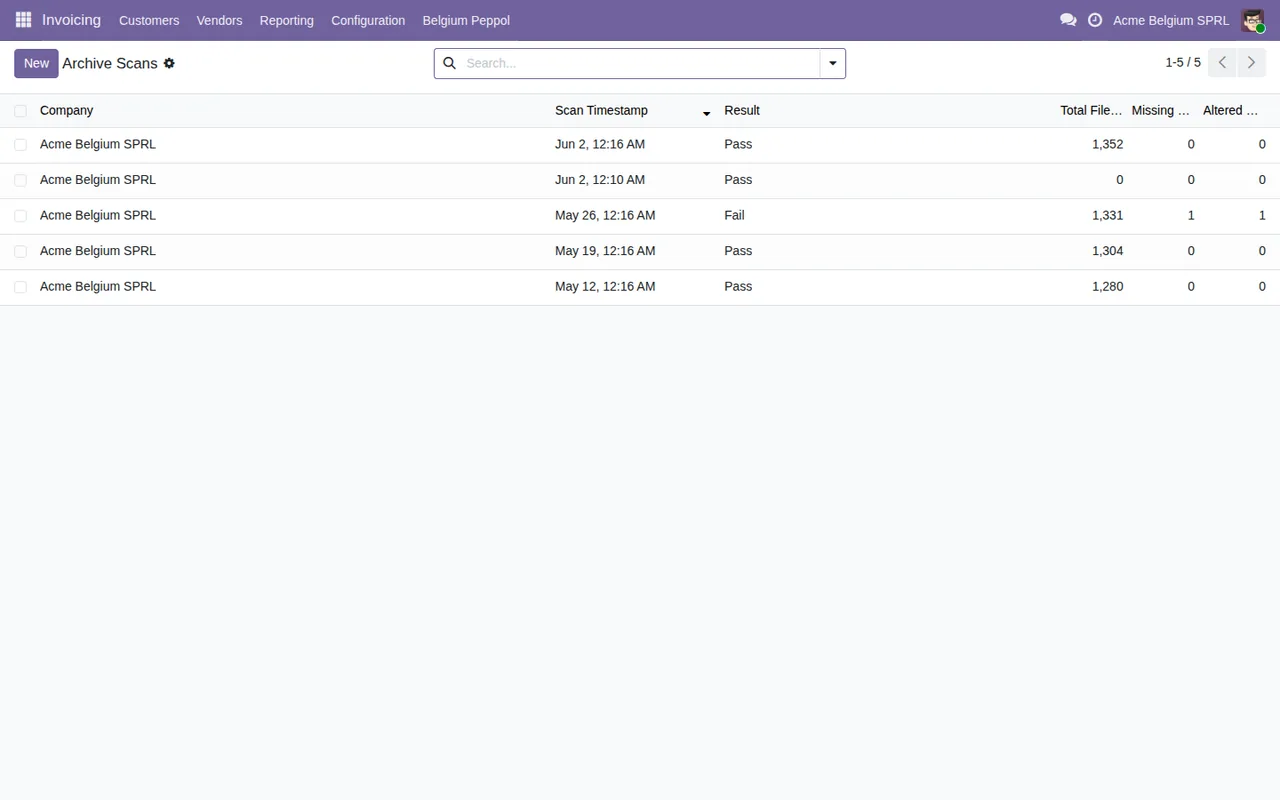
Belgium Peppol for Odoo, by FlexigoTech, runs on Odoo 17 to 20 with account_peppol. Fallback Entries record each temporary switch to paper or PDF when a Belgian customer cannot receive Peppol. Evidence Packs, sealed with SHA-256, can include the first-quarter 2026 tolerance documentation. Archive Scans watch the 7-year retention.
The module licence costs €9 on Odoo Apps for each Odoo version. The module works with a FlexigoTech Cloud subscription: €29 a month or €290 a year per production database, VAT excluded (staging and test copies included), with monitoring of the module's official sources, alerts and a calendar of deadlines. There is a 14-day trial with no card (Odoo Apps listing). Every purchase includes 2 months of support: we help you install it, set it up and get it working, by email and video call.
The module does not build or send the UBL file: account_peppol does. Odoo's normal Send button skips the module's rules.
Keep reading
Checked against the linked sources
Sources
- www.ejustice.just.fgov.be/eli/arrete/2025/07/08/2025005169/moniteur
- www.ejustice.just.fgov.be/eli/loi/2024/02/06/2024001635/moniteur
- efacture.belgium.be/fr/news/periode-de-tolerance-pendant-les-trois-premiers-mois-de-2026
- efactuur.belgium.be/nl/news/tolerantieperiode-eerste-drie-maanden-2026
- einvoice.belgium.be/en/news/period-tolerance-during-first-three-months-2026
- efacture.belgium.be/fr/news/fin-de-la-periode-de-tolerance-pour-le-facturation
- efactuur.belgium.be/nl/news/einde-van-de-algemene-tolerantieperiode-voor-e-facturering
- efacture.belgium.be/fr/FAQ/questions-generales-b2b
- efactuur.belgium.be/nl/FAQ/algemene-vragen-b2b
- einvoice.belgium.be/en/FAQ/general-questions-b2b
- efacture.belgium.be/fr/news/e-facturation-mesures-en-matiere-de-tva-partir-du-1er-janvier-
- efactuur.belgium.be/nl/news/e-facturering-btw-maatregelen-vanaf-1-januari-2026
- apps.odoo.com/apps/modules/19.0/flexigo_belgium_peppol_b2b_e_invoicing_compliance_wizar
- Module source code: flexigo-belgium-peppol-b2b-e-invoicing-compliance-wizar@1449d23c:flexigo_belgium_peppol_b2b_e_invoicing_compliance_wizar/models/be_peppol_fallback_entry.py:1
- Module source code: flexigo-belgium-peppol-b2b-e-invoicing-compliance-wizar@1449d23c:flexigo_belgium_peppol_b2b_e_invoicing_compliance_wizar/models/be_peppol_evidence_pack.py:76
- Module source code: flexigo-belgium-peppol-b2b-e-invoicing-compliance-wizar@1449d23c:flexigo_belgium_peppol_b2b_e_invoicing_compliance_wizar/models/be_peppol_evidence_pack.py:58
- Module source code: flexigo-belgium-peppol-b2b-e-invoicing-compliance-wizar@1449d23c:flexigo_belgium_peppol_b2b_e_invoicing_compliance_wizar/models/account_move.py:3
- Module source code: flexigo-belgium-peppol-b2b-e-invoicing-compliance-wizar@1449d23c:flexigo_belgium_peppol_b2b_e_invoicing_compliance_wizar/README.rst:44
- www.ejustice.just.fgov.be/eli/besluit/2025/07/08/2025005169/staatsblad
- www.ejustice.just.fgov.be/eli/loi/2026/02/10/2026001291/moniteur
- www.lachambre.be/FLWB/PDF/56/1205/56K1205001.pdf
- Module source code: flexigo-belgium-peppol-b2b-e-invoicing-compliance-wizar@1449d23c:flexigo_belgium_peppol_b2b_e_invoicing_compliance_wizar/models/be_peppol_compliance_profile.py:91