

 Français
 Nederlands
Who has to comply
Article 3 of the Law of 6 February 2024 inserted art. 53, §2bis into the VAT Code: a VAT-registered business established in Belgium issues a structured electronic invoice to its VAT-registered counterparty, or has one issued in its name. Article 6 sets the start date at 1 January 2026. According to the FPS Finance (18 September 2024), all Belgian enterprises liable to VAT now use structured electronic invoices with each other.
The FPS Finance has clarified some borderline groups:
- Small enterprises exemption scheme (turnover up to €25,000): in principle subject (B2B FAQ; notice of 7 April 2026).
- Farmers under the special agricultural scheme: concerned at least for receiving B2B invoices (B2B FAQ).
- Businesses selling only to private individuals: no obligation on those invoices, but they must be able to receive structured electronic invoices from Belgian suppliers (18 September 2024 and 7 April 2026).
- Businesses with no invoices to or from Belgian VAT-registered businesses: no obligation (7 April 2026).
What is outside the scope
The law excludes supplies exempt under art. 44 of the VAT Code, businesses under the flat-rate scheme of art. 56 (as issuers) and bankrupt businesses for the activity covered by the bankruptcy (Law of 6 February 2024, art. 3). According to the FPS Finance, the art. 56 flat-rate scheme ends on 1 January 2028 at the latest. Invoices to consumers are outside too.
Non-established businesses are the other case. According to the FPS Finance (notice of 19 December 2025), a business with neither its seat of economic activity nor a permanent establishment in Belgium does not have to issue or receive structured electronic invoices, even with a Belgian VAT number. The FPS Finance applied this from 1 January 2026. Since 20 February 2026 it has also been in the law: art. 4 of the Law of 10 February 2026 took customers that are not established in Belgium out of art. 53, §2bis.
What counts as a structured electronic invoice
Article 2 of the 2024 law adds the definition to art. 1, §13, 3° of the VAT Code: an invoice issued, transmitted and received in a structured electronic form that allows automatic and electronic processing.
The Report to the King that accompanies the Royal Decree of 8 July 2025 sets the base standard: Peppol BIS in its UBL version, sent over the Peppol network. Another format that complies with EN 16931 is possible only if both parties agree, and the business must still be able to send and receive Peppol BIS.
According to the FPS Finance (18 September 2024), a PDF invoice sent by e-mail or through a platform no longer meets the obligation. Your software connects to the Peppol network, and so does your customer's.
When your customer cannot receive
The FPS Finance announced a fallback rule on 19 December 2025 and applied it from 1 January 2026. Since 20 February 2026 it has been in the VAT Code itself, added to art. 53, §2bis by art. 4 of the Law of 10 February 2026. If the recipient cannot technically receive structured electronic invoices, the supplier does not have to issue one. The supplier still has to issue an invoice, which can then be on paper or in an electronic file such as Word or PDF. The recipient keeps its own duty to be able to receive structured electronic invoices and must make the arrangements without delay.
If your supplier is not ready, the FPS Finance B2B FAQ says you keep your right to deduct VAT on the invoice issued in an alternative form.
Not having the technical means to send and receive structured electronic invoices carries its own fine (Royal Decree of 8 July 2025, art. 5). The amounts and the repeat-offence rule are on the page on penalties.
Timeline
- 6 February 2024 The Law introducing the e-invoicing obligation in the VAT Code and the Income Tax Code 1992 is adopted.
- 20 February 2024 The law is published in the Moniteur belge / Belgisch Staatsblad (p. 24025, numac 2024001635).
- 8 July 2025 The Royal Decree amending Royal Decrees no. 1, 8 and 44 is adopted. Its art. 5 adds the fines for missing technical means.
- 14 July 2025 The Royal Decree is published (p. 59264, numac 2025005169).
- 1 January 2026 The law (art. 6) and the Royal Decree (art. 6) enter into force.
- 20 February 2026 The Law of 10 February 2026 is published (numac 2026001291). Its art. 4 applies from that day and puts the fallback rule and the exclusion of non-established customers into art. 53, §2bis.
- 31 March 2026 The general tolerance for the first three months of 2026 ends (FPS Finance, 18 December 2025 and 7 April 2026).
- 30 June 2026 The specific tolerance for self-billing ends, inclusive (FPS Finance, 7 April 2026).
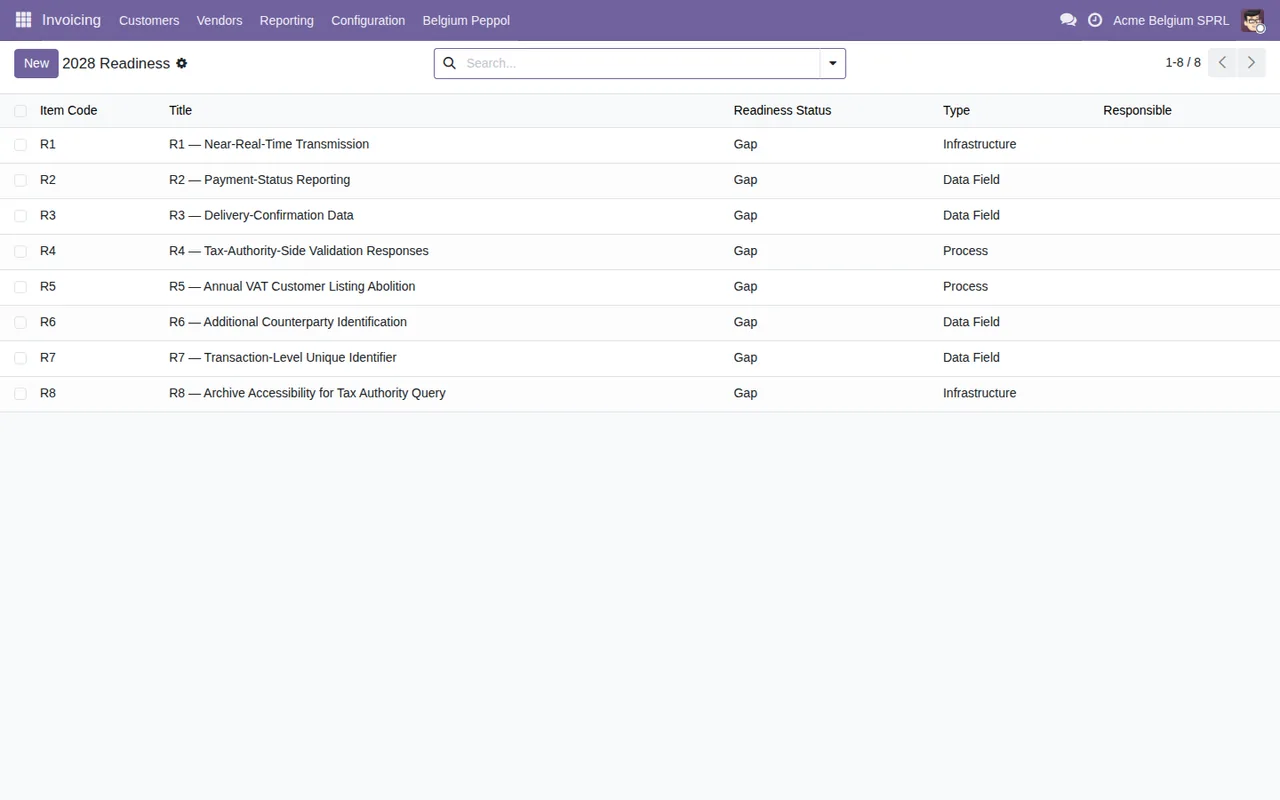
- 2028 E-reporting, announced in the federal coalition agreement. It has yet to be transposed into Belgian law (FPS Finance, e-reporting FAQ).
Tax support from the State
Article 4 of the 2024 law restores art. 64ter of the Income Tax Code 1992 for invoicing programs. According to the FPS Finance, small SMEs and self-employed people using subscription formulas can deduct 120 % of these costs for the 2024 to 2027 taxable periods, and the investment allowance for digital investments has been 20 % since 1 January 2025.
How it works in Odoo
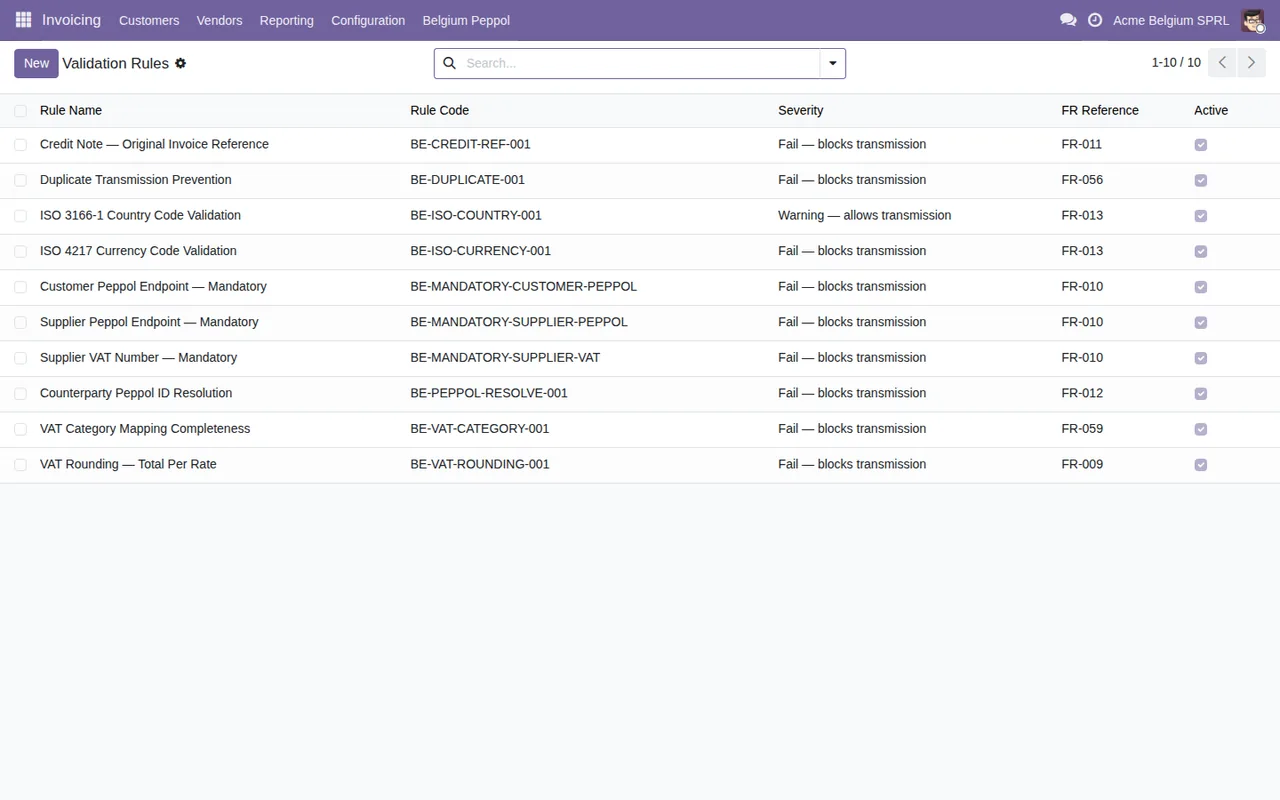
Belgium Peppol for Odoo, by FlexigoTech, runs on Odoo 17, 18, 19 and 20 alongside Odoo's own Peppol module (account_peppol). A 7-step Setup Wizard checks your VAT and enterprise number, takes your own Peppol ID (for example 0208 followed by your enterprise number) and your access point, then looks the ID up on the live Peppol network and calls the access point. On a posted invoice, Peppol check runs 10 Belgian rules and Send via Peppol hands the invoice to Odoo (how it works).
The module licence costs €9 on Odoo Apps for each Odoo version. The module works with a FlexigoTech Cloud subscription: €29 a month or €290 a year per production database, VAT excluded (staging and test copies included), with monitoring of the module's official sources, alerts and a calendar of deadlines. There is a 14-day trial with no card (Odoo Apps listing). Every purchase includes 2 months of support: we help you install it, set it up and get it working, by email and video call.
The module does not build or send the UBL file: Odoo's account_peppol does that. Odoo's normal Send button also skips the 10 rules.
Keep reading
Checked against the linked sources
Sources
- www.ejustice.just.fgov.be/eli/loi/2024/02/06/2024001635/moniteur
- www.ejustice.just.fgov.be/eli/arrete/2025/07/08/2025005169/moniteur
- efacture.belgium.be/fr/article/les-factures-electroniques-structurees-entre-entreprises-so
- efactuur.belgium.be/nl/article/gestructureerde-elektronische-facturen-tussen-ondernemingen
- einvoice.belgium.be/en/article/structured-electronic-invoices-between-companies-are-compul
- efacture.belgium.be/fr/news/e-facturation-mesures-en-matiere-de-tva-partir-du-1er-janvier-
- efactuur.belgium.be/nl/news/e-facturering-btw-maatregelen-vanaf-1-januari-2026
- efacture.belgium.be/fr/news/periode-de-tolerance-pendant-les-trois-premiers-mois-de-2026
- efactuur.belgium.be/nl/news/tolerantieperiode-eerste-drie-maanden-2026
- einvoice.belgium.be/en/news/period-tolerance-during-first-three-months-2026
- efacture.belgium.be/fr/news/fin-de-la-periode-de-tolerance-pour-le-facturation
- efactuur.belgium.be/nl/news/einde-van-de-algemene-tolerantieperiode-voor-e-facturering
- efacture.belgium.be/fr/FAQ/questions-generales-b2b
- efactuur.belgium.be/nl/FAQ/algemene-vragen-b2b
- einvoice.belgium.be/en/FAQ/general-questions-b2b
- efacture.belgium.be/fr/FAQ/questions-generales-sur-le-e-reporting
- efactuur.belgium.be/nl/FAQ/algemene-vragen-over-e-reporting
- einvoice.belgium.be/en/FAQ/general-questions-about-e-reporting
- apps.odoo.com/apps/modules/19.0/flexigo_belgium_peppol_b2b_e_invoicing_compliance_wizar
- Module source code: flexigo-belgium-peppol-b2b-e-invoicing-compliance-wizar@1449d23c:flexigo_belgium_peppol_b2b_e_invoicing_compliance_wizar/wizard/be_peppol_setup_wizard.py:132
- Module source code: flexigo-belgium-peppol-b2b-e-invoicing-compliance-wizar@1449d23c:flexigo_belgium_peppol_b2b_e_invoicing_compliance_wizar/data/be_peppol_validation_rules.xml:8
- Module source code: flexigo-belgium-peppol-b2b-e-invoicing-compliance-wizar@1449d23c:flexigo_belgium_peppol_b2b_e_invoicing_compliance_wizar/models/account_move.py:3
- Module source code: flexigo-belgium-peppol-b2b-e-invoicing-compliance-wizar@1449d23c:flexigo_belgium_peppol_b2b_e_invoicing_compliance_wizar/README.rst:44
- Module source code: flexigo-belgium-peppol-b2b-e-invoicing-compliance-wizar@1449d23c:flexigo_belgium_peppol_b2b_e_invoicing_compliance_wizar/models/be_peppol_fallback_entry.py:1
- www.ejustice.just.fgov.be/eli/loi/2026/02/10/2026001291/moniteur
- www.lachambre.be/FLWB/PDF/56/1205/56K1205001.pdf
- efacture.belgium.be/fr/article/pour-qui-la-facturation-electronique-deviendra-t-elle-oblig
- efactuur.belgium.be/nl/article/voor-wie-wordt-e-facturatie-verplicht
- Module source code: flexigo-belgium-peppol-b2b-e-invoicing-compliance-wizar@1449d23c:flexigo_belgium_peppol_b2b_e_invoicing_compliance_wizar/wizard/be_peppol_setup_wizard.py:322