

 Français
Who must do what, and from when
E-invoicing covers sales of goods and services between two VAT-registered businesses established in France, located in France and subject to French invoicing rules. Sales to consumers and transactions with foreign businesses are not e-invoiced: their data goes to the tax authority through e-reporting.
| Obligation | Who | From | Source |
|---|---|---|---|
| Receive e-invoices through a PA | every VAT-registered company, whatever its size | 1 September 2026 | DGFiP FAQ, 5.1 |
| Issue e-invoices | large companies and mid-caps (ETI) | 1 September 2026 | DGFiP FAQ, 5.1 |
| Issue e-invoices | SMEs and micro-businesses | 1 September 2027 at the latest | DGFiP FAQ, 5.1 |
| E-reporting of transactions and payments | large companies and mid-caps | 1 September 2026 | DGFiP FAQ, 8.1 |
| E-reporting of transactions and payments | SMEs and micro-businesses | 1 September 2027 | DGFiP FAQ, 8.1 |
Size is measured per legal unit (SIREN number) on 1 January 2025, using the last financial year closed before that date. An SME has fewer than 250 staff and either turnover up to €50 million or a balance sheet up to €43 million. A mid-cap has fewer than 5,000 staff and either turnover up to €1,500 million or a balance sheet up to €2,000 million. Anything larger is a large company. The timetable comes from Article 91 of the 2024 Finance Act.
If your company is not established in France
A foreign company with no fixed establishment in France for VAT purposes is outside French e-invoicing: it neither has to issue nor to receive e-invoices through a PA. It must e-report the transactions located in France for which it owes French VAT, for example sales from France to another business with no French VAT number. Sales to consumers are excluded when the company uses the EU One-Stop Shop (OSS or IOSS). Its timetable follows its worldwide size: 1 September 2026 for large companies and mid-caps, 1 September 2027 for smaller ones, and 1 September 2027 for every size when it is the buyer liable for the VAT (reverse charge, intra-EU acquisitions). It has to choose a PA before its start date. A French subsidiary, or a foreign company with a fixed establishment in France, follows the same rules as a French company.
What counts as an e-invoice
A PDF sent by email is not an e-invoice. An e-invoice carries its data in a structured format from the common base, all compliant with the European standard EN 16931: UBL, CII or Factur-X, which pairs a readable PDF with an XML file. It always travels through accredited platforms. Four new mandatory particulars apply since 1 September 2026: the customer's SIREN, the category of the transaction (goods, services or both), the option to pay VAT on debits where chosen, and the delivery address when it differs from the billing address.
Accredited platforms (PA), the directory and the PPF
A PA, called PDP (plateforme de dématérialisation partenaire) in earlier documents, is an operator registered by the DGFiP for three renewable years. It issues, transmits and receives invoices, and sends invoice, transaction and payment data to the tax authority. A company can pick one or several PAs and change at any time, and it can use different PAs for issuing, receiving and e-reporting. The official list, updated on 16 November 2026, holds 159 operators, plus 6 still waiting for their interoperability tests. Odoo SA has been on it since 15 April 2026. Ordinary invoicing software can stay in use as a solution compatible, a compatible tool connected to at least one PA.
The public invoicing portal (PPF, portail public de facturation) does not exchange invoices between companies. Since a change of course in October 2024, it runs the national e-invoicing directory (annuaire), which tells each sender's PA which platform receives a given company's invoices, and it gathers the data sent to the tax authority. Anyone can look a company up in the directory on the public directory portal. Invoices to French public bodies go through Chorus Pro.
E-reporting
E-reporting covers what is not e-invoiced: sales to consumers, transactions with foreign businesses and, for services where VAT is due on payment, the payment data. B2C sales are reported as daily totals per period, international B2B sales invoice by invoice. The pace depends on the VAT regime: a company on the monthly normal regime reports transactions three times a month, one under the VAT franchise every two months. Payment data for an e-invoice goes as the 212 Encaissée (cashed) status on that invoice.
Penalties
| Failure | Penalty | Law |
|---|---|---|
| Invoice not issued electronically | €50 per invoice, up to €15,000 per calendar year | French Tax Code, Art. 1737 |
| No PA chosen to receive invoices | formal notice with three months to comply, then €500, then €1,000 for each further three-month period | Art. 1737 IV bis |
| E-reporting data not sent | €500 per transmission, up to €15,000 per calendar year | Art. 1788 D |
These amounts come from the 2026 Finance Act (Article 123) and apply to each company from the date it enters the reform, according to its size. A first offence put right spontaneously, or within thirty days of the tax authority's first request, is not fined. For the start-up phase, the DGFiP's practical guide of July 2026 says that companies with real, documented difficulties that they are correcting will not be fined. This is not a postponement: lasting inaction or refusal can still be penalised.
French e-invoicing in Odoo
Odoo Community includes the l10n_fr_pdp module, whose full name is France - E-Invoicing (Approved Platform), in versions 17, 18, 19 and 20. It builds the French UBL and the e-reporting flows, and it works with Odoo SA's own accredited platform.
If you chose another PA, our Factur-X & PA France module connects Odoo to it through the standard AFNOR XP Z12-013 API:
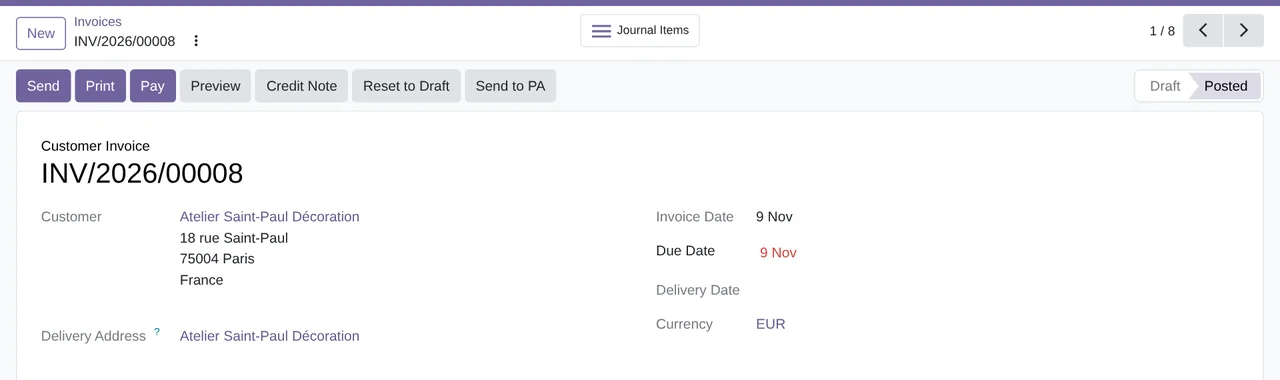
- it deposits your invoices and credit notes as UBL (Odoo's French profile), CII (EN 16931) or Factur-X, the invoice PDF with the CII embedded;
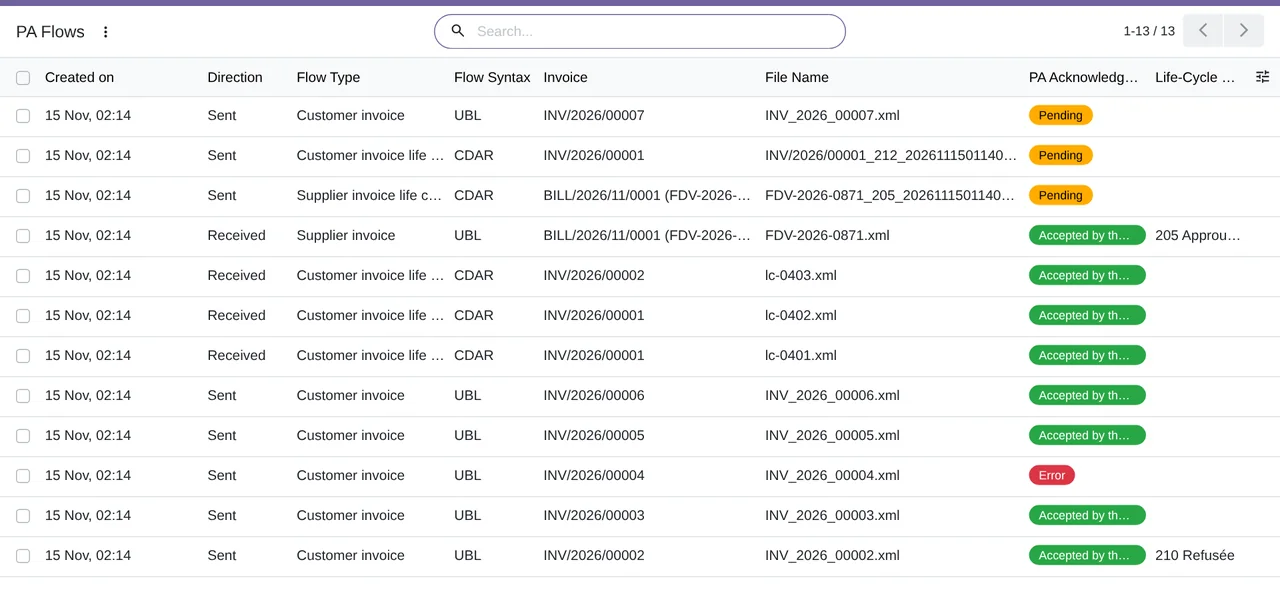
- it receives the life-cycle statuses 200 to 213 and sends the buyer's and seller's statuses, including 212 Encaissée, as CDAR messages;
- it turns the supplier invoices your PA makes available into draft vendor bills;
- it sends the e-reporting data built by Odoo's French module to your PA instead of Odoo's, and looks companies up in the directory through your PA.
The module is not a PA: you need a contract with a PA that offers the XP Z12-013 API, and the URLs, credentials and matricule it gives you. No PA gives us a test environment yet, so the module is tested against a simulator of the XP Z12-013 standard (version 1.3.0), not against a real PA. Ask yours first whether it offers this API. Its automated tests pass on Odoo.sh for 17, 18, 19 and 20 (test run of 15 November 2026). It runs on Odoo.sh or your own server, not on Odoo Online. Its license costs €9 on Odoo Apps, per Odoo version, and it needs a FlexigoTech Cloud subscription: €49 a month or €490 a year, VAT excluded, with a 14-day free trial.
Frequently asked questions
Has French e-invoicing been postponed?
No. Reception for every company, and issuing for large companies and mid-caps, have applied since 1 September 2026. Smaller companies must issue e-invoices by 1 September 2027. The DGFiP only said that real, documented start-up difficulties would not be fined automatically.
Does a foreign company have to receive French e-invoices?
Not if it has no fixed establishment in France. Its French suppliers invoice it as before. It may still have to e-report the transactions located in France for which it owes French VAT.
Is a PDF invoice sent by email still valid?
It is not an e-invoice. For companies that must issue e-invoices, the target is the electronic channel through a PA. During the start-up phase, a PDF invoice for a real transaction is not to be rejected for that reason alone.
Do invoices go to the tax authority?
No. Invoices travel between accredited platforms. Only the data required by law goes to the tax authority, through the PPF.
Legal basis and date checked
We checked every date, threshold and penalty on 17 November 2026 on impots.gouv.fr (DGFiP FAQ of 1 September 2026, the practical start-up guide of July 2026, the e-reporting page for foreign companies and the official PA list of 16 November 2026), in the adopted text of the 2026 Finance Act on assemblee-nationale.fr (Articles 1737 and 1788 D of the French Tax Code as amended by that Act) and on Légifrance (Decree 2026-677 of 27 July 2026). The full list of sources is at the bottom of the page.
Keep reading
Checked in the connector's source code (version 17.0, 18.0, 19.0 and 20.0) and the linked sources
Sources
- www.impots.gouv.fr/sites/default/files/media/1_metier/2_professionnel/EV/2_gestion/290_fac
- aife.economie.gouv.fr/nos-applications/facturation-electronique-b2b/
- www.impots.gouv.fr/foire-aux-questions-japprofondis-la-facturation-electronique
- www.impots.gouv.fr/specifications-externes-b2b
- www.impots.gouv.fr/facturation-electronique-et-plateformes-agreees
- www.impots.gouv.fr/je-consulte-la-liste-des-plateformes-agreees
- www.impots.gouv.fr/international-professionnel/le-reporting-pour-les-entreprises-etrangere
- www.assemblee-nationale.fr/dyn/17/textes/l17t0227_texte-adopte-seance.pdf
- www.legifrance.gouv.fr/codes/article_lc/LEGIARTI000046869201
- www.impots.gouv.fr/sites/default/files/media/1_metier/2_professionnel/EV/2_gestion/290_fac
- www.impots.gouv.fr/sites/default/files/media/1_metier/2_professionnel/EV/2_gestion/290_fac
- www.legifrance.gouv.fr/jorf/id/JORFTEXT000054499487
- github.com/odoo/odoo/tree/17.0/addons/l10n_fr_pdp
- Module source code: flexigo_france_pdp, __manifest__.py line 9 in 20.0 (6ad2dd5)
- Module source code: flexigo_france_pdp, models/account_move.py line 59 in 20.0
- Module source code: flexigo_france_pdp, __manifest__.py line 14 in 20.0
- Module source code: flexigo_france_pdp, __manifest__.py line 17 in 20.0
- Module source code: flexigo_france_pdp, __manifest__.py line 18 in 20.0
- Module source code: flexigo_france_pdp, __manifest__.py line 23 in 20.0
- apps.odoo.com/apps/modules/20.0/flexigo_france_pdp
- Module source code: flexigo_france_pdp, tests/, 17.0 (0b4e6d7), 18.0 (14869ba), 19.0 (ad166b6) and 20.0 (6ad2dd5)