

 Français
How a Factur-X file is built
A Factur-X file is a single PDF that holds two versions of the same invoice:
- the readable version, a PDF/A-3 (the archiving flavour of PDF) that the customer opens and prints like any invoice;
- the structured version, an XML file attached to the PDF as factur-x.xml, in UN/CEFACT CII syntax (D22B) and compliant with EN 16931, which the customer's software reads without retyping.
The customer chooses whether to read the PDF, import the data, or both. Factur-X has been accepted on Chorus Pro, the French public sector invoicing portal, since 2018.
The Factur-X profiles
A profile sets how much data the XML carries. The FNFE-MPE defines five data profiles, plus reference profiles such as EXTENDED-CTC-FR for France:
- MINIMUM
- the minimum data Chorus Pro requires, roughly what you would capture from an invoice header and footer.
- BASIC WL
- the header and footer data buyers ask for most, without invoice lines.
- BASIC
- BASIC WL plus the core data of each invoice line.
- EN 16931
- all the data in the European semantic standard EN 16931.
- EXTENDED
- the EN 16931 profile with extra data.
- EXTENDED-CTC-FR
- a subset of EXTENDED for France.
The formats and profiles used in the French reform are described in the AFNOR standard XP Z12-012 (formats and profiles of invoice and life-cycle status messages). Ask your platform which profiles it accepts before you choose one.
Factur-X in French e-invoicing
Since 1 September 2026, invoices between businesses established in France travel through accredited platforms (PA), in one of the three base formats: UBL, CII or Factur-X, all compliant with EN 16931. A supplier cannot force a format on its customer: the customer's receiving platform can convert the invoice. A Factur-X file sent by email, outside an accredited platform, does not meet the French obligation to issue e-invoices: what counts is transmission through a PA. The whole French timetable is in our guide to France e-invoicing.
Factur-X and ZUGFeRD
Factur-X and ZUGFeRD are the same standard, published jointly by FNFE-MPE in France and FeRD in Germany. Factur-X 1.09.2 matches ZUGFeRD 2.5.2. Germany sets its own rules for using it. The full specification is a free download on the FNFE-MPE website.
Creating and sending Factur-X with Odoo
Odoo can produce Factur-X: its account_edi_ubl_cii module attaches the CII XML to the invoice PDF as factur-x.xml. For French e-invoicing, the invoice still has to go through an accredited platform.
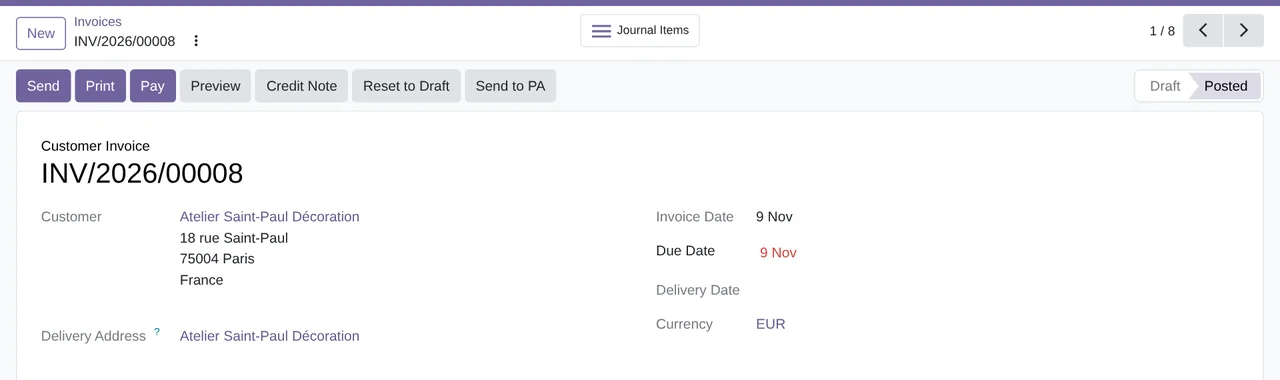
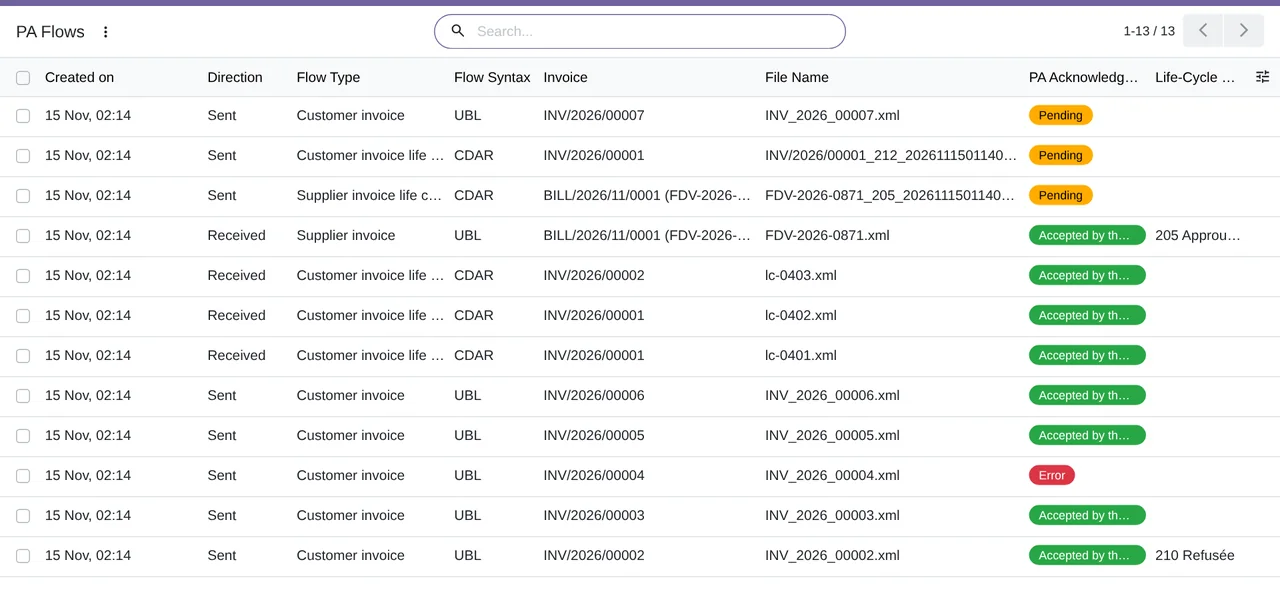
Our Factur-X & PA France module deposits your invoices and credit notes with the PA you chose, through the AFNOR XP Z12-013 API, in the format set on each connection: UBL in Odoo's French profile, CII or Factur-X. For Factur-X it sends the invoice PDF with Odoo's EN 16931 CII embedded as factur-x.xml, then collects each invoice's life-cycle statuses.
The module is not a PA: you need a contract with a PA that offers the XP Z12-013 API. It is tested against a simulator of that standard, not against a real PA, because no PA gives us a test environment yet. Its automated tests pass on Odoo.sh for 17, 18, 19 and 20, and it runs on Odoo.sh or your own server, not on Odoo Online. Its license costs €9 on Odoo Apps, per Odoo version, and it needs a FlexigoTech Cloud subscription at €49 a month or €490 a year, VAT excluded, with a 14-day free trial.
Frequently asked questions
Is Factur-X mandatory in France?
No. It is one of the three base formats, with UBL and CII. You can issue in any of them, and your receiving platform can convert what you receive.
Is a Factur-X invoice sent by email compliant?
Not for a company that must issue e-invoices in France. The invoice has to go through an accredited platform, whatever its format.
What is the latest Factur-X version?
Version 1.09.2, published on 4 August 2026 by FNFE-MPE and FeRD, together with ZUGFeRD 2.5.2.
Can I open a Factur-X invoice without special software?
Yes. The PDF part opens in any PDF reader. The attached XML is for accounting software or an ERP.
Sources and date checked
We checked this page on 17 November 2026 against the FNFE-MPE Factur-X page, the DGFiP external specifications (version 3.2), the impots.gouv.fr page on specifications and standards, the DGFiP FAQ of 1 September 2026 and Odoo's source code. The full list of sources is at the bottom of the page.
Keep reading
Checked in the connector's source code (version 17.0, 18.0, 19.0 and 20.0) and the linked sources
Sources
- fnfe-mpe.org/factur-x/
- www.impots.gouv.fr/specifications-externes-b2b
- www.impots.gouv.fr/foire-aux-questions-japprofondis-la-facturation-electronique
- www.impots.gouv.fr/sites/default/files/media/1_metier/2_professionnel/EV/2_gestion/290_fac
- www.impots.gouv.fr/facturation-electronique-et-plateformes-agreees
- github.com/odoo/odoo/blob/17.0/addons/account_edi_ubl_cii/wizard/account_move_send.py
- Module source code: flexigo_france_pdp, models/account_move.py line 59 in 20.0
- Module source code: flexigo_france_pdp, __manifest__.py line 23 in 20.0
- apps.odoo.com/apps/modules/20.0/flexigo_france_pdp
- Module source code: flexigo_france_pdp, tests/, 17.0 (0b4e6d7), 18.0 (14869ba), 19.0 (ad166b6) and 20.0 (6ad2dd5)