

 Español
 Català
 Deutsch
 Français
 Português
 Italiano
 Nederlands
 Polski
What a payment is in Deel
This guide looks at contractor payments from the side of the company that pays. On the Pay tab under Finance, Deel selects every outstanding invoice by default so they can all be paid at once, and the company can remove the ones it does not want to pay yet, although Deel says some invoices can be mandatory in certain cases, such as overdue ones. When it pays by bank transfer, it has to include the payment's Deel reference. Until the money arrives, the payment shows as processing, and once Deel confirms it has received it, the status changes to Paid. So a single payment to Deel settles the invoices of several contractors at once.
Deel's API keeps the two apart. GET /payments lists the payments to Deel with their status, which is paid or processing, their totals, the currency and the payment method, but it no longer includes the invoices they cover. That is what GET /payments/{payment_id}/breakdown is for: according to Deel, it returns each invoice and the Deel fee as separate lines. Each line carries, among other fields, the invoice ID (invoice_id), the contract and its type, the person's name, the amount with its currency, the amount in the payment currency and whatever general ledger account has been set up in Deel (general_ledger_account).
How the connector splits it
| What Deel sends | What the connector does in Odoo |
|---|---|
Payments from GET /payments | Reads them from the previous run minus 7 days; the first time, from Import invoices issued from |
processing status | The payment waits in Waiting for Deel and the connector does not ask for its breakdown |
paid status | The payment moves to To register and the connector reads its breakdown, if Deel marks it paid within 7 days of its creation |
invoice_id on each line | The vendor bill of that Deel invoice, which receives its payment |
paid_at | Payment date in Odoo |
deel_reference | Payment memo; if it is missing, the payment's label |
general_ledger_account | Stored in Deel GL account, but it does not decide where the payment goes |
Each bill is paid with Odoo's register payment wizard, in the Payments journal of its legal entity, so a payment to Deel that covers several invoices becomes one Odoo payment per bill. Each payment covers what is still owed on its vendor bill, not the amount on the breakdown line, so if someone edited the bill in Odoo, the bill's amount is what gets paid. If a bill already shows as paid in Odoo, the connector does not create another payment, and a line already paid is not paid again on later runs. When no bill has to wait, the Deel payment ends up Registered.
All the conditions
For a bill to get its payment, all of these conditions have to hold at the same time:
- The connection has the
Payments to Deelbox ticked, which it is by default. - Deel marks the payment as paid (
paid) within 7 days of its creation. - The Deel invoice already has its vendor bill in Odoo.
- That vendor bill is posted. With
Vendor billsset toDraft, to review, the default, someone has to post it; withPosted when everything matches, it posts itself when everything matches. - Its legal entity has a
Payments journal, a bank or cash journal. That field starts empty on every new entity, and without it the bills stay unpaid in Odoo.
If a bill misses any of the last three conditions, the payment stays at Some bills not ready, with a warning that explains it, and the bills that do qualify are paid anyway. The sync looks at it again every 30 minutes, and as soon as the bill is posted and the entity has a journal, its payment is registered. If the connection receives webhooks, Deel's payment.statement.initiated and payment.statement.mark-paid events start the payments part sooner, and the data is read again through the API.
When the payment arrives before its invoice
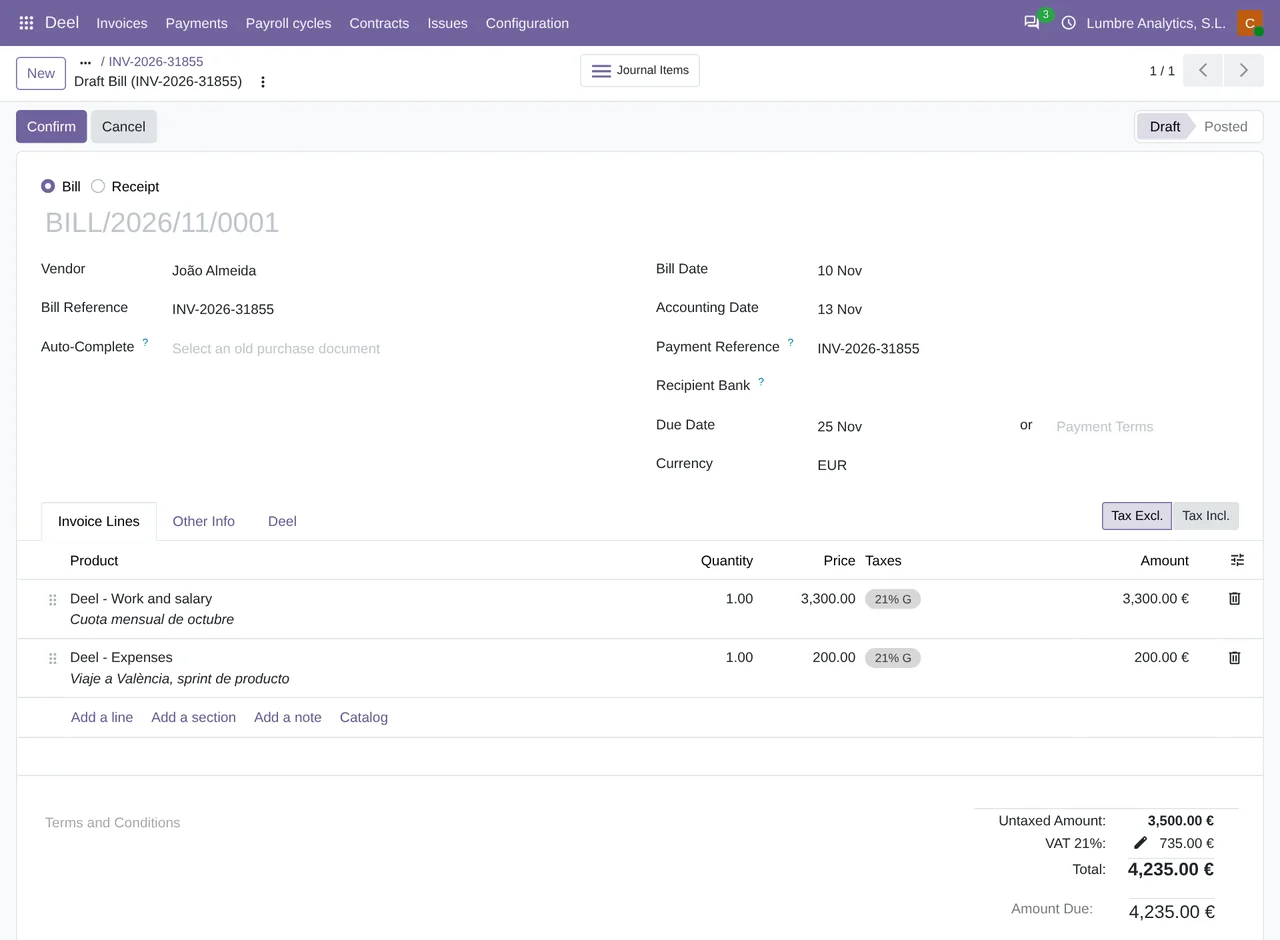
The breakdown can name a Deel invoice that Odoo does not have yet: one issued before the date you import from, or a COR worker's invoice, which the connector does not ask for when it lists invoices. In that case it reads the invoice from Deel by its ID, with GET /invoices/{id}, and creates its vendor bill right away, with the same rules as any other. If that bill stays in draft, which is the default, the payment waits at Some bills not ready until someone posts it, and it is registered on the next run.
Contractors with their own vendor
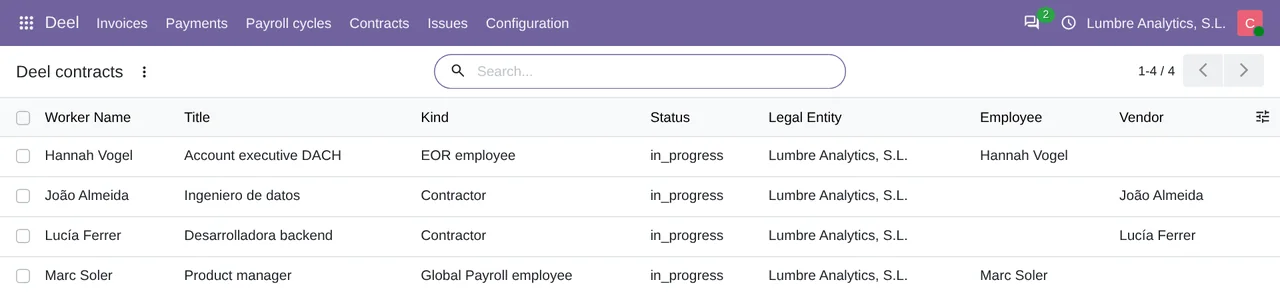
In Deel the money goes to Deel, but in Odoo every bill is in a vendor's name, and the Deel legal entity decides the company, the purchase journal and that vendor. A contractor is their own vendor: the connector looks them up by email, but only among Odoo contacts that are already vendors and have no user; if it finds none, it creates a new one. While Deel does not have that person yet, for example because they have not accepted the invitation, their bills go to the Deel vendor. EOR and COR bills always go to Deel, to the legal entity's Deel vendor or, if that is empty, to the connection's. Since the payment is registered on the bill, it settles the debt with the same vendor the bill has.
What it does not do
The connector does not use the general ledger account from the breakdown: it stores it in Deel GL account, and the payment goes to the entity's payments journal. It does not read credit notes either, which Deel's API serves through another call (GET /billing/invoices), and it stops reading a payment that is still processing more than 7 days after it was created, because Deel, according to its API reference, filters the payment list by creation date. If Deel marks the payment paid later than that, it stays at Waiting for Deel with no warning, and its bills remain unpaid in Odoo. Webhooks trigger that same read, so they do not recover it either, and there is currently no button that does. Also, no payment has been tested against Deel's live API. The Deel demo organization the connector was tested against, through FlexigoTech Cloud, had no payments, so this part was tested with responses modelled on Deel's API reference, and nobody has yet seen how the Deel fee line comes through in a real breakdown. The connection, legal entities, a contract with its person and vendor, webhooks and a second sync without duplicates were tested against that organization.
The connector works on Odoo 17, 18, 19 and 20 on your own server or on Odoo.sh, not on Odoo Online. How each bill comes in is covered in Deel invoice in Odoo, Global Payroll in Deel gross to net, and the comparison with Bill Sync, Deel's invoice sync, in its accounting integrations. The connector is explained in full on its page and published on Odoo Apps.
Keep reading
Checked in the connector's source code (version 20.0) and the linked sources
Sources
- help.letsdeel.com/hc/en-gb/articles/4407737772689-Making-Invoice-Payments-With-Deel
- developer.deel.com/api/reference/endpoints/accounting/retrieve-payment-receipts-v-2027-01-
- developer.deel.com/api/reference/endpoints/accounting/retrieve-a-payment-breakdown-v-2026-
- Module source code: flexigo_deel_connector 20.0 (18442307): models/deel_payment.py
- Module source code: flexigo_deel_connector 20.0 (18442307): models/deel_account.py
- Module source code: flexigo_deel_connector 20.0 (18442307): models/deel_legal_entity.py
- Module source code: flexigo_deel_connector 20.0 (18442307): data/deel_cron.xml
- Module source code: flexigo_deel_connector 20.0 (18442307): models/deel_invoice.py
- Module source code: flexigo_deel_connector 20.0 (18442307): models/deel_contract.py
- help.letsdeel.com/hc/en-gb/articles/46057955155217-Accounting-Integrations-Overview
- apps.odoo.com/apps/modules/20.0/flexigo_deel_connector