

 Deutsch
The two formats side by side
| XRechnung | ZUGFeRD | |
|---|---|---|
| Published by | KoSIT, for the public sector | FeRD, part of the AWV, with support from the Federal Ministry for Economic Affairs and Energy |
| File | plain XML | PDF/A-3 with embedded XML |
| Syntax | UBL 2.1 or UN/CEFACT CII | UN/CEFACT CII |
| Readable without software | no, it needs a viewer | yes, as a PDF |
| If PDF and XML differ | there is no PDF | the XML prevails |
| Valid as a German e-invoice | yes | from version 2.0.1, except MINIMUM and BASIC-WL |
| Current release | version 3.0, specification 3.0.2; 4.0 in draft | version 2.5.2 of 4 August 2026 |
| Federal OZG-RE platform | yes | only ZUGFeRD 2.2.0 in its XRECHNUNG profile, as a plain XML file |
XRechnung, the public-sector standard
XRechnung is developed by KoSIT, the German coordination office for IT standards, as the standard for invoices to public contracting authorities. It implements Directive 2014/55/EU and narrows EN 16931 with German business rules: for example, field BT-10 (Buyer reference) is mandatory, and an XRechnung without it fails with error BR-DE-15. For federal authorities that field holds their Leitweg-ID. An XRechnung has no PDF, so the buyer needs software to display it; the German tax administration offers a free viewer at e-rechnung.elster.de.
ZUGFeRD, a PDF that carries the data
FeRD, the German e-invoicing forum, publishes ZUGFeRD under the name "ZUGFeRD/Factur-X". It is free and works across industries: a PDF/A-3 for people to read, with the invoice data as CII XML for the buyer's software. FeRD says it can be used between businesses, with public bodies and with consumers. Under the German rules the XML is the leading part: if it differs from the PDF, the XML counts, and the BMF recommends displaying the XML part itself.
Which one to send to a German customer
German law does not prefer either: both qualify, and you may agree the format and the channel with your customer, or use another structured format such as EDIFACT if every mandatory detail can be read from it. If your company has no establishment in Germany, you are not obliged to send e-invoices at all, but every German business must be able to receive both. In practice:
- A customer that still reads invoices by eye can open a ZUGFeRD as a normal PDF, while its software reads the XML later.
- A customer that imports invoices automatically will usually tell you which of the two its system expects: ask.
- For federal public bodies, XRechnung is the standard and the Leitweg-ID goes in BT-10. The OZG-RE platform takes another standard only if it meets EN 16931, the federal E-Invoicing Ordinance (E-RechV) and the platform's terms of use; the federal FAQ names ZUGFeRD 2.2.0 in its XRECHNUNG profile, sent as a plain XML file. Whether your public client uses OZG-RE comes with the order, or you ask the client.
Both formats in Odoo
Odoo Community 18, 19 and 20 offers the partner formats "Germany (XRechnung)" and "Germany (ZUGFeRD)"; when you send the invoice, Odoo generates the XML and attaches it, and for ZUGFeRD it embeds the XML in the PDF. Our module XRechnung & ZUGFeRD Odoo generates XRechnung 3.0 in CII and UBL and ZUGFeRD EN16931 or EXTENDED as PDF/A-3, in the format set on each customer or on the company. FlexigoTech Cloud validates XRechnung and ZUGFeRD EN16931 against KoSIT's official rules; the EXTENDED profile is generated but not validated.
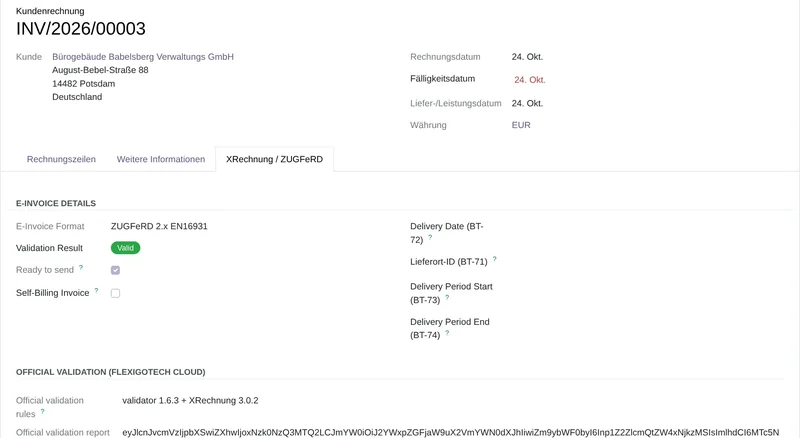
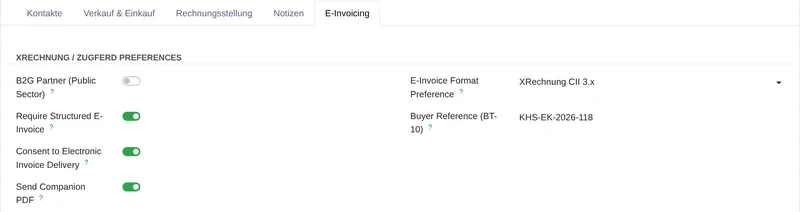
The module runs on Odoo 17, 18, 19 and 20 and costs €9 per version on Odoo Apps, plus FlexigoTech Cloud from €29 a month or €290 a year, VAT excluded. You start the 14-day free trial in Odoo under Settings › FlexigoTech Cloud, and it does not ask for a card.
Frequently asked questions
Can I send a ZUGFeRD invoice to a German public body?
The rule is XRechnung. Another standard is allowed if it meets EN 16931, the E-RechV and the platform's terms; the federal FAQ names ZUGFeRD 2.2.0 in its XRECHNUNG profile, as a plain XML file without the PDF. Your public client tells you with the order whether it uses OZG-RE, and you can ask it which format it takes.
Is a ZUGFeRD invoice just a PDF?
No. It is a PDF/A-3 with embedded XML. If the XML is missing or has a format error, the file is not an e-invoice.
Do I need XRechnung if my company is outside Germany?
You are not obliged to issue e-invoices if you have no establishment in Germany. If your German customer asks for one, either format meets the rules.
Keep reading
Checked in the module's source code (version 20.0) and the linked sources
Sources
- www.bundesfinanzministerium.de/Content/DE/FAQ/e-rechnung.html
- www.gesetze-im-internet.de/ustg_1980/__14.html
- www.bundesfinanzministerium.de/Content/DE/Downloads/BMF_Schreiben/Steuerarten/Umsatzsteuer
- www.e-rechnung-bund.de/
- xeinkauf.de/xrechnung/
- www.ferd-net.de/standards/zugferd
- www.e-rechnung-bund.de/faq/
- github.com/itplr-kosit/xrechnung-schematron/releases/tag/v2.6.0
- github.com/odoo/odoo/blob/20.0/addons/account_edi_ubl_cii/models/res_partner.py
- github.com/odoo/odoo/blob/20.0/addons/account_edi_ubl_cii/models/account_move_send.py
- Module source code: flexigo_germany_xrechnung 20.0 (25d19859): models/account_move.py
- Module source code: flexigo_germany_xrechnung 20.0 (25d19859): models/xrechnung_cloud.py
- Module source code: flexigo_germany_xrechnung 20.0 (25d19859): models/account_move_send.py
- apps.odoo.com/apps/modules/20.0/flexigo_germany_xrechnung
- e-rechnung-bund.de/faq/