

 Deutsch
What counts as an e-invoice in Germany
Under section 14(1) of the German VAT Act (UStG), an electronic invoice is, since 1 January 2025, one that is issued, sent and received in a structured electronic format that allows electronic processing. The format must follow EN 16931, the European standard behind Directive 2014/55/EU, or be agreed between the parties, as long as every mandatory detail can be extracted correctly and completely into a format that follows the standard. Paper and plain PDF invoices are now called "other invoices" (sonstige Rechnung). The date of the supply decides which rules apply, not the date of the invoice.
The obligation comes from the Growth Opportunities Act (Wachstumschancengesetz) of 27 March 2024, Federal Law Gazette 2024 I No. 108. The Federal Ministry of Finance (BMF) describes it as the groundwork for a later transaction reporting system; the government has not yet proposed the law for that system.
If your company is not German
The obligation to issue applies only when both seller and buyer are established in Germany (section 14(2) UStG). A business counts as established there if its seat, its management or a fixed establishment that takes part in the supply is in Germany. Without a seat, its residence or habitual abode counts. So:
- A foreign company registered for VAT in Germany, but with no establishment there, does not have to issue e-invoices. The BMF says it can state this on its invoice, and its German customer may rely on that statement.
- An invoice from a German business to a customer abroad is not covered either, because the buyer is not established in Germany.
- A German subsidiary is a German business, and so is a fixed establishment in Germany that takes part in the supply: for those, the dates below apply.
Receiving is a different duty: it applies to every business established in Germany, so your German customers can always accept an e-invoice from you, even when you are not obliged to send one.
Who must issue e-invoices, and from when
| Supply date | What a German business may issue | Source |
|---|---|---|
| 1 January 2025 to 31 December 2026 | e-invoice; paper is still allowed, and a PDF or other electronic format if the buyer agrees | section 27(38) no. 1 UStG |
| 2027, previous-year total turnover up to €800,000 | the same as before, until 31 December 2027 | section 27(38) no. 2 UStG |
| 2027, previous-year total turnover above €800,000 | e-invoice only | section 27(38) no. 2 UStG |
| 2027, EDI that does not follow EN 16931 | allowed with the buyer's consent until 31 December 2027 | section 27(38) no. 3 UStG |
| from 1 January 2028 | e-invoice for every domestic B2B supply, except the exemptions below | BMF e-invoicing FAQ |
Cash payment changes nothing: a business lunch or a purchase at a hardware store above €250 needs an e-invoice once the seller can no longer use a transition rule.
No e-invoice needed
You do not need an e-invoice when VAT law does not require an invoice at all: sales to consumers (B2C) and many VAT-exempt supplies under section 4 nos. 8 to 29 UStG, such as financial services or letting flats. Even where an invoice is required, an "other invoice" is enough for:
- small invoices up to €250 gross (section 33 UStDV),
- tickets that count as invoices (section 34 UStDV),
- supplies by small businesses under the Kleinunternehmer scheme (section 34a UStDV),
- supplies to legal persons that are not businesses, such as many associations,
- certain supplies to private individuals connected with real estate.
Formats, sending and penalties
XRechnung and ZUGFeRD from version 2.0.1 meet the requirements, except the ZUGFeRD profiles MINIMUM and BASIC-WL. The parties may also agree on another format, such as EDIFACT, if every mandatory detail can be read from it correctly. Validation is not a legal condition for the invoice to be recognised, but the BMF recommends it when the invoice is created. The law does not prescribe a channel: email, an interface, a portal or shared storage within a group all work.
Sending an "other invoice" where an e-invoice is required is not an administrative offence under the current wording of section 26a UStG, according to the tax authorities. Deliberately or recklessly issuing no invoice, or issuing one late, is still an offence, with a fine of up to €5,000. For the wrong format, the risk sits with the buyer. An "other invoice" that should have been an e-invoice is not a proper invoice and does not, in principle, give the right to deduct input VAT, unless the seller corrects it later with an e-invoice that refers to it. The buyer also has a civil claim to receive an e-invoice.
Invoices to public bodies (B2G)
Invoicing the public sector has its own rules on top of the VAT Act. Suppliers to the federal administration have had to invoice electronically since 27 November 2020 for direct orders from €1,000 net, under the federal e-invoicing ordinance (ERechV), through the OZG-RE platform and with the authority's Leitweg-ID. Where both sets of rules apply, the stricter one prevails. Between businesses, the BMF says a placeholder such as "-" in field BT-10 (Buyer reference) is enough for VAT purposes.
E-invoices in Odoo
Odoo Community 18, 19 and 20 includes the partner formats "Germany (XRechnung)" and "Germany (ZUGFeRD)" in its account_edi_ubl_cii module, which exports and imports XRechnung (UBL) and Factur-X (CII). Our module XRechnung & ZUGFeRD Odoo adds:
- XRechnung 3.0 in CII and UBL, and ZUGFeRD EN16931 or EXTENDED as PDF/A-3, from a posted invoice or credit note, one by one or in a batch.
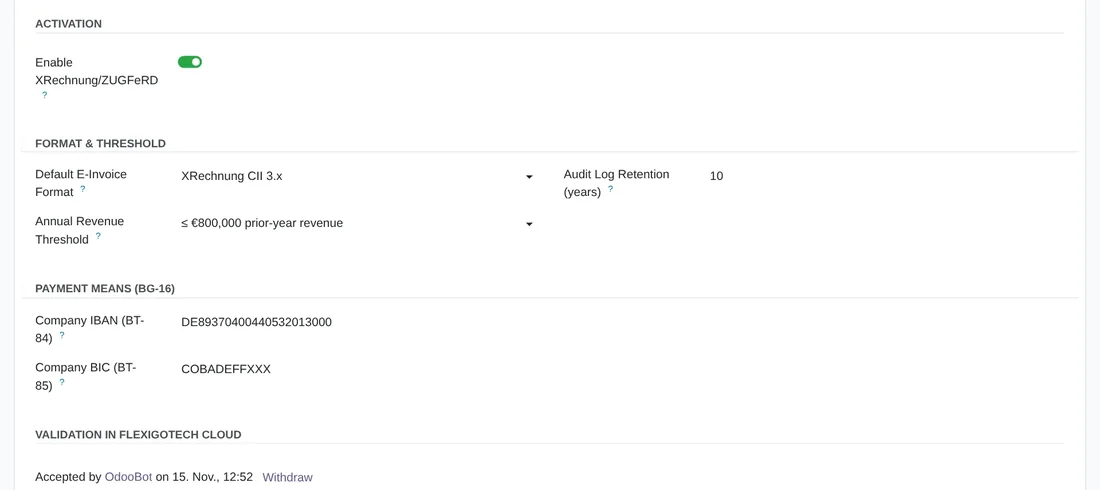
- A check before generating: IBAN, the customer's VAT number, your company's phone and email, country, Buyer Reference (BT-10) and, for public bodies, the Leitweg-ID. If anything is missing, it says what.
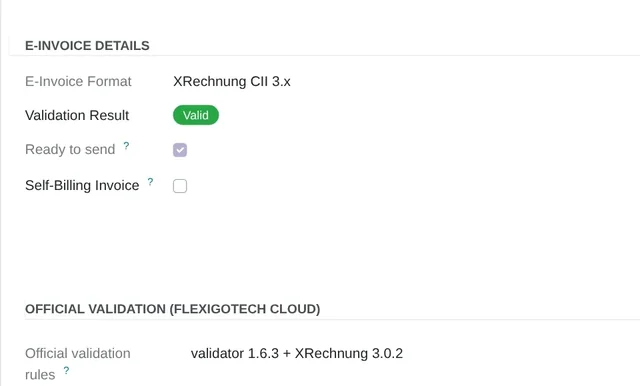
- Validation of every XRechnung and ZUGFeRD EN16931 against KoSIT's official rules in FlexigoTech Cloud, which returns a signed report. Only a valid report marks the invoice "Ready to send". ZUGFeRD EXTENDED is not validated.
- A notice on a domestic B2B invoice above €250 once an e-invoice is mandatory for it and none has been generated, based on the revenue band you set: from 2027 above €800,000, from 2028 for everyone.
- It does not send anything over Peppol or to portals. The e-invoice stays attached to the invoice and goes out with Odoo's invoice email.
It runs on Odoo 17, 18, 19 and 20, on Odoo.sh or your own server, not on Odoo Online. On Odoo Apps it costs €9 per Odoo version and needs a FlexigoTech Cloud subscription from €29 a month or €290 a year, VAT excluded. You start the 14-day free trial in Odoo under Settings › FlexigoTech Cloud, and it does not ask for a card. Its Odoo Apps page says each version has 134 to 137 automated tests and that on 15 November 2026 KoSIT's official validator 1.6.3 accepted its XRechnung files in CII and UBL on all three versions with no errors or warnings.
Frequently asked questions
Does a foreign seller have to send e-invoices to German customers?
Not if it has no seat, management or fixed establishment in Germany that takes part in the supply, even when it is registered for VAT there. It can say so on its invoice. Its German customers must still be able to receive e-invoices.
Is a PDF invoice by email still allowed?
As an e-invoice, no. It is an "other invoice", allowed for supplies until the end of 2026 if the buyer agrees, and in 2027 only for sellers whose total turnover in the previous year was €800,000 or less, and again only if the buyer agrees.
Is there a fine for not issuing an e-invoice?
Not for sending an "other invoice" instead: under the current wording of section 26a UStG, the tax authorities do not treat that as an administrative offence. Deliberately or recklessly issuing no invoice, or a late one, can cost up to €5,000. The buyer may lose the input VAT deduction and can demand an e-invoice.
Do I need a Leitweg-ID?
Only to invoice a public body. Between businesses a placeholder such as "-" in BT-10 is enough when the buyer gives you no reference of its own.
How long must e-invoices be kept?
8 years, like any invoice (section 14b UStG), at least the structured part, unchanged and in its original form.
Legal basis and date checked
We checked dates, thresholds and exemptions on 17 November 2026 in the original texts: sections 14, 14b and 27(38) UStG on gesetze-im-internet.de, the Growth Opportunities Act in the Federal Law Gazette, the BMF's questions and answers on the e-invoice (dated 29 October 2026) and its letters of 15 October 2024, 15 October 2025 and 15 October 2026, and e-rechnung-bund.de for the public sector. The BMF's answers are guidance without legal force; in a specific case the tax office decides. All sources are listed at the bottom of the page.
Keep reading
Checked in the module's source code (version 20.0) and the linked sources
Sources
- www.gesetze-im-internet.de/ustg_1980/__14.html
- www.bundesfinanzministerium.de/Content/DE/FAQ/e-rechnung.html
- www.gesetze-im-internet.de/ustg_1980/__27.html
- www.gesetze-im-internet.de/ustg_1980/__14b.html
- www.recht.bund.de/bgbl/1/2024/108/VO.html
- www.bundesfinanzministerium.de/Content/DE/Downloads/BMF_Schreiben/Steuerarten/Umsatzsteuer
- www.e-rechnung-bund.de/
- github.com/odoo/odoo/blob/20.0/addons/account_edi_ubl_cii/models/res_partner.py
- Module source code: flexigo_germany_xrechnung 20.0 (25d19859): models/account_move.py
- Module source code: flexigo_germany_xrechnung 20.0 (25d19859): models/xrechnung_cloud.py
- Module source code: flexigo_germany_xrechnung 20.0 (25d19859): models/account_move.py, models/res_company.py
- Module source code: flexigo_germany_xrechnung 20.0 (25d19859): models/account_move_send.py
- apps.odoo.com/apps/modules/20.0/flexigo_germany_xrechnung
- apps.odoo.com/apps/modules/17.0/flexigo_germany_xrechnung
- www.gesetze-im-internet.de/ustg_1980/__26a.html