

 Español
 Català
Which system applies to you
Two things decide it: where your company is resident for tax purposes, and who you invoice. One company can have three at once, for example the SII, FACe and B2B e-invoicing.
| Your situation | What applies | From | Rule |
|---|---|---|---|
| Taxed in Álava, Bizkaia or Gipuzkoa (Basque Country) | TicketBAI (in Bizkaia, as part of Batuz) | already mandatory in all three; the last phase started on 1 January 2026 in Bizkaia | Batuz, Gipuzkoa, Álava |
| Monthly VAT returns (over €6,010,121.04 of turnover, monthly refund register, VAT group or a tax warehouse for motor fuels) | SII: VAT books kept on the AEAT website | since 2017 | VAT Regulation, Art. 62.6 |
| Corporate income taxpayer with its tax domicile in the common territory, not in the SII | VeriFactu | software adapted before 1 January 2027 | Royal Decree 1007/2023 |
| Sole trader or other taxpayer covered by VeriFactu | VeriFactu | before 1 July 2027 | Royal Decree 1007/2023 |
| Company (SA, SL and others) invoicing a public body | e-invoice through that body's general entry point (FACe for central government) | since 15 January 2015 | Law 25/2013, Art. 4 |
| Invoices to businesses and professionals established in Spain | B2B e-invoicing under the Crea y Crece law | October 2027 above €8 million; October 2028 for the rest | Royal Decree 238/2026 |
For the Basque Country and Navarre, the VeriFactu regulation applies to taxpayers whose tax domicile is in the common territory (Art. 1.3 of Royal Decree 1007/2023). TicketBAI applies to those subject to Basque rules for income or corporate tax, under the connecting factors of the Economic Agreement. VeriFactu also excludes companies that keep their VAT books through the SII (Art. 3.3).
If your company is not Spanish
A non-resident company falls under VeriFactu only when it earns income in Spain through a permanent establishment (Art. 3.1 of Royal Decree 1007/2023). TicketBAI applies to whoever is taxed under Basque rules for personal income tax, corporate tax or non-resident tax with a permanent establishment.
The B2B obligation applies to invoices that Spain's invoicing regulation requires you to issue, when the customer is a business or professional with its seat, a permanent establishment or its domicile in Spain (Art. 3 of Royal Decree 238/2026). Simplified invoices are outside it, except qualified ones.
VeriFactu
VeriFactu is the common name of the regulation on invoicing software, Royal Decree 1007/2023. It covers companies, self-employed people with an economic activity, non-residents with a permanent establishment and entities taxed under the attribution regime, whenever they invoice with software. After Royal Decree-law 15/2025, corporate income taxpayers must have compliant software before 1 January 2027 and everyone else before 1 July 2027. Our English guides: what VeriFactu means in Odoo, the 2027 deadlines and the errors the AEAT returns.
TicketBAI and Batuz in the Basque Country
The three Basque tax authorities (Haciendas Forales) require TicketBAI from anyone taxed with them for personal income tax, corporate tax or non-resident tax with a permanent establishment. Each invoice produces a file for the tax authority (in Gipuzkoa and Álava it goes as the invoice is issued; in Bizkaia, within the deadlines the provincial council sets), and the invoice carries a QR code the customer can check. Álava finished its rollout on 1 December 2022, Gipuzkoa on 1 June 2023 and Bizkaia on 1 January 2026. In Bizkaia, TicketBAI is one part of Batuz, which also includes the LROE, an online ledger of income, expenses and invoices.
SII, the VAT books within four days
The Immediate Supply of Information (Suministro Inmediato de Información) applies to monthly VAT filers: companies with more than €6,010,121.04 of turnover in the previous year, businesses in the monthly refund register, VAT groups and, since 2025, holders of tax warehouses for petrol, diesel or biofuels. Any other business may opt in and then stays at least for the calendar year. Records of issued and received invoices must reach the AEAT within 4 calendar days, not counting Saturdays, Sundays and national holidays. SII filers no longer submit forms 347 and 390.
FACe and Facturae: invoicing public bodies
Since 15 January 2015, public limited and limited companies, among others, must invoice public bodies electronically through the body's general entry point. FACe is the central government's entry point, and other administrations use it too. The invoice is a Facturae file, electronically signed, carrying three codes for the recipient: accounting office, managing body and processing unit (the DIR3 codes). Each administration may exempt invoices up to €5,000.
B2B e-invoicing under Royal Decree 238/2026
Law 18/2022 (Crea y Crece) made business-to-business e-invoicing depend on an implementing regulation. That regulation is Royal Decree 238/2026 of 25 March. The clock started with Order HAC/1028/2026, in force since 6 October 2026: the obligation applies 12 months later to companies with more than €8 million of turnover in the previous year and 24 months later to everyone else. By our count, that is October 2027 and October 2028.
- The invoice is a structured message on the EN16931 semantic model, in UBL, CII, EDIFACT or Facturae syntax, with an advanced electronic signature when it travels through a private platform (Art. 7).
- It travels through a private exchange platform or through the AEAT's free public solution. A customer that has not agreed to a private platform is taken to receive through the public solution, and private platforms send the public solution a true copy of every invoice in UBL.
- The customer tells the supplier about acceptance or rejection and about full payment, with their dates, within 4 calendar days, not counting Saturdays, Sundays and national holidays (Art. 10). It also reports each full payment to the public solution within 4 days of paying, and any rejection (Art. 12).
- For the first 12 months, companies above €8 million attach a readable PDF unless the customer accepts the original format alone.
In Odoo
Odoo Community ships its own Spanish modules in versions 17, 18, 19 and 20: l10n_es_edi_tbai («Spain - TicketBAI»), l10n_es_edi_sii («Spain - SII EDI Suministro de Libros»), l10n_es_edi_facturae («Spain - Facturae EDI») and l10n_es_edi_verifactu («Spain - Veri*Factu»).
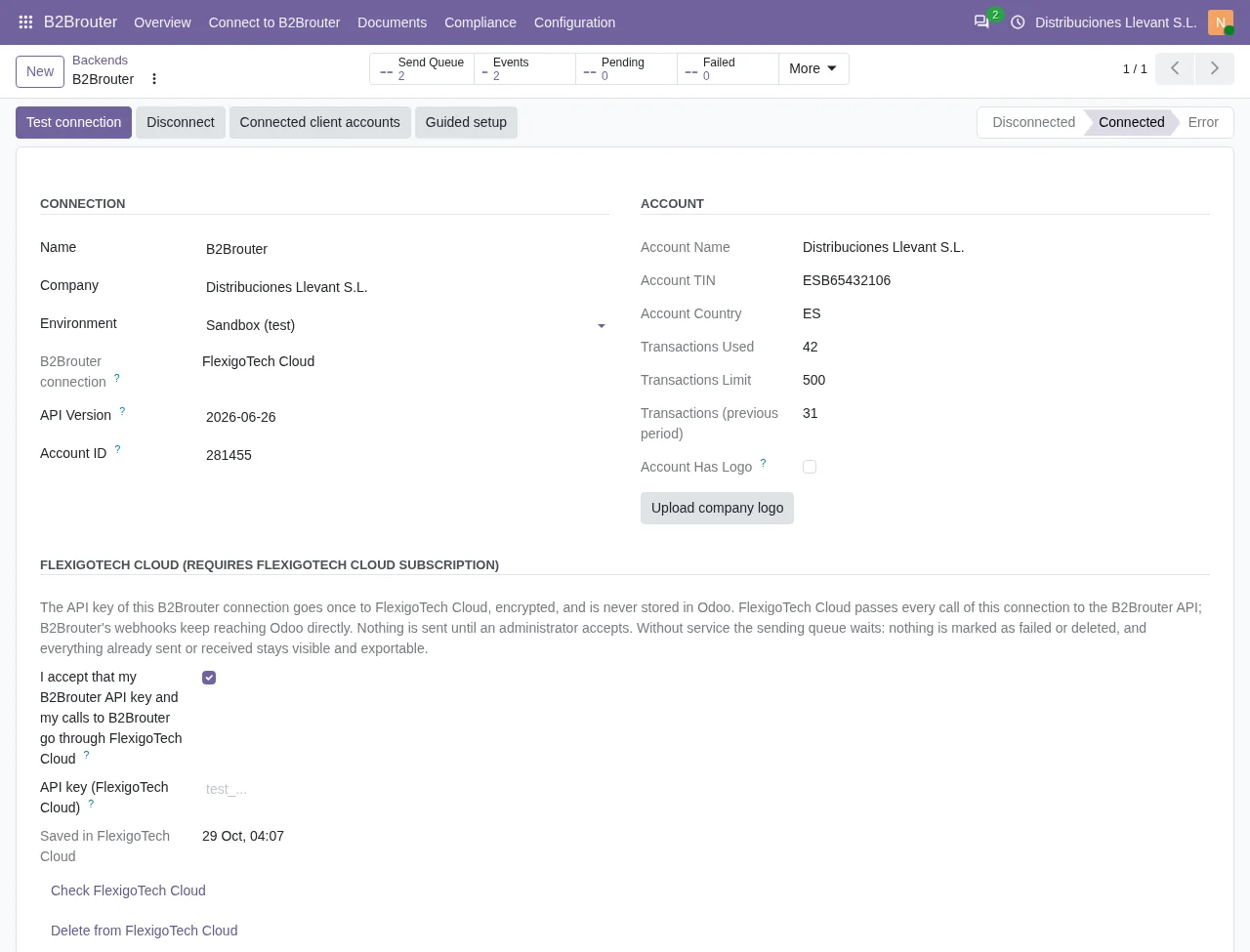
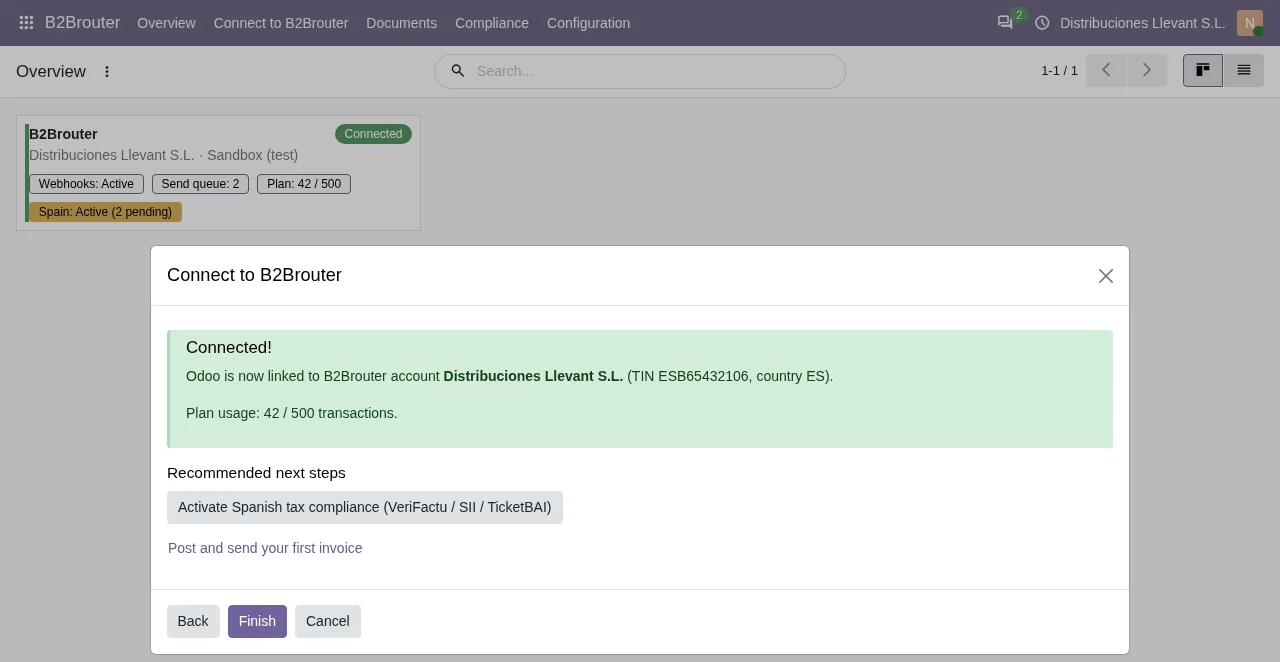
Our B2Brouter Odoo Connector takes the other route: Odoo hands each invoice to B2Brouter, which handles TicketBAI, the SII, FACe or VeriFactu and sends and receives invoices over Peppol, email or its own network. You pick one Spanish mode on the connection: VeriFactu, SII or TicketBAI. The connector refuses to switch on VeriFactu when another VeriFactu system already issues for that company, whether our flexigo_spain_verifactu module or l10n_es_edi_verifactu, or when the company is in the SII. It also holds back any FACe invoice that lacks the recipient's three DIR3 codes.
If all you need is VeriFactu, sent straight to the AEAT with your own certificate, our VeriFactu module does it without B2Brouter: €9 per Odoo version plus FlexigoTech Cloud from €29 a month or €290 a year, VAT excluded.
The B2Brouter connector costs €9 per Odoo version on Odoo Apps and needs FlexigoTech Cloud, from €49 a month or €490 a year, VAT excluded, with a 14-day free trial. It runs on Odoo 17, 18, 19 and 20, on Odoo.sh or your own server, not on Odoo Online. Your B2Brouter plan is separate and paid to B2Brouter; TicketBAI needs a Premium plan. B2Brouter's plans are explained in B2Brouter pricing with Odoo.
Frequently asked questions
Is e-invoicing mandatory in Spain in 2026?
For invoices to public bodies, yes, since 2015. Between businesses, not yet: Royal Decree 238/2026 is in force, but the obligation starts 12 months after Order HAC/1028/2026 for companies above €8 million and 24 months after it for the rest, which is October 2027 and October 2028.
Does VeriFactu apply to a foreign company selling to Spain?
Only if it earns its Spanish income through a permanent establishment. Without one, the VeriFactu regulation does not cover it.
Do companies in the SII also need VeriFactu?
No. The VeriFactu regulation does not apply to taxpayers who keep their VAT books through the SII (Art. 3.3 of Royal Decree 1007/2023).
Can I keep sending PDF invoices to Spanish customers?
Until the B2B obligation reaches you, yes. After that, the invoice must be a structured e-invoice; during the first 12 months, companies above €8 million add a PDF copy unless the customer accepts the original alone.
Is there a free option?
The AEAT's public solution is free and must be available at least two months before the obligation first applies. The AEAT will also offer a free form to issue e-invoices and report their status.
Legal basis and date checked
We checked every date and threshold on 17 November 2026 in the Spanish Official Gazette (BOE) and on the AEAT and Basque tax authority websites: Law 18/2022, Royal Decree 238/2026, Order HAC/1028/2026, Royal Decree 1007/2023, the VAT Regulation and Law 25/2013. The full list of sources is at the bottom of the page.
Keep reading
Checked in the connector's source code (version 17.0, 18.0, 19.0 and 20.0) and the linked sources
Sources
- www.boe.es/buscar/act.php?id=BOE-A-2023-24840
- store.flexigotech.com/catalog
- www.gipuzkoa.eus/es/web/ogasuna/ticketbai/faq
- www.batuz.eus/es/implantacion-definitiva
- www.batuz.eus/es/inicio
- web.araba.eus/es/-/ticketbai/faq/1-9
- web.araba.eus/es/hacienda/ticketbai/informacion-general
- www.batuz.eus/es/preguntas-frecuentes
- efact.aoc.cat/bustia/receiver/list.htm?siteLanguage=ca
- proveedores.face.gob.es/administraciones_y_organismos/buscador-de-puntos-de-entrada
- Module source code: b2brouter_connector 17.0 (645657a), 18.0 (3b35692), 19.0 (1ffced0), 20.0 (ab307eb): models/countries/es_face.py, line 106
- sede.agenciatributaria.gob.es/Sede/iva/suministro-inmediato-informacion/informacion-genera
- www.boe.es/buscar/act.php?id=BOE-A-1992-28925
- www.boe.es/buscar/act.php?id=BOE-A-2013-13722
- www.facturae.gob.es/que-quiere-hacer-usted/administraciones-publicas
- www.facturae.gob.es/face
- docs.b2brouter.net/es/developers/use-cases-by-country/send-to-face-with-imported-file/
- www.boe.es/buscar/act.php?id=BOE-A-2007-22440
- www.boe.es/buscar/act.php?id=BOE-A-2026-7295
- www.boe.es/buscar/act.php?id=BOE-A-2026-20587
- FlexigoTech calculation with the figures cited
- github.com/odoo/odoo/blob/20.0/addons/l10n_es_edi_tbai/__manifest__.py
- github.com/odoo/odoo/blob/20.0/addons/l10n_es_edi_sii/__manifest__.py
- github.com/odoo/odoo/blob/20.0/addons/l10n_es_edi_facturae/__manifest__.py
- github.com/odoo/odoo/blob/20.0/addons/l10n_es_edi_verifactu/__manifest__.py
- Module source code: b2brouter_connector 17.0 (645657a), 18.0 (3b35692), 19.0 (1ffced0), 20.0 (ab307eb): __manifest__.py, line 3
- Module source code: b2brouter_connector 17.0 (645657a), 18.0 (3b35692), 19.0 (1ffced0), 20.0 (ab307eb): models/countries/es_ticketbai.py, line 96
- Module source code: b2brouter_connector 17.0 (645657a), 18.0 (3b35692), 19.0 (1ffced0), 20.0 (ab307eb): models/b2brouter_sii_batch.py, line 54
- Module source code: b2brouter_connector 17.0 (645657a), 18.0 (3b35692), 19.0 (1ffced0), 20.0 (ab307eb): models/countries/es_face.py, line 40
- Module source code: b2brouter_connector 20.0 (ab307eb): models/b2brouter_backend.py, line 515
- Module source code: b2brouter_connector 17.0 (645657a), 18.0 (3b35692), 19.0 (1ffced0), 20.0 (ab307eb): __manifest__.py, line 12
- docs.b2brouter.net/es/user-guide/tax-report/ticketbai/
- apps.odoo.com/apps/modules/20.0/b2brouter_connector
- app.flexigotech.com/api/v1/precios