

What e-invoicing means under Indian GST
E-invoicing in India is not a new kind of invoice: it is a way of preparing one. Rule 48(4) of the CGST Rules, 2017 says that a notified business prepares its invoice with the particulars of FORM GST INV-01 after obtaining an Invoice Reference Number, by uploading that information to the Common Goods and Services Tax Electronic Portal. The rule that follows is the one that matters in practice: an invoice that such a business issues in any other way "shall not be treated as an invoice" (rule 48(5)).
So your accounting system still creates the invoice, and the IRN is what makes it valid. Rule 48(3) also links each invoice to your returns: the serial numbers of the invoices you issue in a tax period are reported in FORM GSTR-1.
Who must generate an IRN
Notification 13/2020-Central Tax, as amended, names the businesses in scope. Since 1 August 2023 it covers every registered person whose aggregate turnover exceeded ₹5 crore in any preceding financial year from 2017-18 onwards, for supplies to registered persons and for exports. One year above the threshold is enough, even if turnover fell afterwards.
The notification leaves out:
- government departments and local authorities;
- Special Economic Zone units;
- insurers, banking companies and financial institutions, including non-banking financial companies;
- goods transport agencies;
- passenger transportation services;
- admission to cinema in multiplex screens.
Sales to consumers (B2C) are outside the IRN requirement.
How the threshold came down
| From | Aggregate turnover above | Notification |
|---|---|---|
| 1 October 2020 | ₹500 crore | 13/2020 as amended by 61/2020 |
| 1 January 2021 | ₹100 crore | 88/2020 |
| 1 April 2021 | ₹50 crore | 05/2021 |
| 1 April 2022 | ₹20 crore | 01/2022 |
| 1 October 2022 | ₹10 crore | 17/2022 |
| 1 August 2023 | ₹5 crore | 10/2023 |
Notification 70/2020 changed the test from "a financial year" to "any preceding financial year from 2017-18 onwards" and added exports.
What changes on 1 January 2027
Two notifications of 26 October 2026 widen e-invoicing for the first time since 2023. Notification 04/2026-Central Tax adds two cases to the businesses already in scope: supplies received from an unregistered person when you pay the tax under reverse charge, and imports of services. Until then, e-invoicing covers only supplies to registered persons and exports.
The CGST (Amendment) Rules, 2026 (Notification 05/2026-Central Tax) update FORM GST INV-01 to schema version 1.2 on the same date. The supply type field then takes these codes:
| Code | Supply |
|---|---|
| B2B, B2C | business to business, business to consumer |
| SEZWP, SEZWOP | to an SEZ with or without payment |
| SEZWPA, SEZWPNA | to an SEZ with payment, authorised or non-authorised operations |
| EXPWP, EXPWOP, DEXP | export with or without payment, deemed export |
| RCMDOM | domestic supply from an unregistered person under reverse charge (new) |
| RCMIMP | import of services (new) |
If your software or your provider builds the INV-01 data, check that it sends version 1.2 and the two new codes before January.
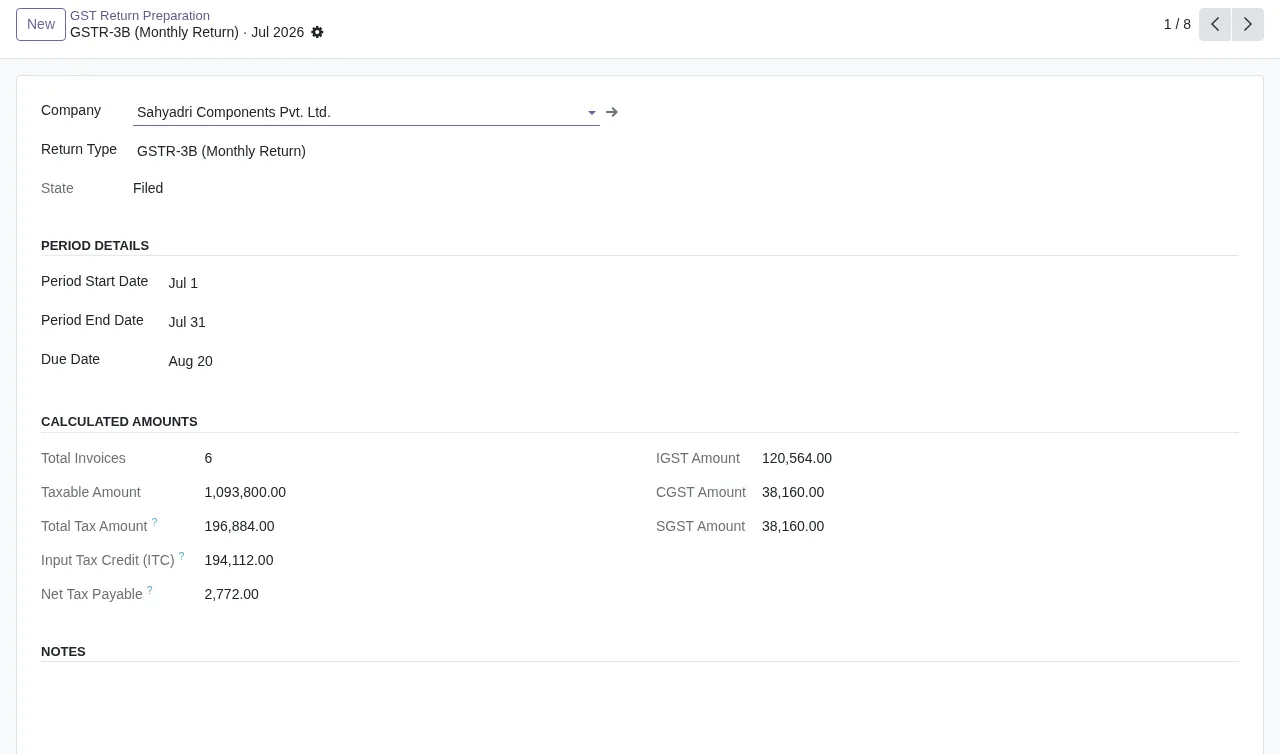
GST return due dates
| Return | What it covers | Due date |
|---|---|---|
| GSTR-1 | outward supplies | 11th of the next month; 13th of the month after the quarter for quarterly filers |
| GSTR-3B | summary return and tax payment | 20th of the next month; quarterly filers, 22nd or 24th of the month after the quarter, depending on the State or Union territory |
| GSTR-9 | annual return | 31 December after the end of the financial year |
The GSTR-1 dates come from Notification 83/2020-Central Tax, in force since 1 January 2021; GSTR-3B and GSTR-9 from rules 61 and 80. From financial year 2024-25, a business whose aggregate turnover in the year is up to ₹2 crore does not have to file GSTR-9 (Notification 15/2025-Central Tax of 17 September 2025). The government sometimes extends a due date for one month or one region by notification, so check the latest ones before a deadline.
Penalties
The first consequence is the one in rule 48(5): without an IRN, a business in scope has not issued an invoice at all. Section 122(1)(i) of the CGST Act penalises supplying goods or services without an invoice, or with an incorrect or false one: ₹10,000 or the tax evaded, whichever is higher. Where no specific penalty applies, section 125 allows a general penalty of up to ₹25,000.
E-invoicing and GST returns in Odoo
Odoo includes the app Indian - E-invoicing (l10n_in_edi) in versions 17, 18, 19 and 20. It sends invoices to the government e-invoice system through an API, using Tera Software Limited as its GSP, with an API user that you create on the e-invoice portal for each GSTIN. That is the part that gets you the IRN.
Our module, India GST for Odoo, works on the returns side, for Odoo 17, 18, 19 and 20. It:
- prepares GSTR-1, GSTR-3B and GSTR-9 from posted invoices and bills, with output tax, input tax credit and tax payable;
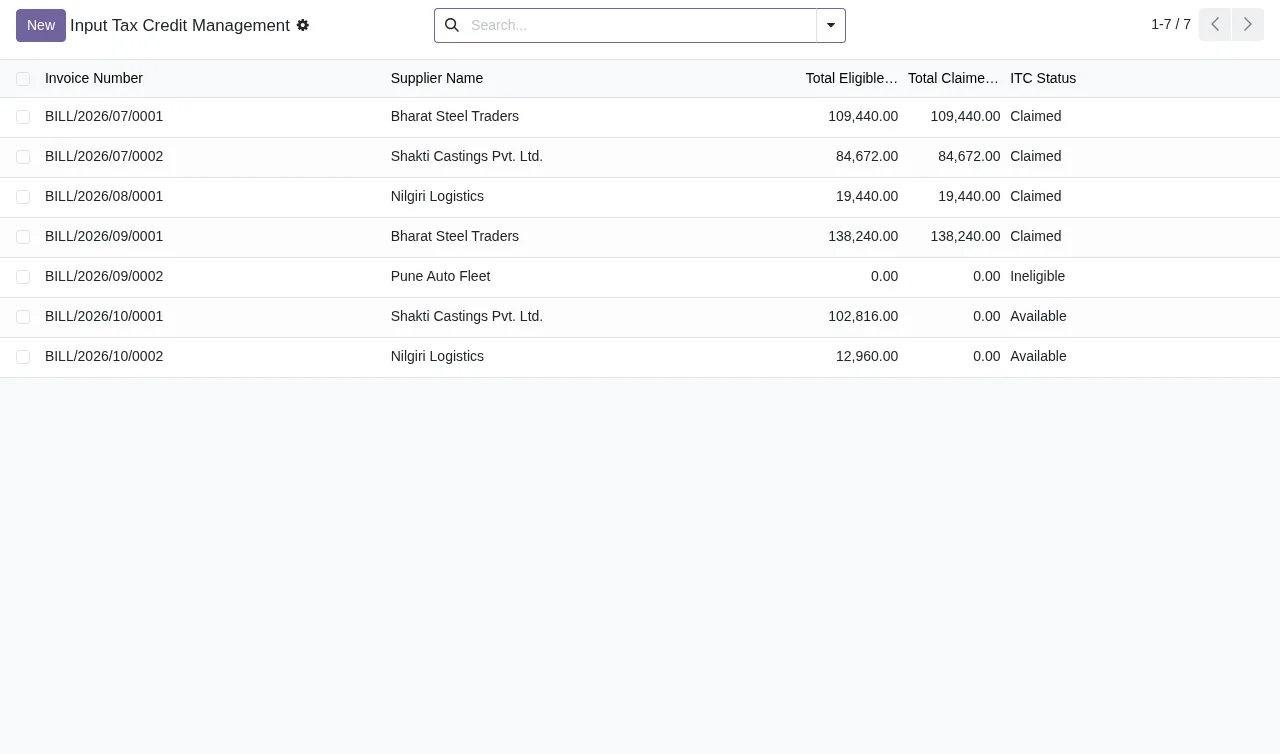
- keeps input tax credit records per bill, marked eligible, ineligible or rejected, with the business-use share;
- keeps compliance alerts, audit support records and staff training;
- shows a dashboard that counts invoices still waiting for an e-invoice record, and those more than 30 days old.
It does not connect to the e-invoice portal or to the GST portal. Its e-invoice button says so: "Not submitted: this module does not connect to the e-invoice portal (IRP) of the GSTN, so no IRN is requested." You file each return on the GST portal yourself and then mark it as submitted in Odoo. Its error messages, one by one, and the setup steps are in two separate guides.
The licence is €9 once per Odoo version on Odoo Apps, for Odoo.sh or your own server, not Odoo Online. It works with a FlexigoTech Cloud subscription: Standard at €29 a month or €290 a year, or Pro at €58 a month or €580 a year, VAT excluded, with a 14-day trial and no card required. The cloud watches the official sources of the module every day and alerts you when they change.
Frequently asked questions
Do I need an IRN if my turnover is below ₹5 crore this year?
Yes, if it was above ₹5 crore in any financial year since 2017-18. The test looks at every preceding year, not only the last one.
Do B2C invoices need an IRN?
No. The notification covers supplies to registered persons and exports; from 1 January 2027 it also covers reverse charge purchases from unregistered persons and imports of services.
Does India GST for Odoo generate the IRN?
No. The IRN comes from Odoo's own Indian - E-invoicing app or from the e-invoice portal. Our module prepares the returns and keeps the input tax credit, alerts and audit records.
Legal basis and date checked
We checked every threshold, date and penalty on 24 November 2026 in official documents: the Central Tax notifications on e-invoicing from 13/2020 to 04/2026 published by the GST Council and CBIC, the CGST (Amendment) Rules, 2026, Notification 83/2020 and 15/2025, the current text of rules 48, 54, 61 and 80 of the CGST Rules and sections 122 and 125 of the CGST Act on CBIC's tax information portal. All sources are listed below.
Keep reading
Checked against the linked sources
Sources
- taxinformation.cbic.gov.in/content-page/explore-rules
- www.gstcouncil.gov.in/sites/default/files/2024-05/10ct_eng.pdf
- www.gstcouncil.gov.in/cgst-tax-notification
- www.gstcouncil.gov.in/sites/default/files/2024-05/notfctn-23-central-tax-english-2021.pdf
- taxinformation.cbic.gov.in/content-page/explore-notification
- www.gstcouncil.gov.in/sites/default/files/2024-05/notfctn-83-central-tax-english-2020.pdf
- taxinformation.cbic.gov.in/content-page/explore-act
- github.com/odoo/odoo/tree/20.0/addons/l10n_in_edi
- apps.odoo.com/apps/modules/20.0/flexigo_india_gst_compliance_suite