
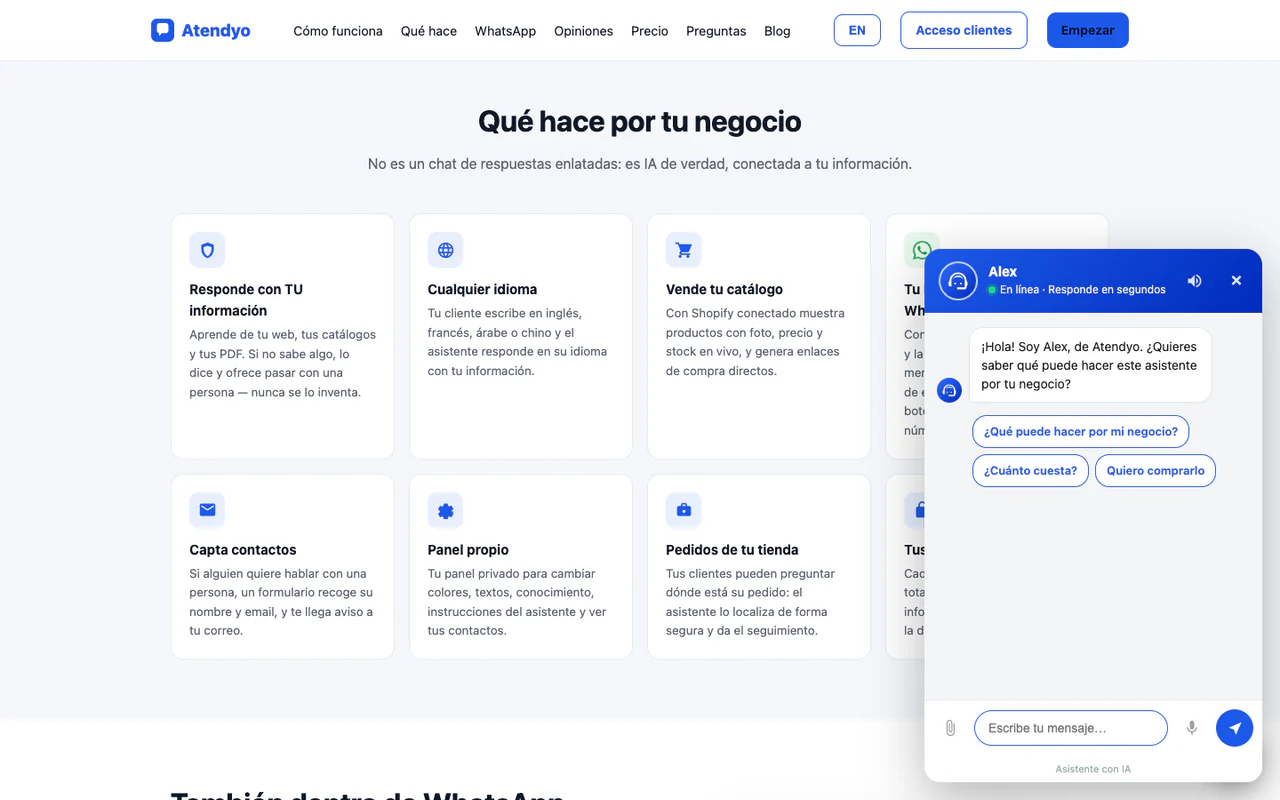
Atendyo is a customer support chatbot that serves on the website and on WhatsApp with the same information behind it. We built it ourselves, it is up and running and it has its own site at atendyo.com, where you can try it exactly as a visitor sees it. This article is not a brochure: it explains which problem it solves for a shop, within which limits, and what needs to be ready before switching it on.
Key idea: the value of a shop chatbot is not in “talking”; it is in three very concrete things: answering what repeats with your information and not the internet's, saying where an order is without anyone looking it up, and handing the conversation to a person at the right moment. Everything else is decoration.
The problem: the same question twenty times a day
Anyone running an online shop knows it without being told: most of the messages that come in are always the same. Opening hours, delivery times, shipping costs, how to return, whether the order has already left, which size or model fits. None of those questions is hard. What makes them expensive is the volume and the timing: they arrive while you are packing orders, through three different channels, and each one interrupts. And the person asking at ten at night who gets no answer until nine in the morning has sometimes already bought elsewhere.
What Atendyo does, in five points
- Answers the questions that repeat with your information. You give it your shipping terms, returns, opening hours, sizes and whatever else you want it to know. It answers from that. It does not invent policies or quote a competitor's.
- Searches your catalogue for products and links the right product page, instead of describing from memory a product that may no longer exist.
- Checks an order's status when the customer asks, using the order number or email, and returns whatever your system says: prepared, shipped, with its tracking.
- Hands the conversation to a person as soon as it stops being a simple question: a complaint, an order that does not show up, someone angry. It does not insist, it does not go round in circles, it alerts the right person with the history in front of them.
- Keeps a written record of what was asked. After a month you have the list of what people cannot find on your site. It is the best content audit you can ask for, and it comes free.
Where it works: website and WhatsApp, one set of information
The same chatbot serves both channels. There are not two configurations to maintain: if you change a shipping condition, it changes on the website and on WhatsApp at the same time. On the website it installs as a widget that appears bottom-right, with a greeting and quick replies you decide. On WhatsApp it answers on the company number, and when it hands the conversation to a person, that person continues in the same thread.

What Atendyo must never answer
We put this part up front because it is where most of the chatbots we have seen in shops fail. An assistant that answers everything is an assistant that makes things up. Atendyo has limits set on purpose:
- It does not promise delivery times that are not in your information. If you have not given it the lead time for the Canary Islands, it says it does not know and hands over. A made-up “arrives tomorrow” is a guaranteed complaint.
- It does not decide on returns or refunds. It explains the procedure; a person makes the decision.
- It does not give order data to anyone who cannot identify it. Without the order number and the associated email, there is no status.
- It does not advise on health, legal matters or anything outside your shop. If the conversation drifts elsewhere, it steers it back or closes it.
How it goes live: your information first
The order matters, and it is the opposite of what is usually imagined. First your information is collected: shipping and return terms, real frequently asked questions (the ones you already answer by email), the catalogue and, where available, access to order status. Then the greeting, the quick replies and the handover rules are configured. Only then is it switched on, first on the website and then on WhatsApp. During the first weeks the conversations are reviewed to see what it is missing, and the information is completed. A chatbot is not “trained”: it is given the information it lacks.
With Odoo behind it, or without
Atendyo does not need Odoo. It works with a shop on Shopify, on WooCommerce or custom-built, as long as it can read the catalogue and, if desired, order status. That said, when the shop runs Odoo behind it, the order part is where it shows most: the status it returns is that of the real delivery order, with the tracking left by the carrier connector, and the handover to a person can open a ticket directly in Odoo Helpdesk. It is the same criterion we follow in everything we do: whatever already lives in the ERP is not duplicated.
What to expect, said plainly
We do not promise percentages of resolved tickets because they depend on your shop and on how complete your information is. What can be said: opening-hours, shipping, returns and “where is my order” questions are the majority in almost any shop, and those are exactly the ones Atendyo answers on its own. Whatever remains reaches a person with the context already gathered. And the list of what people asked tells you what your website is missing. If you want to see it before deciding, it is open at atendyo.com; there is no staged conversation there.
Frequently asked questions
Does Atendyo replace the person doing support?
No. It takes the repeated questions off their hands and passes on the ones that need judgement, with the history in front of them. The person is still the one deciding on returns, complaints and anything not written in the shop's information.
What do you need to have to start?
Your shipping and return terms in writing, the questions you already answer daily, access to the catalogue and, if you want order lookups, access to the system where they live. With that it gets configured; without it, any chatbot answers from memory, which is exactly what must be avoided.
Does it work without Odoo?
Yes. It needs to read your catalogue and, optionally, order status; that can come from Shopify, WooCommerce, a custom shop or Odoo. With Odoo, order lookups and the handover integrate with the delivery order and the ERP's own Helpdesk.
Useful links inside FlexigoTech
Tired of answering the same thing twenty times a day?
Tell us what you sell and where people write to you. We will tell you what Atendyo would answer on its own, what would go to a person and which information you still need in writing. Email comercial@flexigobe.com or call +34 616 809 504.