
Choosing an e-signature provider for Odoo comes down to three questions, not a brand: which eIDAS level the document requires, how many documents you sign per year, and which country the signer is in. If the answer is “simple, few, and country does not matter”, Odoo Sign is enough. If you need a qualified signature, a country-specific identification method, or a volume that makes paying per signature pay off, one of the three providers we have built a connector for comes in: e-Signature.eu, Scrive or Signaturit. What eIDAS is lives in eIDAS e-signature in Odoo.
Where this comes from: three connectors of ours for Odoo 19, 18 and 17, tested on real Odoo.sh builds. e-Signature.eu: published and in production, 121 tests across nine round files, one per review with the provider. Signaturit: seven modules, 270 tests on the 19 branch, 262 on 18 and 266 on 17. Scrive: 242 tests in the main module, verified against the real API; App Store listing pending.
Native Odoo Sign: what level it gives and where it is enough
Odoo's official documentation says it plainly: of the three types eIDAS distinguishes, “Odoo generates the first type, simple electronic signatures”. Sign is an Enterprise module, absent from the Community addons, and does its job well: the signer draws a signature or accepts with a click and the document lands in the chatter with a certificate of completion (hash per signer, timestamp and IP). As extra identification it offers an SMS code, itsme® (EU, United Kingdom, Iceland and Norway) and Aadhaar in India; all three spend in-app-purchase credits and, with none left, the authentication is skipped.
It is enough for what is signed between parties who will not dispute authorship: acknowledgements of receipt, internal authorisations, annexes, acceptances from regular customers. It is not enough when someone demands an advanced or qualified signature in writing, when the signer needs a national identity scheme Sign does not carry, or when the group's parent already chose the provider.
The four, side by side
“Strong countries” is where the identification method is the one people already have installed. No price figures: each provider sets its own.
| Criterion | Odoo Sign | e-Signature.eu | Scrive | Signaturit |
|---|---|---|---|---|
| eIDAS level | SES, per Odoo's documentation. | SES, AES or QES per request; the connector refuses to save a method below the minimum level. | From simple to QES, depending on the signing method. | Three signature types (simple, advanced with biometrics, “smart”) plus a qualified-certificate signer. |
| Identification | Email, SMS code, itsme®, Aadhaar. | OTP by email or SMS (SES), Veriff with document verification (AES), itsme® or Evrotrust (QES). | 20 methods: BankID, MitID, FTN, iDIN, Freja, Onfido, Smart-ID, itsme®, Verimi and Scrive's own QES. None Spanish. | Per recipient: SMS code, photo, photographed ID document, required uploads. |
| Strong countries | Anywhere; itsme® in the EU, UK, Iceland and Norway. | France: the Guichet unique has required QES since 2023. In the module's catalogue: itsme® ~32 European countries, Evrotrust 60+, Veriff and OTP worldwide. | Sweden, Norway, Denmark, Finland, the Netherlands, Belgium, the Baltics, Germany. Subsidiaries of Nordic groups. | Spain: a Barcelona-based provider. |
| Payment model | Included in Enterprise; all three identifications use IAP credits. | Pay per signature: prepaid credit, 0.4 SES / 0.7 AES / 1 QES in the module's catalogue. | Annual subscription in transaction packages; each company signs its own contract with Scrive. | Subscription plans; confirm with the provider that yours includes API access. |
| Evidence that comes back | Signed document and certificate of completion in the chatter. | Signed PDF, provider audit trail, own evidence report with the level reached, and a validation button for the European Commission's DSS tool. | Sealed PDF (re-sealed 15-30 days later) and an evidence ZIP on demand. | Signed PDF and audit trail; if it does not exist yet, the connector requests it and fetches it later. |
By type of document
- Quote and sales order. The most-signed document and the one needing the lowest level: Odoo Sign or any provider's simple level. Sending it out has an operational reason, not a legal one: the “signed” state reaching the order by itself.
- Contract with an external counterparty. Verified identity (AES) and, if litigation is realistic or the counterparty demands it, QES. The expensive mistake is defaulting to QES and having the counterparty take days to enrol in a digital identity they did not have.
- Employment contract and HR. Born in HR (hr.version in Odoo 19, hr.contract in 18 and 17); all three connectors have an HR bridge and the simple or advanced level is usually enough. What matters is that the signed contract and its evidence return to the employee's file.
- Regulated sectors and public filings. When the rule says “qualified” there is no level to choose: it is QES or the filing is rejected, as in the French Guichet unique for company amendments and closures. What you choose is the method: with e-Signature.eu, itsme® or Evrotrust; in Scrive, the QES variants of Norwegian BankID, Smart-ID, Verimi or its own.
The flow inside Odoo changes with the provider
All three connectors start at a button on the Odoo record and end with the signed PDF attached to that record; the middle changes, because each API reports state its own way and none of the three signs its change notice: all three treat it as a doorbell and ask the API again before touching anything. e-Signature.eu handles six states on the request (draft, sent, signed, stopped, cancelled, error) and seven on the source document, counting “not sent”; it deduplicates the notice by the body hash and has an hourly rescue cron. On completion the signed PDF, the provider audit trail and an own evidence report remain. Step by step in eIDAS signing in Odoo with e-Signature.eu.

Scrive distinguishes ten states (draft, preparation, awaiting start, pending, signed, cancelled, timed out, rejected, error and saved as template); changes arrive by callback, authenticated with a per-account token in the URL, and by an hourly cron. Its quirk: the PDF is sealed twice and the connector refreshes the same attachment so as not to leave two contracts on one order. It is in Scrive and Odoo (Spanish) and, with the endpoints, in its English technical version.
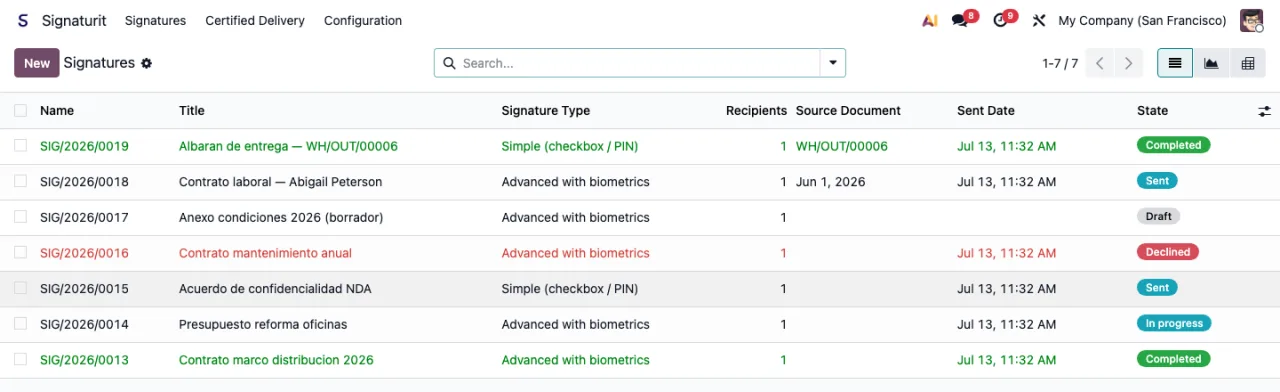
Signaturit does not sign its events either: the connector authenticates them with a per-account token in the URL and, if enabled, by checking the source IP; then it deduplicates and asks the API again. The request goes through eight states and the source document shows seven; declined, expired and error schedule an activity for whoever created the request. The detail is in Signaturit in Odoo.

Changing provider without changing Odoo
Providers get changed: the contract expires, a QES requirement appears that the current one does not cover. What should not change is what Odoo knows about each document. Four things must stay stable so that switching is a new module rather than a migration:
- The link between the request and the source record: model and identifier.
- A state field on the source with a common vocabulary: not sent, pending, signed, declined, expired, cancelled, error.
- The signed PDF and its evidence as attachments of the source record, named after the document and not the provider's identifier.
- A chatter note for every state change.
With that, what was signed before stays searchable and the automations never notice the change. Requests in flight are not migrated: they are finished with the old provider or re-sent with the new one. It is the criterion behind any Odoo connector for a partner's software.
Decision checklist
- Who could demand a specific level in writing for each document? If nobody, it is SES and Odoo Sign will do.
- Look at the signers' country, not yours: the method they already have installed decides more than the logo.
- Divide the annual fee by the per-signature price: that is the point where each model pays off.
- Check that the plan includes API access. Without a token there is no connector.
- Require that the signed PDF and the evidence return to the source Odoo record.
- Ask what happens when the webhook never arrives. Without a scheduled job that asks again, there is no integration.
- If the group already chose the provider, integrate what is there and leave internal documents to Odoo Sign. All three are on technology and Odoo partners and under solutions.
Frequently asked questions
Is Odoo Sign enough for signing contracts?
Between parties who will not dispute authorship, yes: it produces a simple signature valid in the EU, with a certificate of completion. It is not when someone demands an advanced or qualified signature in writing: per Odoo's documentation, Sign generates the first of the three eIDAS types.
Which is the best e-signature for Odoo?
There is no best in the abstract. Pay-per-signature and EU signers: e-Signature.eu. A Nordic group or signers with BankID, MitID or Smart-ID: Scrive. A Spanish, subscription-based provider: Signaturit. Everything internal and low-risk: Odoo Sign. All three connectors run on Community and Enterprise without depending on the Sign app.
Can a Spanish signer get a qualified signature with these providers?
It depends on the method, not the provider. With e-Signature.eu, Evrotrust covers more countries than itsme® in the module's catalogue. Scrive has no Spanish method. Signaturit offers a qualified-certificate signer. Always confirm the method with the provider before promising a QES.
Useful links inside FlexigoTech
What we do about this
Not sure which signature provider fits your Odoo?
Tell us which documents you sign, which record they come from and which country the signer is in. We will tell you which eIDAS level each one needs, whether Odoo Sign is enough and, if not, which provider and which connector. Email comercial@flexigobe.com or call +34 616 809 504.