Pay data scattered everywhere
Salaries, allowances and non-salary benefits live across payroll, contracts and spreadsheets. Pulling them together and breaking them down by sex and job category by hand every cycle is slow and easy to get wrong.

EU Directive 2023/970 now asks every employer to measure, report and act on its gender pay gap. Rebuilding those numbers in spreadsheets each cycle is slow and hard to defend. This Odoo module computes 10 pay gap metrics, generates the pay register, handles workers' information requests and structures the pay audit, natively and on the HR data you already keep in Odoo.

The very screens you get in Odoo, the real thing.
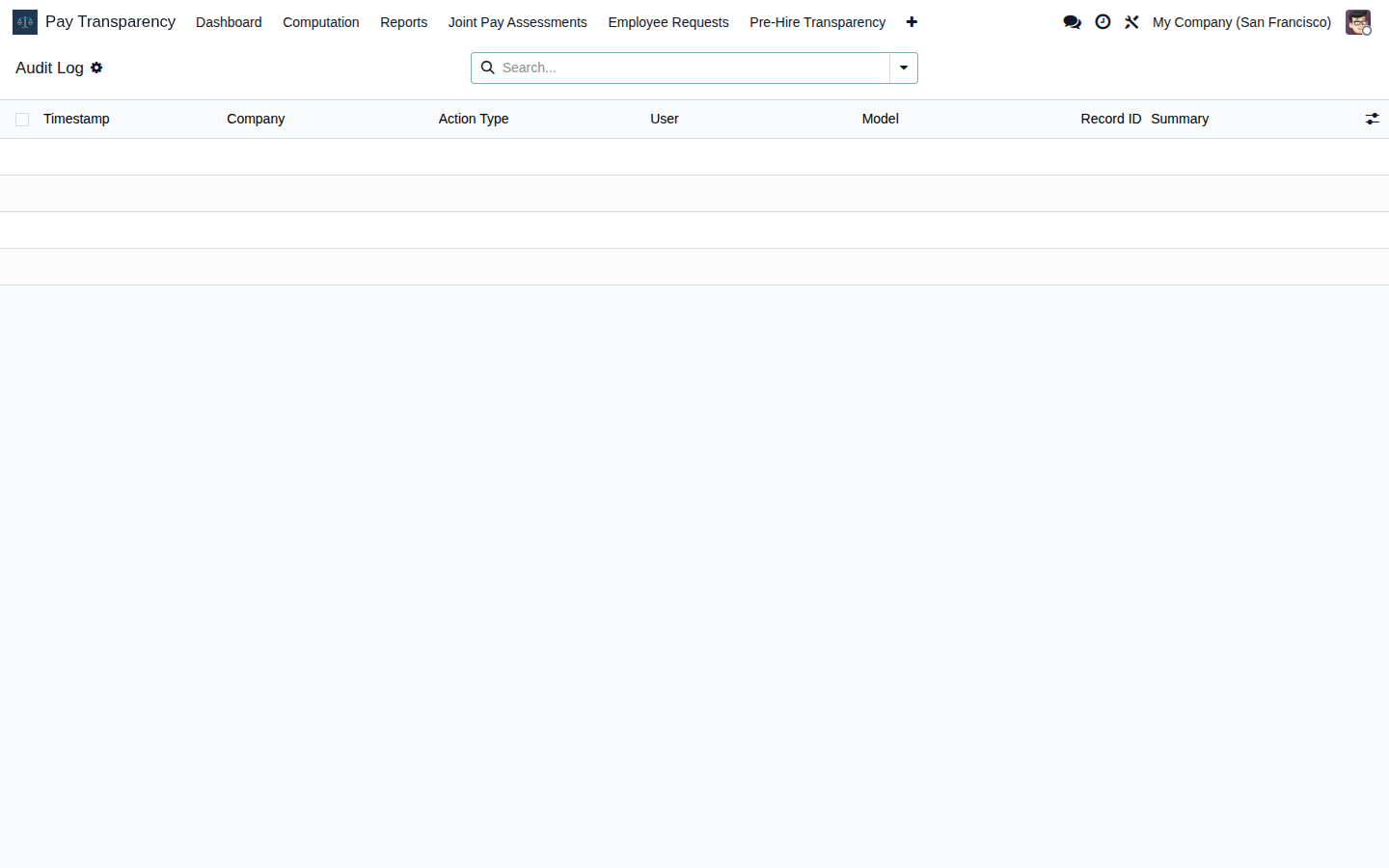
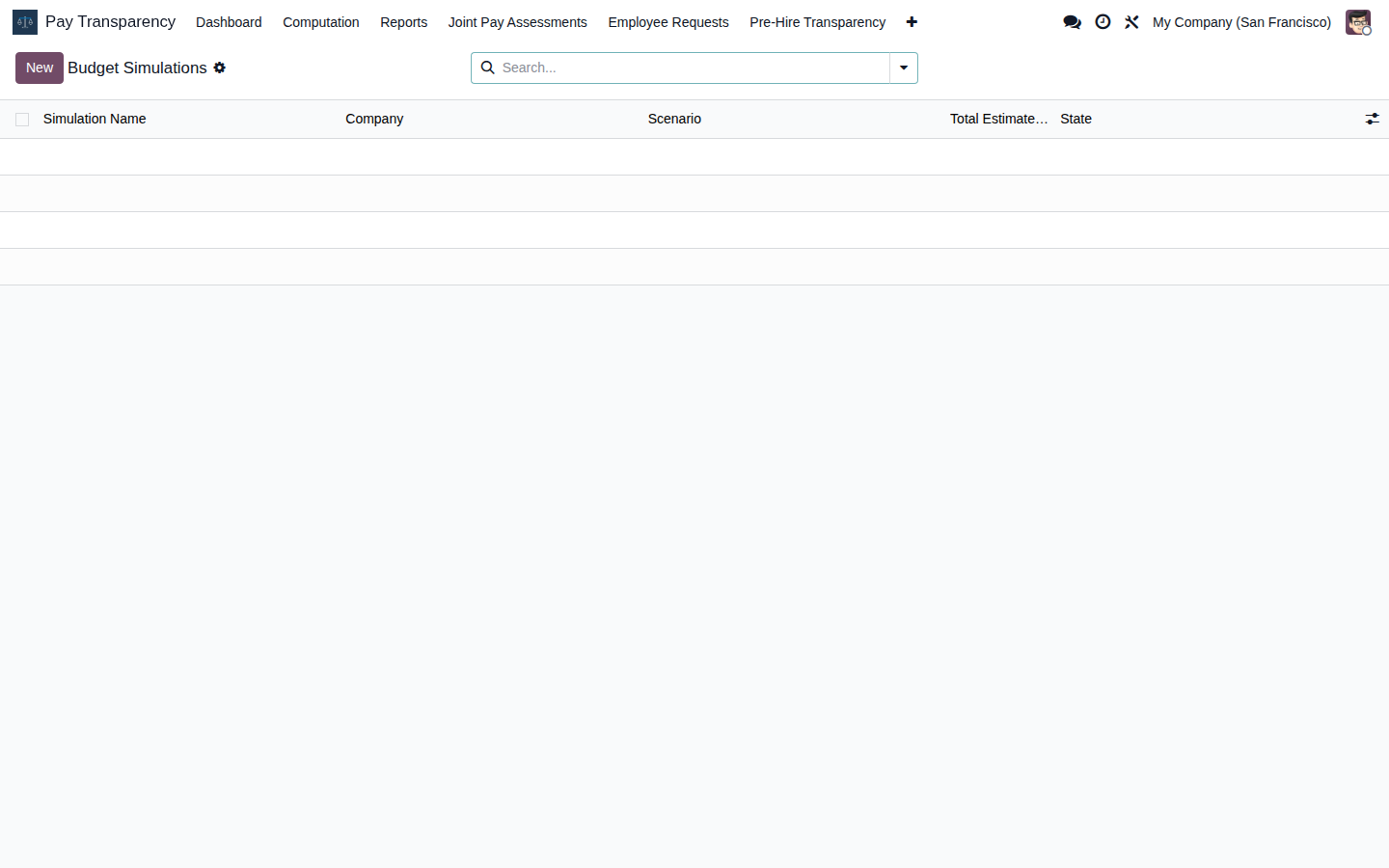
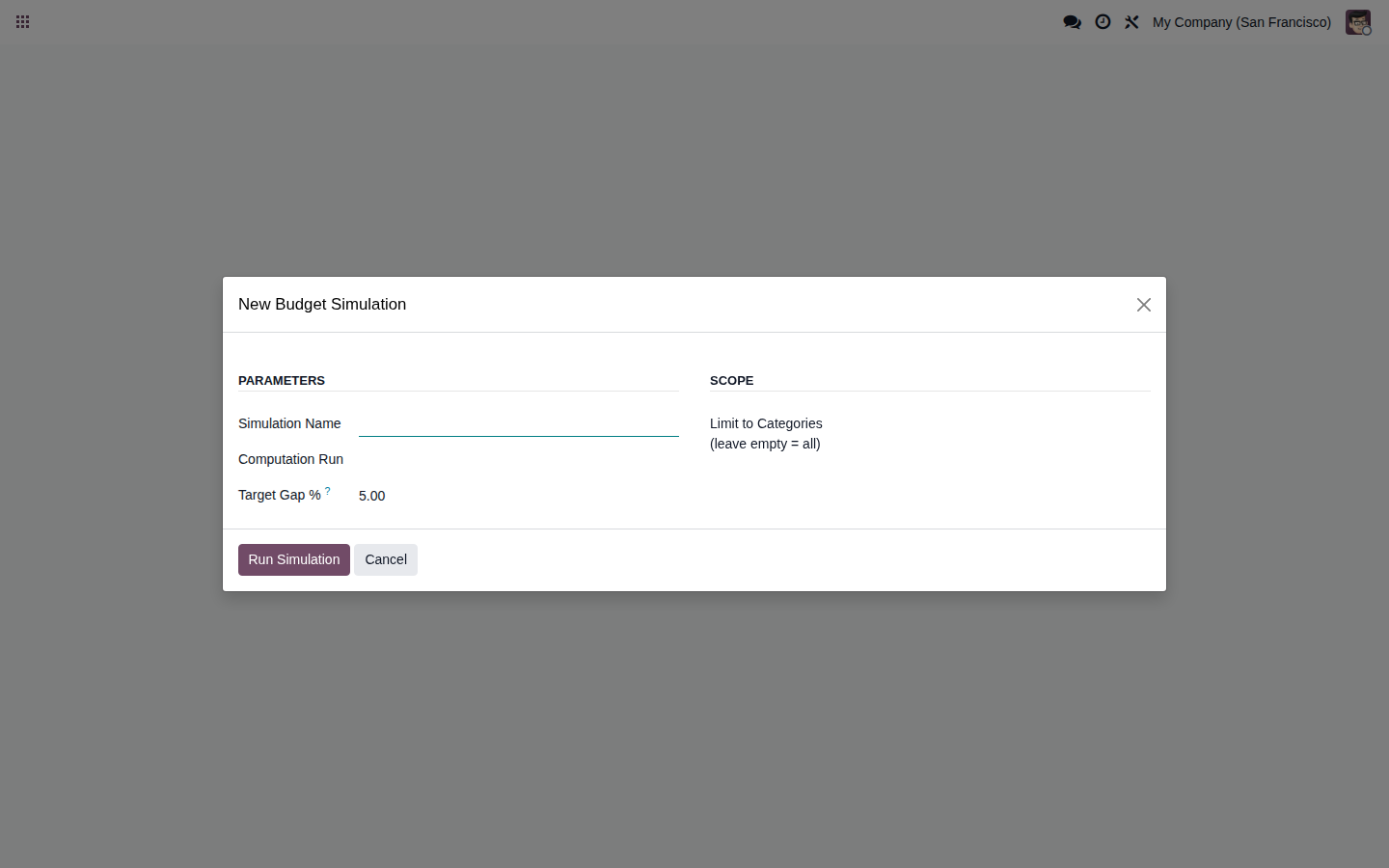
Try the pay transparency module inside a real Odoo 19, no sign-up. User demo / flexigodemo.
EU Directive 2023/970 turns pay transparency from a one-off exercise into a recurring, documented control of the gender pay gap. Every cycle you have to measure the gap, explain it and be ready to prove your numbers, and spreadsheets do not hold up well when someone asks how a figure was reached.
Salaries, allowances and non-salary benefits live across payroll, contracts and spreadsheets. Pulling them together and breaking them down by sex and job category by hand every cycle is slow and easy to get wrong.
The Directive asks for concrete gender pay gap indicators, not a rough estimate. Without a reproducible, auditable calculation it is hard to stand behind the numbers in front of an inspection or your worker representatives.
Outsourcing the report every cycle or paying for a separate pay-equity SaaS is a fixed cost that adds little and, on top of that, pushes your HR data outside the ERP where it belongs.
It does not promise to make you compliant on its own. It does the concrete, useful part: compute the gap metrics, generate the pay register, handle information requests and structure the pay audit, all on the data you already keep in Odoo.
Computes 10 gender pay gap indicators from the pay recorded in Odoo, with both mean and median, so your report reflects the real situation of the workforce rather than a single headline number.
Generates the pay register with salaries, allowances and non-salary benefits broken down by sex and by job category, drawn directly from Odoo's employee and payroll data, ready to review and export.
A guided workflow for the joint pay assessment: states, review steps and full traceability, so it is always documented who did what and when if a gap has to be justified with worker representatives.
The metrics and breakdowns follow the EU Pay Transparency Directive framework, so the register you produce today is the base you build on as national transposition adds concrete filing rules.
These are not promises: they are the real screens on the App Store listing and in the demo. Beyond the metrics, the pay register and the audit workflow, the module includes all of this.
A pay gap dashboard that gives you the big picture: metrics computed per reporting cycle so you can see the trend at a glance and spot where the gap is widening.
A remediation budget simulator that works out what it costs to close the gap before you sign off on salary increases, so pay-equity decisions are grounded in numbers.
Handling of the workers' right-to-information requests set out in Article 7 of Directive (EU) 2023/970, logged and tracked to resolution inside Odoo.
Employee data subject access requests (DSAR) managed in the same module and aligned with the GDPR, so information rights are handled in one place.
Pay secrecy notices to document that staff are not prevented from discussing their pay, which is exactly what the Directive bans employers from doing.
An equality plan area for employers required to keep one, connected to the pay register so the equality plan and the pay data stay in sync.
CSV import of pay data for companies running payroll outside Odoo: load the figures and compute every metric all the same, no Enterprise payroll app required.
An immutable audit log of every computation and change, built to defend the register under review, plus configurable report templates and worker categories.
No new platform and no data export: the module reads what is already in Odoo and turns it into a pay register you can stand behind.
Install the module on your own Odoo 17, 18 or 19, Community or Enterprise. It is a standard addon and ships with full source code, so there is nothing external to connect.
Point it at the employee and payroll data already in Odoo, or, if you run payroll elsewhere, load it once with the CSV import. Define your job categories and reporting cycle.
The module calculates the 10 pay gap metrics and builds the pay register broken down by sex and job category, with an immutable audit log recording every calculation.
Review the report, answer right-to-information and DSAR requests, and run the pay-audit workflow when a gap needs justifying, all documented and traceable in one place.
Buy it once on the Odoo App Store and it is yours: no subscription, no per-employee fee and no separate platform to keep paying for.
A single payment on the Odoo App Store. No recurring fee and no cost per employee: the same price whether you report on ten people or a thousand.
You get the complete source code under the OPL-1 licence, so you can read it, adapt it to your own job categories and keep it running on your infrastructure.
One purchase covers Odoo 17, 18 and 19, Community and Enterprise, so an ERP upgrade does not mean buying the module again.
Questions go straight to the developer who wrote the module, not a support queue, so you get a real answer about how the gap is computed.
FlexigoTech is Flexibles y Accesorios Gobe, S.L., based in Barcelona. The module is built by a single developer, so when you ask about the pay register or how the gap is calculated you speak directly with the person who wrote the code, not with a salesperson.
It is a native Odoo module, with no external platform and no SaaS fee. It computes the gap, generates the pay register, handles information requests and structures the pay-audit workflow. It does not file anything on your behalf with a labour authority or take on your responsibility as an employer: the register and its publication stay yours, and we tell you that before you buy, not after. National transposition of Directive (EU) 2023/970 is still under way across member states.
Pay transparency usually comes alongside other HR compliance and governance duties, all handled within the same Odoo.
The EU Pay Transparency Directive (2023/970) requires employers to measure and report their gender pay gap, give workers the right to request pay information, and act where an unjustified gap of 5% or more appears. Larger employers must report the gap periodically, and where it exceeds the threshold and cannot be justified, run a joint pay assessment with worker representatives. This module gives you the metrics, the register and the workflow to prepare that reporting from the HR data already in Odoo.
It computes 10 gender pay gap metrics with mean and median, generates the pay register broken down by sex and job category, handles workers' right-to-information and data-access requests, and structures the pay audit with a documented, traceable workflow. Everything runs natively on your employee and payroll data in Odoo. It is not a separate SaaS: it works on the data you already keep in your ERP and leaves the reports ready to review.
Yes. The module is built as a standard Odoo addon and installs on both Community and Enterprise editions of Odoo 17, 18 and 19. If you run payroll outside Odoo, the CSV import lets you load pay data and compute every metric all the same, so you do not need the Enterprise payroll app to use it.
Yes. There is a live demo: a real Odoo 19 with the module installed and no sign-up (user demo, password flexigodemo), where you can explore the pay-gap metrics, the pay register, the right-to-information requests and the audit workflow with sample data. When you are ready, you buy the licence once on the Odoo App Store, and we help you set it up if you need it.
It is a one-time payment of EUR 49 on the Odoo App Store. The price includes the full source code under the OPL-1 licence and works on Odoo 17, 18 and 19. There is no subscription, no per-employee fee and no separate platform: you own the module and run it inside your own Odoo.
No, and we say so up front. It does the concrete, useful part: it computes the gap, builds the pay register, manages information requests and keeps an immutable audit trail. It does not file anything on your behalf with a labour authority or take on your responsibility as an employer. National transposition of Directive (EU) 2023/970 is still in progress across member states, so final filing obligations depend on your country's law; the register the module produces is the base you build that reporting on.
The question is whether you rebuild the numbers by hand every cycle or solve it inside Odoo. Try the live demo and see how the pay register looks with real workforce data.