KSeF 2.0 · FA(3) · Odoo 17-19 · Poland

KSeF for Odoo 17-19: the e-invoicing readiness validator for Poland

KSeF 2.0 makes the structured FA(3) invoice mandatory in Poland, and a submission that fails on incomplete data or an expired certificate blocks your invoicing overnight. This module for Odoo 19, 18 and 17 does not replace the native l10n_pl_edi submission: it adds a control layer that validates FA(3) readiness, manages the lifecycle of certificates and offline24 mode, tracks authorizations, and gives you a compliance dashboard so you can operate under the mandate without surprises.

€49 · one-time license · source code included

FA(3) readinessValidates that your data and configuration meet the FA(3) schema before you submit.
Certificates & offline24Tracks the lifecycle of certificates and offline24 mode, with no surprise expirations.
On top of l10n_pl_ediIt builds on Poland's native module; it does not replace or duplicate it.
Native in Odoo 17-19Inside the ERP, with no separate SaaS and no extra tool to maintain.

KSeF 2.0 readiness validator and FA(3) compliance dashboard inside Odoo 19
Source code included Odoo 17 - 18 - 19 Direct support from the developer No middleware, no separate SaaS

Real module screenshots

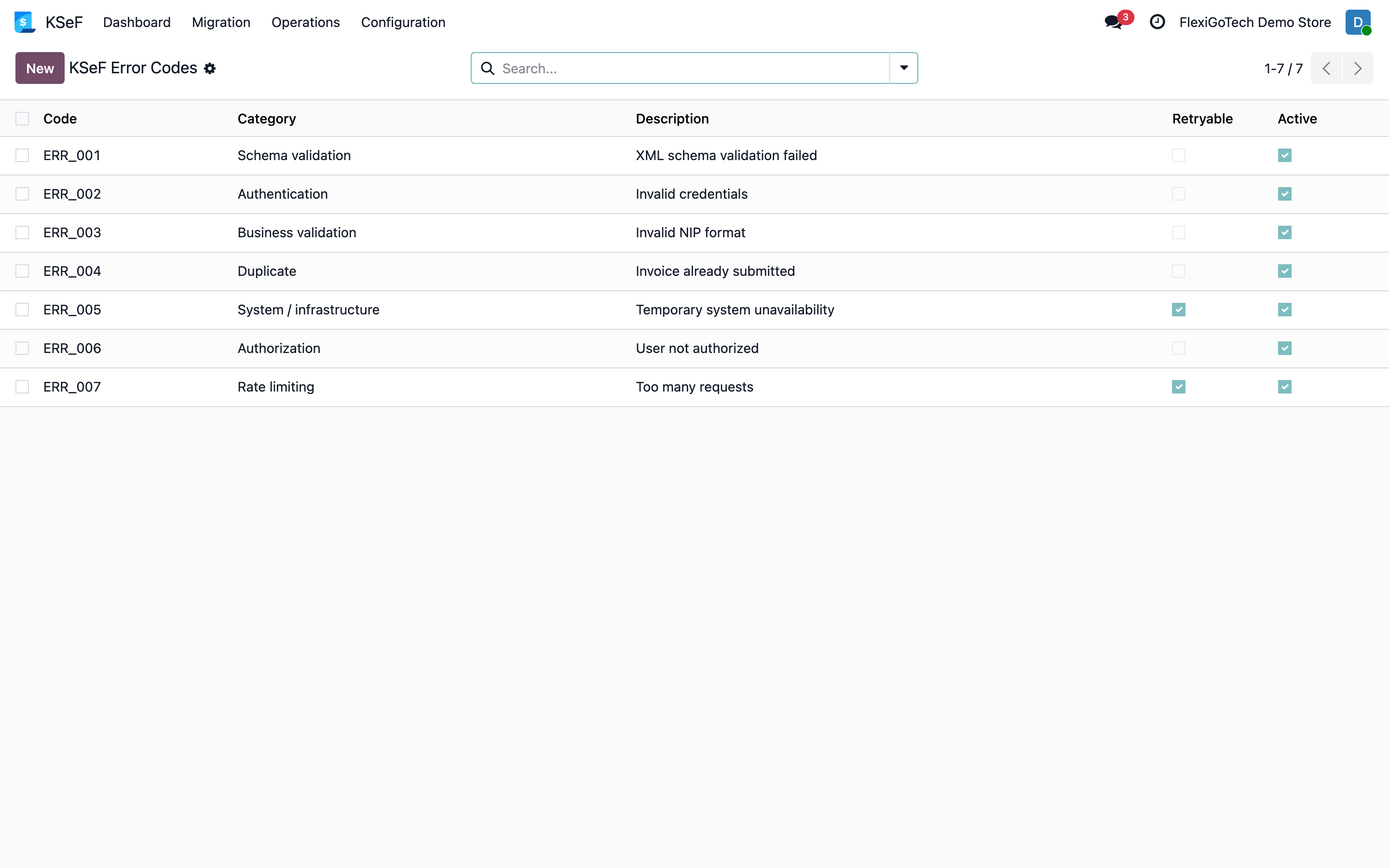
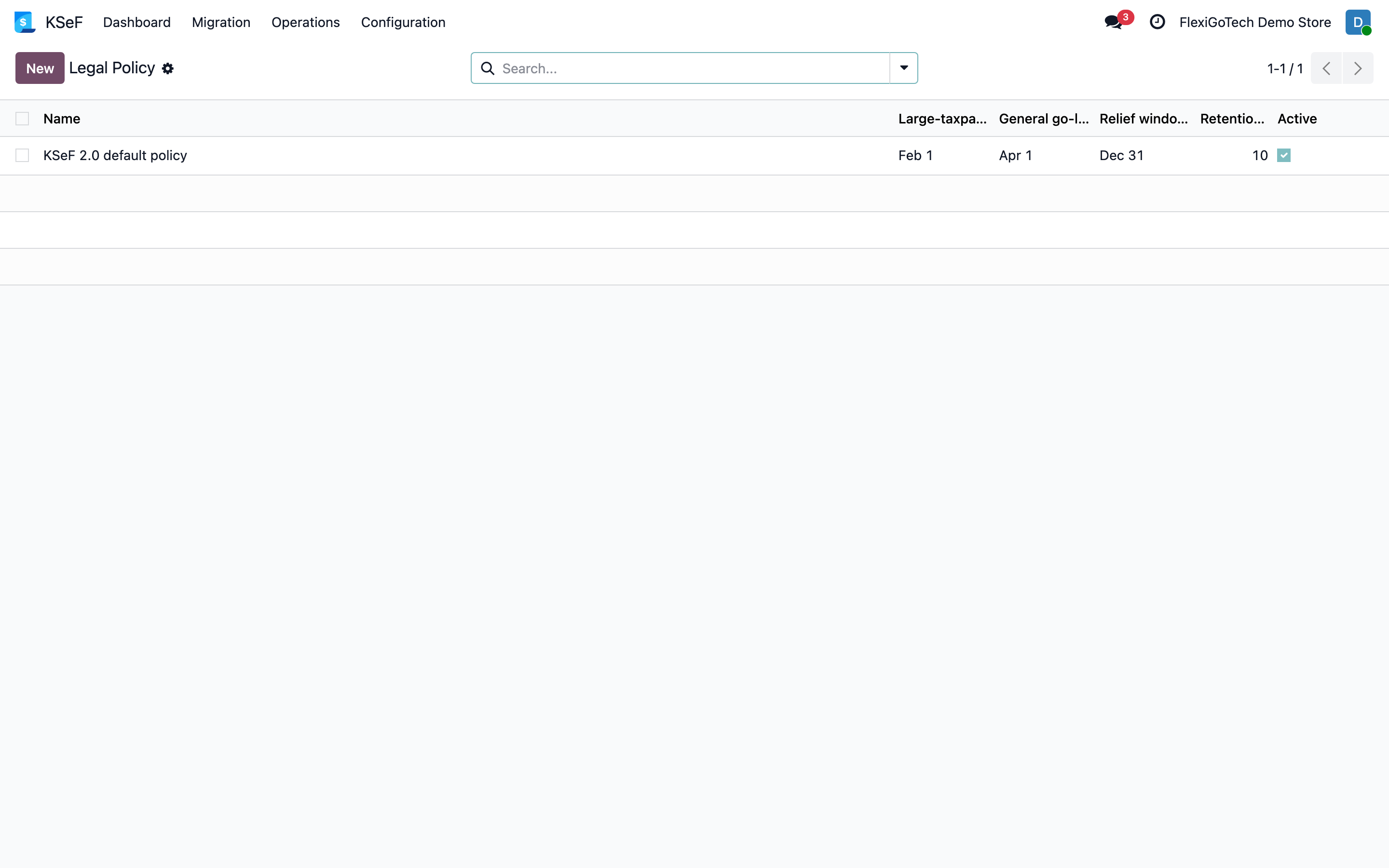
The very screens you get in Odoo.

KSeF for Odoo screenshot KSeF for Odoo screenshot

Try the KSeF 2.0 module inside a real Odoo 19, no sign-up. User demo / flexigodemo.

Try the live demo View on the App Store

The real problem of migrating to KSeF 2.0

Knowing that KSeF 2.0 is already mandatory is not the hard part. The hard part is operating under the mandate with the right customer data, valid certificates, authorizations in order and the FA(3) schema adding up. Every gap turns into rejected invoices.

Rejections from incomplete FA(3) data

The FA(3) schema is strict: NIP number, mandatory fields, exact format. If your invoices in Odoo do not meet the structured schema, KSeF rejects them one by one, and you find out in production, right when it is already mandatory.

Certificates and offline24 out of control

An expired certificate or an offline24 submission past its deadline blocks or invalidates invoices. Without lifecycle tracking it is easy to miss until the system rejects it.

Authorizations nobody reviews

Who is authorized to operate in KSeF on behalf of the company changes over time. Without a register inside the ERP, a missing authorization stops the submission and nobody knows why.

What the module does inside Odoo

It does not replace the KSeF submission, which the native l10n_pl_edi still handles. It does the concrete, useful part: validate FA(3) readiness, control certificates and offline24 mode, track authorizations and show you a compliance dashboard for the migration.

FA(3) readiness validator

Checks your invoice data and your Odoo configuration against the requirements of the FA(3) structured schema of KSeF 2.0, and flags what is missing before the system rejects it.

Certificate and offline24 lifecycle

Keeps control of the certificates tied to KSeF and of offline24 mode, with their status and validity, so no submission fails because of an expired certificate or a missed offline deadline.

Authorization tracking

Registers and tracks the authorizations to operate in KSeF, so you always know who is enabled and never discover a missing permission in the middle of a submission.

Compliance and migration dashboard

A dashboard on top of l10n_pl_edi that brings FA(3) readiness, certificates, offline24 and authorizations into a single view, so you can manage the migration to the KSeF 2.0 mandate with everything in sight.

Built on the native l10n_pl_edi

The module extends Poland's native e-invoicing localization instead of duplicating it, so your existing KSeF submission flow keeps working exactly as it does today, now with a readiness layer around it.

Runs on Odoo 17, 18 and 19

One purchase covers three Odoo series. It stays inside the ERP, with no external middleware, no separate SaaS platform and no extra tool to maintain alongside your accounting.

The person who builds the module is the one who answers you

FlexigoTech is Flexibles y Accesorios Gobe, S.L., based in Barcelona. Development is handled by a single developer, so when you ask something about KSeF 2.0, the FA(3) schema or offline24 mode, you talk directly to the person who wrote the code, not to a salesperson or a first-line support desk forwarding tickets.

17-19native Odoo
BCNlocal development
0separate SaaS

What it does and what it does not do

It is a native Odoo module — versions 19, 18 and 17 — built on l10n_pl_edi, with no external platform to maintain and no extra SaaS fee. It does not replace the KSeF submission and we do not invent reviews: the tool validates FA(3) readiness, controls certificates and offline24, tracks authorizations and builds the compliance dashboard. The official submission to KSeF and the tax liability remain yours, and we tell you that before you buy, not after.

Try the live demoAsk a question

If KSeF 2.0 brought you here, this will interest you too

Mandatory e-invoicing rarely comes alone: it shows up alongside the need to organize invoicing, tax compliance and multi-country operations inside a single Odoo.

Questions that usually come up with KSeF 2.0

What is KSeF for Odoo and who does it apply to in Poland?

KSeF (Krajowy System e-Faktur) is Poland's National e-Invoicing System. Under KSeF 2.0 the structured FA(3) invoice is already mandatory for most Polish VAT taxpayers: since 1 February 2026 for companies with over PLN 200 million in turnover, and since 1 April 2026 for everyone else; the smallest taxpayers join on 1 January 2027, when penalties also start and the 2026 transitional reliefs end. This module does not replace your KSeF submission: it validates that your invoice data and configuration in Odoo are ready for FA(3), and it keeps certificates, authorizations and offline24 mode under control.

Does the module send my invoices to KSeF for me?

No. The actual submission to KSeF is handled in Odoo by the native l10n_pl_edi module. This tool sits on top of l10n_pl_edi and adds a readiness layer: it validates FA(3) conformity, tracks the lifecycle of certificates and offline24 mode, and keeps a compliance dashboard so the real submission does not fail because of incomplete data or an expired certificate.

What is offline24 mode and why does it need to be tracked?

Offline24 mode lets you issue invoices when KSeF is unavailable, with the obligation to submit them to the system within the set deadline. The module tracks that lifecycle and the associated certificates, so no invoice issued offline is left unregistered in KSeF past its deadline.

Does it work with Odoo Community?

The module runs on Odoo 17, 18 and 19 and builds on the native l10n_pl_edi localization for Poland. l10n_pl_edi is the layer that actually submits to KSeF, so you need an Odoo edition where that Polish e-invoicing localization is available and active. If you are not sure whether your Community or Enterprise setup already has l10n_pl_edi enabled, tell us how you invoice in Poland and we will confirm the fit before you buy.

How much does it cost and are there recurring fees?

It is a €49 one-time purchase on the Odoo App Store, with the source code included and no recurring fees. That one license covers Odoo 17, 18 and 19, so you do not pay again when you move between series. There is no separate SaaS subscription and no middleware to license on the side.

Can I try it before buying?

Yes. There is a live demo, a real Odoo 19 with the module installed and no sign-up (user demo, password flexigodemo), where you can see the FA(3) readiness validator, the certificate and offline24 controls, the authorization tracking and the compliance dashboard. Once you are sure, you buy the license on the Odoo App Store; and if you need it, we help you configure it and get the migration on track.

If you invoice in Poland, KSeF 2.0 and FA(3) are already mandatory for most taxpayers.

The question is no longer whether the date arrives, but whether you operate with your data, certificates and authorizations in order, or discover it through rejected invoices. And milestones remain: the smallest taxpayers join in 2027, the 2026 transitional reliefs end and penalties begin. Tell us how you invoice and we will tell you straight if the module fits you.

Try the live demoView on the App Store · +34 639 913 105