Data scattered all over the place
The imported quantities live in your purchases, the country of origin somewhere else and the embedded emissions in supplier emails. Gathering it by hand for every declaration is slow and error-prone.

The CBAM transitional period and its quarterly report ended on 31 December 2025. Since 1 January 2026 the definitive regime applies: authorised declarant status, CBAM certificates and an annual declaration of the emissions embedded in your imports. Piecing all of that together by hand is a headache. This module tracks your affected imports inside Odoo, calculates the embedded emissions, keeps the ledger and quarterly check of the certificates you hold, and leaves the annual declaration data ready for you to review and file.
The very screens you get inside Odoo.
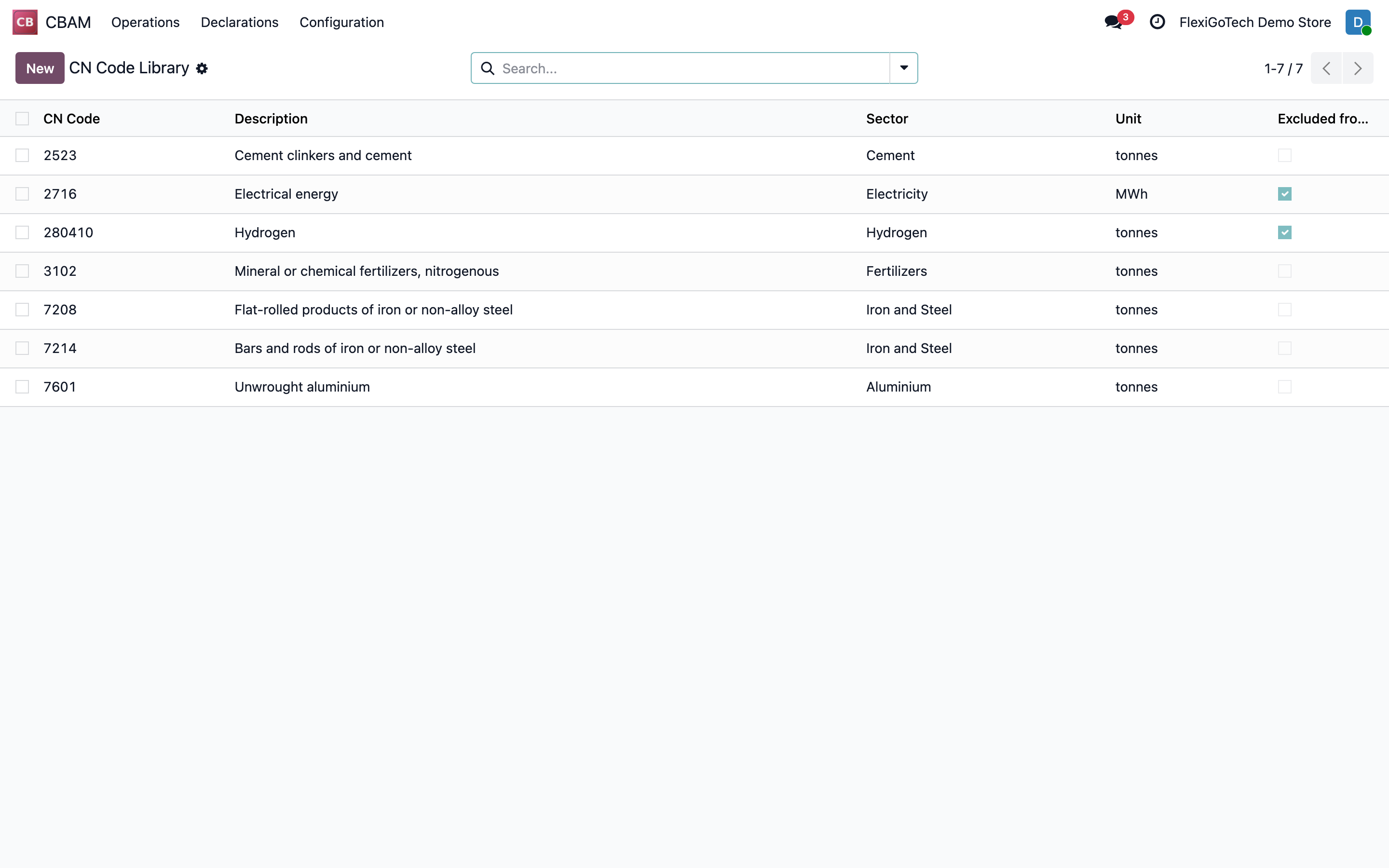
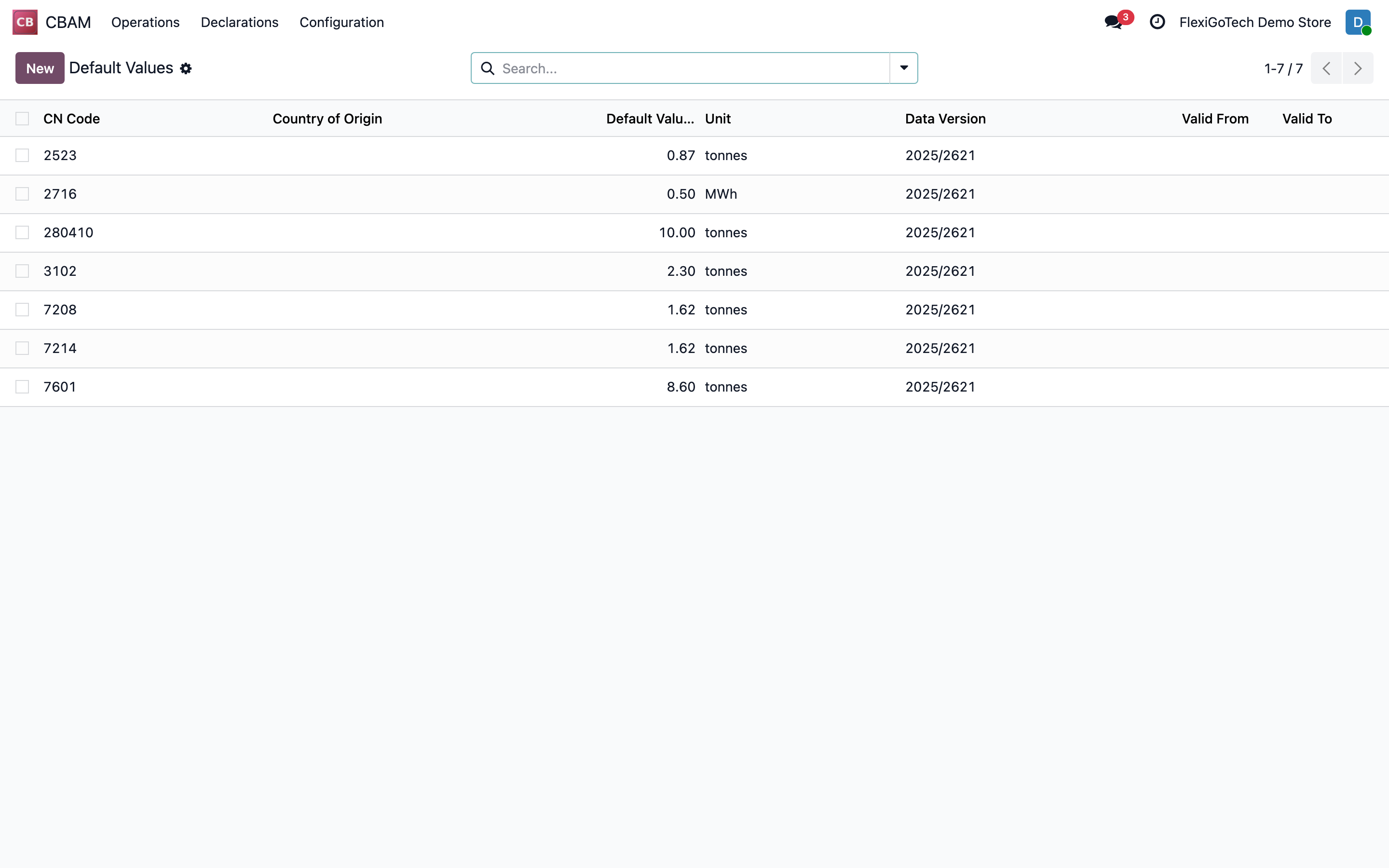
Try the CBAM module inside a real Odoo 19, no sign-up. User demo / flexigodemo.
The definitive regime doesn't care about size: if you import affected goods you need declarant authorisation, certificates and an annual declaration just like a large group. But an SME has no dedicated compliance department to keep all of that up to date.
The imported quantities live in your purchases, the country of origin somewhere else and the embedded emissions in supplier emails. Gathering it by hand for every declaration is slow and error-prone.
The annual declaration has its date, and at the end of each quarter you have to check that the certificates you hold cover the year to date. Without a process inside the system, someone remembers too late.
Outsourcing the tracking of imports, certificates and the declaration is a fixed cost that adds no value to the business. For many SMEs it is wildly out of proportion to what they actually import.
It doesn't promise to comply for you or file with the CBAM Registry on your behalf. It does the concrete, useful part: tracking your imports, calculating the emissions, managing the certificates you hold and getting the annual declaration data ready.
Identifies and gathers in Odoo the purchase lines of goods subject to CBAM (iron and steel, aluminium, cement, fertilisers, electricity and hydrogen), with their quantities and origin, backed by a CN code library.
Records and links the emissions declared for each imported product and calculates the embedded emissions for the period, so your declaration matches what your supplier reports.
Keeps the CBAM certificate ledger (purchases and surrenders) along with certificate prices, and checks at the end of each quarter that your holdings cover the year's accumulated emissions, flagging any shortfall.
Manages the annual declaration periods with their draft and export, and records the status of your CBAM declarant authorisation together with its deadlines.
Ships with a library of the Combined Nomenclature codes covered by CBAM, so you can tag which of your products are affected without hunting through the regulation's annexes yourself.
Everything runs inside your own Odoo (17, 18 or 19), with no separate SaaS to log into and no extra subscription. The full source code is included, so your team or ours can adapt it to how you work.
FlexigoTech is Flexibles y Accesorios Gobe, S.L., based in Barcelona. Development is handled by a single developer, so when you ask about CBAM, certificates or the annual declaration you talk directly to the person who wrote the code, not a salesperson or a first-line support desk forwarding tickets.
It's a native Odoo module, available for 17, 18 and 19, with no external platform to maintain and no extra SaaS fee. We don't invent reviews or customer stories: the tool tracks your imports, calculates the emissions, manages the certificates you hold and prepares the annual declaration. The official filing and the declarant's responsibility stay with you, and we tell you that before you buy, not after.
No per-seat licence, no monthly SaaS fee and no surprise renewals. You buy the module once on the Odoo App Store and it's yours.
One-time payment on the Odoo App Store · VAT may apply at checkout
CBAM rarely comes alone. It usually shows up alongside the need to organise purchasing, imports and compliance inside a single Odoo.
CBAM (the Carbon Border Adjustment Mechanism) is the EU regulation that puts a price on the carbon embedded in certain imports: iron and steel, aluminium, cement, fertilisers, electricity and hydrogen. The transitional period and its quarterly report ended on 31 December 2025. Since 1 January 2026 the definitive regime applies: authorised declarant status, an annual declaration and CBAM certificates. It affects importing SMEs too, not just large groups.
Not automatically. The module gathers the data of your affected imports inside Odoo, manages your certificates and prepares the structured annual declaration for you to review and submit to the CBAM Registry. The official filing and the legal responsibility stay with the authorised declarant.
Yes. It is a native Odoo module built to run on Odoo 17, 18 and 19, and it works on Community as well as Enterprise. It plugs into the Purchase data you already keep, with no separate SaaS platform to run alongside it.
They are two separate products. CBAM Quarterly Reporting is focused on the quarterly report of the transitional period. This module, EU CBAM Compliance Manager, covers the definitive regime in force since 2026: the annual declaration, the CBAM certificate ledger with its quarterly check, declarant authorisation and a CN code library.
Yes. It is built precisely for SMEs with a moderate volume of affected imports that don't want to build spreadsheets for the annual declaration or pay an external consultancy just to keep certificates and deadlines up to date.
It is a one-time payment of 49 EUR on the Odoo App Store, with the full source code included and no subscription. Before buying you can use the live demo: a real Odoo 19 with the CBAM module installed and no sign-up (user demo, password flexigodemo), where you can see the import tracking, the emissions calculation, the certificate ledger and the annual declaration periods. When you're ready, you buy the licence on the App Store, and we can help you set it up if you need it.
The only question is whether you piece it together by hand every year or leave it solved inside Odoo. Tell us what you import and we'll tell you straight whether the module fits.