
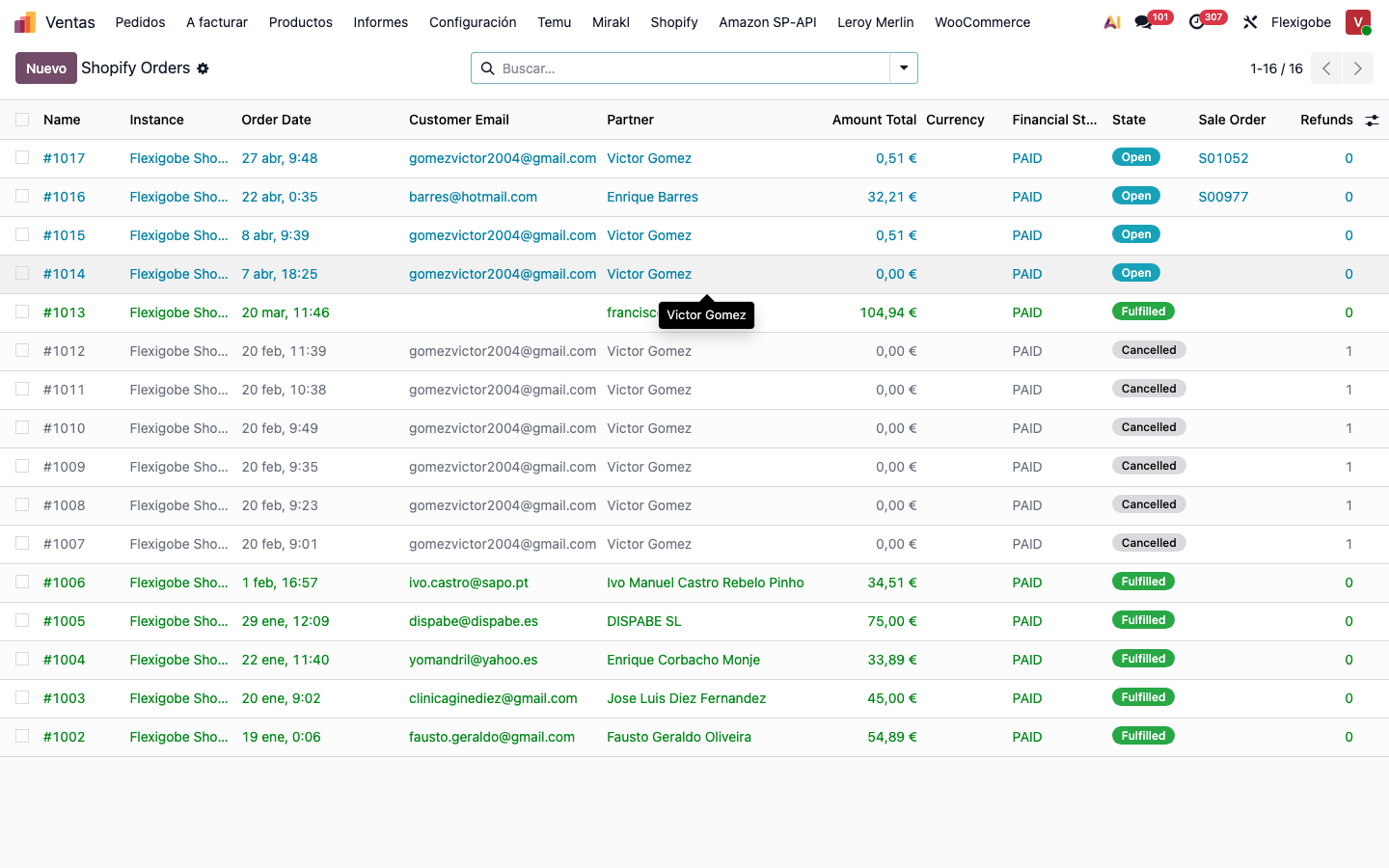
Shopify sells very well, but it shouldn't be the only place where a company controls stock, purchasing, fulfillment and billing. That's where Odoo comes in as the operating core.
Key idea: A profitable integration is not measured by just connecting an API. It is measured by reducing manual work, avoiding errors and leaving traceability within the operational flow.
Orders: from Shopify to Odoo
The order enters Shopify and it must create a sales order in Odoo with customer, lines, taxes and address.
Odoo then reserves stock and lets you prepare the shipment within the warehouse flow.
Stock by SKU and variant
The key isn't just syncing a total quantity. Variants, SKUs and locations need to be mapped correctly.
If Amazon, Temu or Leroy Merlin are in play alongside Shopify, Odoo must stop each channel from inventing its own stock numbers.
Fulfillment and tracking
When the delivery order is completed in Odoo, the status and tracking number must flow back to Shopify.
This cuts down customer queries and keeps the store up to date without manual work.
Typical errors
- Duplicate SKU across variants
- Repeated webhooks
- Canceled orders that keep reserving stock
- Tracking that never makes it back to Shopify
- Refunds handled outside of Odoo
Useful links within FlexigoTech
Frequently asked questions
Do we stop using Shopify?
No. Shopify remains the storefront and sales channel; Odoo controls internal operations.
Can variants be synchronized?
Yes, but you need to take care of bindings, SKUs and metadata.
What are webhooks?
Automatic notifications from Shopify to communicate changes such as new orders or status updates.
Should we start with products or orders?
Usually with orders, stock and tracking; catalog sequencing depends on the specific case.
Want us to review your case?
We'll look at your channels, stock, carriers and Odoo version to propose the cleanest path.