
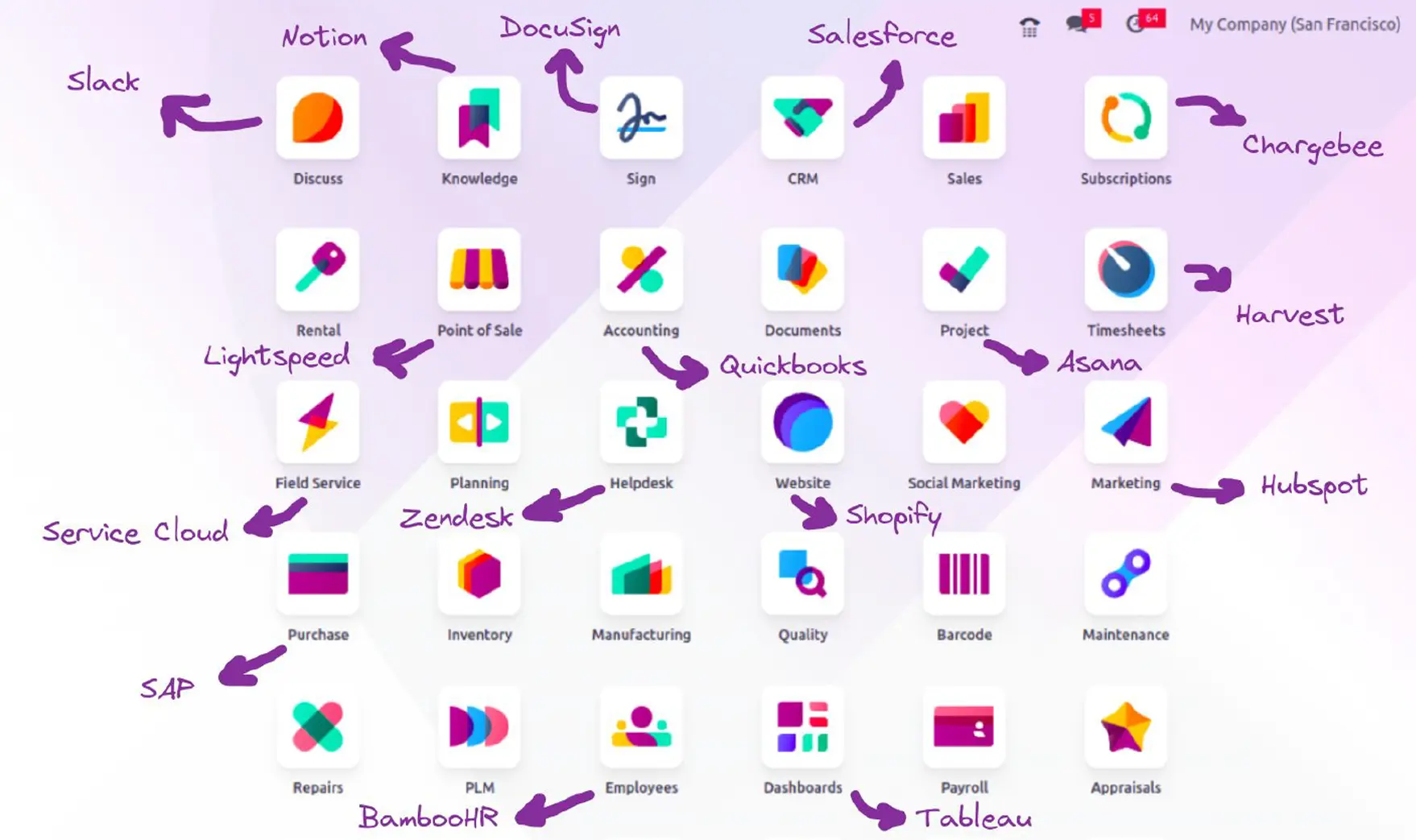
"Odoo or Shopify?" is the wrong question to ask. Shopify is an ecommerce platform: a storefront engineered to turn visits into purchases as fast as possible. Odoo is an ERP: the system that runs everything that happens after someone clicks "Buy", real stock, purchasing from suppliers, accounting, manufacturing where it applies, and everything that happens before, when someone has to decide what to buy and from whom. They don't compete on the same ground, even though they're often pitched as if they did.
Key point: most growing businesses don't actually pick one over the other. They run Shopify as the storefront (checkout, shopping experience, brand) and Odoo as the connected back office (real stock, purchasing, accounting, manufacturing). The order gets created in Shopify and syncs into Odoo on its own.
What Shopify does well (and why you shouldn't touch it)
Shopify wins outright at everything customer-facing: a checkout that's been optimized and battle-tested across millions of transactions, themes and apps to customize the store without touching code, integrated payments (Shopify Payments plus every other gateway via app), and a marketing ecosystem (email, SMS, upsells, cart abandonment) that's hard to match with any ERP's native ecommerce module, Odoo included. If your business lives and dies on conversion and shopping experience, Shopify is usually the best tool for that particular layer.
Its weak spot shows up when the business outgrows the storefront: a second warehouse, a supplier with complex replenishment cycles, the need for a real chart of accounts your accountant can actually work with, or manufacturing what you sell instead of just reselling it.
Where Odoo takes the lead: real operations
Multi-warehouse stock and routes
Odoo runs on a stock engine with unlimited locations, configurable routes (1 or 2-step receipt, drop shipping, cross-docking), automatic replenishment between warehouses, and full lot/serial number traceability. Shopify lets you create multiple locations and assign stock to each, but it has no routes or replenishment rules between warehouses: that requires a third-party app or, as we said, connecting it to an ERP.
Purchasing and suppliers
Odoo generates automatic purchase proposals based on minimum-stock rules, manages multiple supplier price lists per product, lead times and partial receipts. Shopify has no native purchasing module at all: managing purchase orders to suppliers requires a dedicated app, and it's often disconnected from what's actually happening with stock.
Real accounting
Odoo has a real general ledger, a chart of accounts adaptable to local regulation, bank reconciliation and e-invoicing. Shopify logs sales and produces basic financial reports, but it isn't an accounting system: most Shopify stores end up exporting to a spreadsheet or through a connector into dedicated accounting software, carrying the coordination risk that involves.
Manufacturing
If your business doesn't just resell but actually manufactures or assembles what it sells, bills of materials, manufacturing orders, quality control, Shopify simply has no answer: it isn't its territory at all. Odoo has a full manufacturing module integrated with the same stock and the same accounting.
Comparison table: Odoo vs Shopify by area
| Area | Shopify | Odoo |
|---|---|---|
| Checkout and shopping UX | Excellent, optimized and battle-tested at scale | Functional but generic; not its strong suit |
| Multi-warehouse stock | Basic locations, no routes or automatic replenishment | Routes, automatic replenishment and lot/serial traceability |
| Purchasing from suppliers | Not native; requires a third-party app | Automatic purchase proposals, per-supplier price lists |
| Accounting | Basic reports; not an accounting system | Real general ledger, e-invoicing, bank reconciliation |
| Manufacturing | Not available | Bills of materials, manufacturing orders, quality control |
| Business reporting | Good for sales and marketing; limited beyond that | Cross-functional: sales, purchasing, stock and finance in one report |
| Total cost (average SME) | Monthly fee + third-party apps to cover operations | Per-user license + initial setup; covers the whole operation |
When it makes sense to use Shopify + Odoo connected
This is the pattern we see most often in growing SMEs: the store keeps living on Shopify (brand, checkout, marketing apps), while real stock, purchasing, accounting and, where it applies, manufacturing move over to Odoo. The order is created in Shopify the moment the customer buys, and it syncs automatically into Odoo: customer, order lines, shipping address and payment method. Odoo then deducts the real stock (shared with other channels too, if there are any, like Amazon or a physical store), generates the delivery slip, and once it ships, the tracking number flows back to Shopify so the customer sees it in their account.
Our Shopify Connector for Odoo 17-19 does exactly that: it syncs orders, customers, products, stock and prices in both directions, handles fulfillment and tracking, and processes returns, all for a one-time payment of 149 EUR, with source code included and no monthly fees stacked on top of what you already pay for Shopify and Odoo.
When it makes sense to migrate fully to Odoo
There are cases where Shopify's frontend matters less: mostly B2B businesses, catalog-driven sales or recurring orders, where storefront design isn't the main conversion driver. In those cases, moving everything, storefront included, into Odoo avoids running two platforms and two subscriptions, and centralizes absolutely everything in a single system. A well-executed implementation, with data migrated, modules configured and carriers connected, is exactly what we offer through our Odoo 19 implementation service for ecommerce.
Frequently asked questions
Can I run my entire operation on Shopify alone, without Odoo?
For a store with a single warehouse, few SKUs and no manufacturing, yes, it's viable for a while. Once a second warehouse shows up, purchasing from several suppliers, kits or raw materials that get turned into product, or the need for real accounting with a general ledger, Shopify starts leaning on third-party apps to plug that gap, with recurring cost and less control over your own data.
Does Shopify handle multi-warehouse stock management?
Shopify lets you create multiple locations and assign stock to each one, but it has no configurable stock routes, no replenishment rules between warehouses, and no native lot/expiry traceability. That requires an extra layer, usually through an app or through a connected ERP like Odoo.
What does a business gain by running Shopify as the storefront and Odoo as the backend?
It keeps Shopify's checkout and shopping experience (fast, proven, backed by a huge theme and app ecosystem) while centralizing real stock, purchasing, accounting, manufacturing if it applies, and the relationship with other sales channels (marketplaces, a physical store, B2B) inside Odoo. The order is created in Shopify and syncs into Odoo automatically, with no manual double entry.
How much does it cost to connect Shopify with Odoo?
FlexigoTech's Shopify Connector for Odoo 17-19 is a one-time payment of 149 EUR, with source code included and no monthly fees. It syncs orders, customers, products, stock and prices in both directions, and handles fulfillment, tracking and returns.
Does it pay off to migrate fully from Shopify to Odoo, storefront included?
It depends on how much weight the storefront carries in conversion. If Shopify's design and shopping experience are a meaningful marketing asset, it almost always pays off more to keep Shopify as the storefront and connect Odoo behind it than to replace the entire frontend with Odoo's own ecommerce.
Want us to review your case?
Tell us how your operation is set up today and we'll tell you on the first call whether you need to connect Shopify with Odoo or migrate fully. Email us at comercial@flexigobe.com or call +34 616 809 504.