
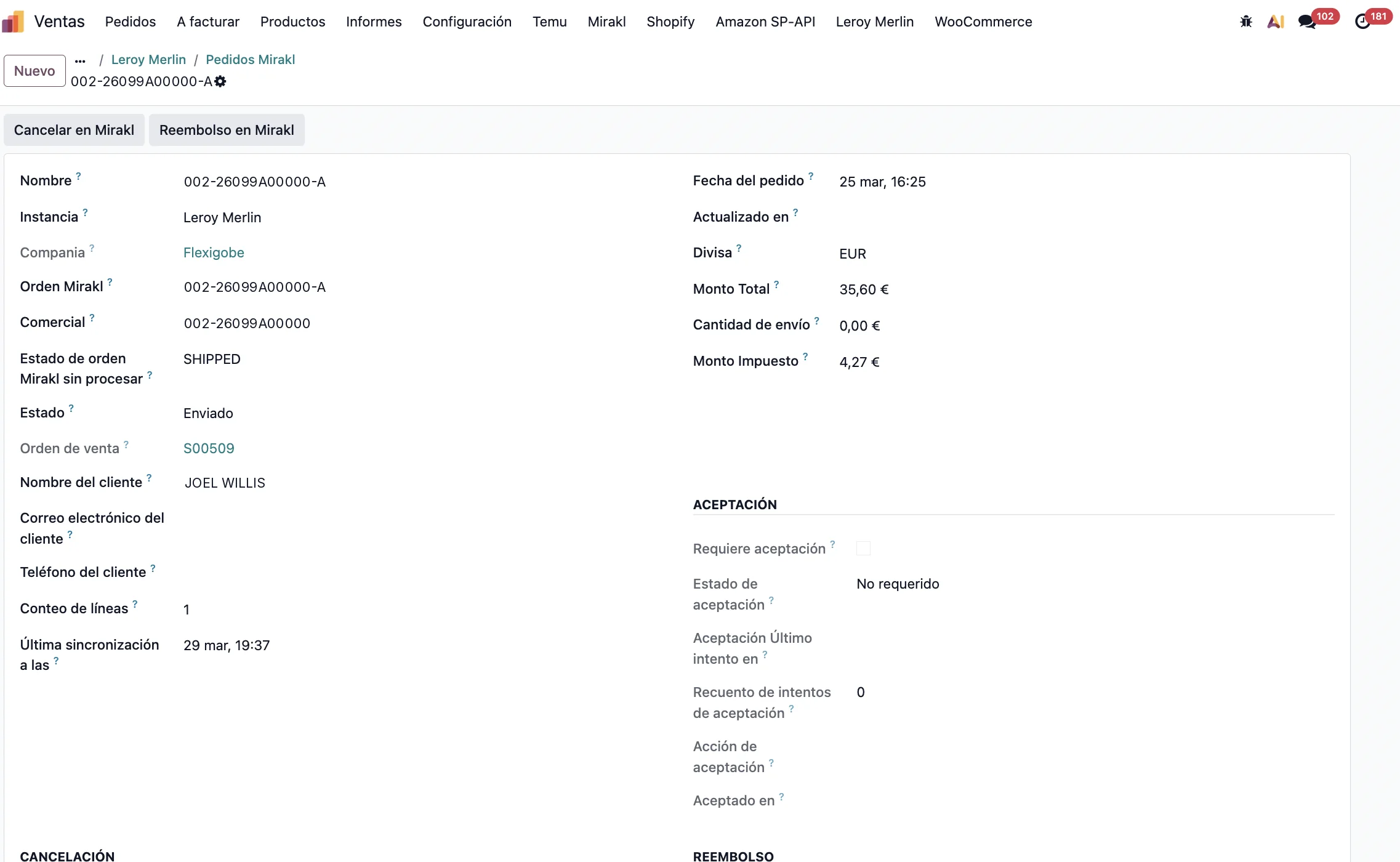
Leroy Merlin Marketplace runs on Mirakl. That means a useful integration can't stop at importing orders — it has to handle offers, categories, attributes, stock, carriers and order states.
Key idea: a worthwhile integration isn't measured by simply connecting an API. It's measured by how much manual work it removes, how many errors it prevents, and how much traceability it leaves inside the operational flow.
Mirakl demands a well-organized catalog
Mirakl-based marketplaces typically require a defined category structure, attributes and publishing rules.
If the catalog starts out disorganized, the connector just makes the mess move faster.
Offers, stock and price
The integration needs to keep offers, price and stock under control from within Odoo.
That way data gets corrected in one central place instead of across separate screens.
Orders and after-sales
Orders, tracking, returns and incidents all need to be recorded and traceable.
When the after-sales team is working from fragmented information, the risk of mistakes goes up.
Signs of a solid integration
Category mapping
Logs per operation
Error handling
Carriers and tracking
Scheduled synchronization
Controlled manual operations
Useful links within FlexigoTech
Frequently asked questions
Are Leroy Merlin and Mirakl the same thing?
No. Leroy Merlin is the marketplace; Mirakl is the marketplace technology that powers many of its flows.
Do categories need to be mapped?
Yes, it's usually a critical part of publishing your catalog correctly.
Can you start with just orders?
Yes, but if you sell a broad catalog it's worth planning offers and attributes from the start.
Can Odoo control several Mirakl marketplaces?
Yes, if the design accounts for instances, credentials, mappings and rules per channel.
Want us to review your case?
We look at your channels, stock, carriers and Odoo version to propose the cleanest path forward.