When an SME starts sending contracts, quotes or purchase orders from Odoo for signature, it's easy to assume every electronic signature carries the same weight. It doesn't. Regulation (EU) 910/2014, known as eIDAS, defines three levels of electronic signature — simple (SES), advanced (AES) and qualified (QES) — and only one of them carries, by law, the same legal effect as a handwritten signature across the entire European Union. Knowing which one a given document actually needs is the difference between an agreement that holds up and a piece of paper you'll have to defend yourself if it's ever challenged.
Key point: SES, AES and QES aren't marketing labels or generic “security levels” — they're legal categories defined in Articles 3, 25 and 26 of the eIDAS Regulation. Only the qualified signature (QES), issued by a qualified trust service provider (QTSP) using a qualified signature creation device, carries the legal presumption of equivalence to a handwritten signature across all 27 EU member states.
What Is an eIDAS Electronic Signature?
eIDAS stands for electronic IDentification, Authentication and trust Services. It's Regulation (EU) No 910/2014, in force since July 2016, which harmonizes electronic identification and trust services — signatures, seals, time-stamping, certified electronic delivery — across every EU member state. Its purpose is simple: a document signed electronically in Spain should carry the same legal recognition in Germany, France or Belgium, with no extra paperwork. Before eIDAS, each country regulated electronic signatures on its own, and cross-border recognition was genuinely uncertain.
SES, AES and QES: The Real Difference (and Why It Matters Legally)
Simple Electronic Signature (SES)
Defined in Article 3(10) of the Regulation, SES is any data in electronic form attached to or logically associated with other electronic data, which the signatory uses to sign. The bar is extremely low: clicking “I accept,” typing a name at the bottom of an email, a scanned image of a handwritten signature, or a confirmation checkbox all technically qualify as SES. Article 25(1) of eIDAS says an electronic signature cannot be denied legal effect purely for being electronic, so SES is valid. But it carries no presumption of authenticity: if the other party disputes the document, whoever wants to enforce it has to prove who signed it and that nothing was tampered with, using ordinary evidence — logs, IP addresses, confirmation emails.
Advanced Electronic Signature (AES)
Article 26 of eIDAS sets four conditions for a signature to qualify as AES: it must be uniquely linked to the signatory, capable of identifying them, created using signature data under their sole control, and linked to the document so that any later change is detectable. In practice this is achieved by verifying the signer's identity (ID document, facial biometrics, video verification) before letting them sign, and generating a cryptographic hash of the document. AES carries more evidentiary weight than SES — there's verified identity and technical proof of integrity — but unlike QES, the Regulation doesn't grant it the automatic presumption of equivalence to a handwritten signature: in a legal dispute, a judge still weighs the evidence, just with much stronger material than an SES would provide.
Qualified Electronic Signature (QES)
Under Article 3(12), QES is an AES created using a qualified signature creation device (QSCD) and based on a qualified certificate issued by a qualified trust service provider (QTSP) listed on its country's Trusted List. It's the only category to which Article 25(2) of eIDAS explicitly grants “the equivalent legal effect of a handwritten signature” across the EU. In practice, this flips the burden of proof in favor of whoever relies on it: if challenged, the person denying they signed is the one who has to prove it, not the other way around. It's the default level legal departments and insurers ask for whenever a contract carries real economic value or legal exposure.
Summary table: SES vs AES vs QES
| Level | Signer identification | Signature device | Legal value in a dispute | Real method in the FlexigoTech connector |
|---|---|---|---|---|
| SES — simple | Minimal or none (click, checkbox, scanned signature) | Any, no control required | Valid, but the burden of proof falls on whoever relies on it | SMS OTP code |
| AES — advanced | Verified (ID document, biometrics or video) | Under the signer's sole control | More evidentiary weight, no automatic presumption | Video verification with Veriff |
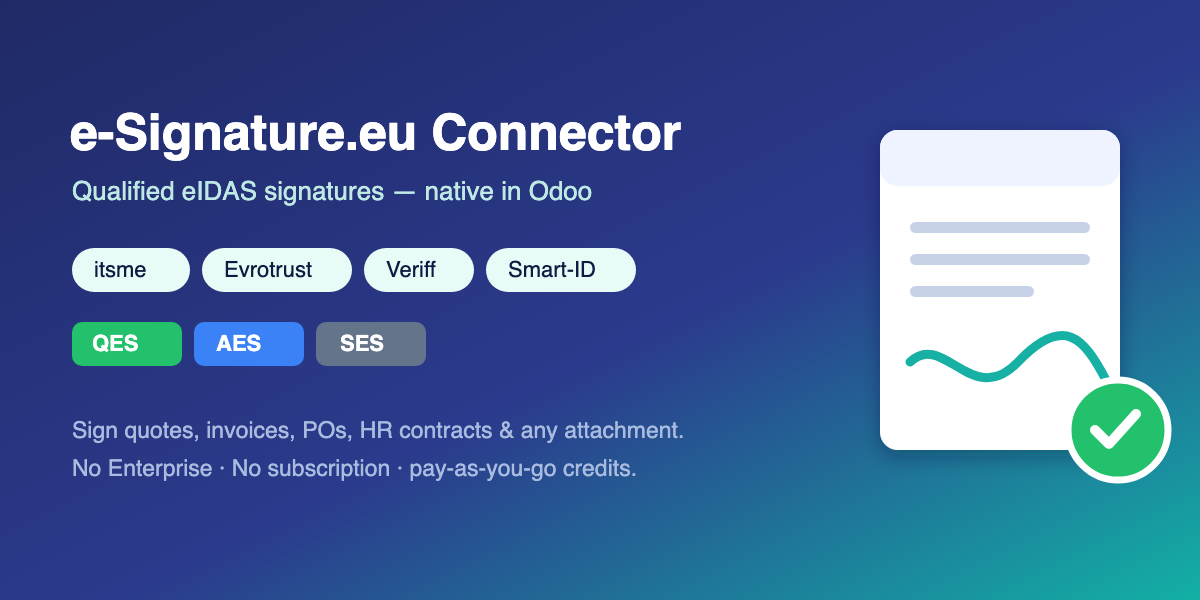
| QES — qualified | Qualified certificate issued by a QTSP | Qualified signature creation device (QSCD) | Same legal effect as a handwritten signature across the EU (Art. 25.2) | itsme® and Evrotrust |
What Native Odoo Sign Does (and Doesn't Do)
Odoo Sign, the signing app bundled with Odoo out of the box, lets you send a document that the recipient signs by drawing a stroke with a mouse or finger, typing their name, or simply accepting with a click, and it gets archived in the record's chatter. It's fast, free, and perfectly valid as SES: it satisfies Article 25(1) of eIDAS. What it doesn't do is verify the signer's identity against an official document or issue a qualified certificate, so it can't produce AES or QES on its own. For acknowledgments of receipt, internal terms, or low-risk documents, that's enough. For a distribution agreement, a partnership deal with real money behind it, or any document where the other side could dispute who actually signed, it isn't.
Most Odoo Signature Connectors Also Stop at SES
The same ceiling shows up in most signature connectors built for Odoo: they wrap an integration with an external provider, but the actual signature level they deliver is still SES (click to sign) or, at best, a basic AES with email or SMS verification. Issuing a real QES requires something most connectors don't have built in: direct access to a qualified trust service provider (QTSP) listed on the EU Trusted List, along with whatever identification methods that QTSP requires to issue the qualified certificate. Without that, no matter how polished the integration looks, the legal ceiling stays exactly the same as native Odoo Sign.
FlexigoTech's Real Connector with e-Signature.eu: True QES Inside Odoo
FlexigoTech built a real connector for Odoo 17, 18 and 19, together with the e-Signature.eu team (VisitOnWeb SRL, Belgium — Bruno Biemans and Dimitri), that lets you send any ERP document — a quote, contract, invoice, purchase order — for eIDAS signature while choosing the exact level you need: SES, AES or QES, without ever leaving Odoo. The signer identifies using whichever method fits the chosen level and country: itsme® or Evrotrust for QES, video verification with Veriff for AES, or an SMS OTP code for SES.
The connector is listed on the Odoo App Store for a one-time 149 EUR (Odoo 17, 18 and 19). The price per signature is set by e-Signature.eu depending on the level and method chosen, and it's pay-as-you-go with no subscription fee: you only pay for the signatures you actually send.
What You Need for Real Qualified Signatures in Odoo
- Install the e-Signature.eu Connector from the Odoo App Store (149 EUR, one-time, Odoo 17-19).
- Set up an account with e-Signature.eu (VisitOnWeb): no subscription, pay per signature sent.
- Choose the signature level (SES, AES or QES) directly from the Odoo document itself, before sending it.
- The signer identifies using itsme®, Evrotrust, Veriff or an OTP code, depending on the level chosen.
- The signed document, the certificate and the evidence (including the time stamp) are automatically archived in Odoo.
When to Use Each Level: A Practical Guide
In practice, most companies don't need QES for everything — using QES for an internal acknowledgment of receipt is overspending. The logic that actually works is this: SES for low-risk documents (internal confirmations, receipt acknowledgments, terms already negotiated through another channel); AES for standard B2B commercial contracts where verified identity is useful but there's no extreme legal risk; and QES for anything with real economic value, contracts with counterparts demanding the highest guarantee level, or any document where, should it end up in litigation, you want the burden of proof on your side. One honest caveat: QES doesn't replace acts the law requires to be raised to a notarial public deed (a property sale in Spain, for instance) — that still needs a notary, regardless of the electronic signature level used.
Useful links within FlexigoTech
Frequently asked questions
Which is the only electronic signature with the same legal value as a handwritten signature in the EU?
The qualified electronic signature (QES). Article 25(2) of the eIDAS Regulation explicitly grants it “the equivalent legal effect of a handwritten signature” across all 27 EU member states. SES and AES are legally valid, but neither carries that automatic presumption of equivalence.
Can I sign a contract with native Odoo Sign and have it count as a qualified signature?
No. Native Odoo Sign produces, at most, a simple signature (SES): it doesn't verify the signer's identity against an official document or issue a qualified certificate through a QTSP. To get AES or QES you need a connector that plugs into a qualified trust service provider, such as FlexigoTech's e-Signature.eu Connector.
Are itsme® and Evrotrust valid across the whole EU, or only in one country?
Both are valid across the entire EU. itsme® is an electronic identification method that, to issue a qualified signature, relies on a qualified certificate; Evrotrust is a Bulgarian qualified trust service provider (QTSP) listed on the EU Trusted List. Under eIDAS's mutual recognition principle, a QES issued by any QTSP on that list has the same legal effect in all 27 member states.
How much does it cost to use qualified signatures (QES) in Odoo with this connector?
The e-Signature.eu Connector costs a one-time 149 EUR on the Odoo App Store (Odoo 17, 18 and 19). The price of each signature is set by e-Signature.eu based on the level (SES, AES or QES) and identity method used, and it's pay-per-use: no subscription fee and no extra surcharge from the connector itself.
Is FlexigoTech an official partner of e-Signature.eu?
Yes. The connector was built together with the e-Signature.eu team (VisitOnWeb SRL, Belgium), through real rounds of feedback and production use. You can see the relationship on FlexigoTech's official partners page.
Need real qualified signatures in your Odoo?
We'll tell you on the first call exactly what level (SES, AES or QES) each of your documents needs and how to get it running in Odoo. Email us at comercial@flexigobe.com or call +34 616 809 504.