
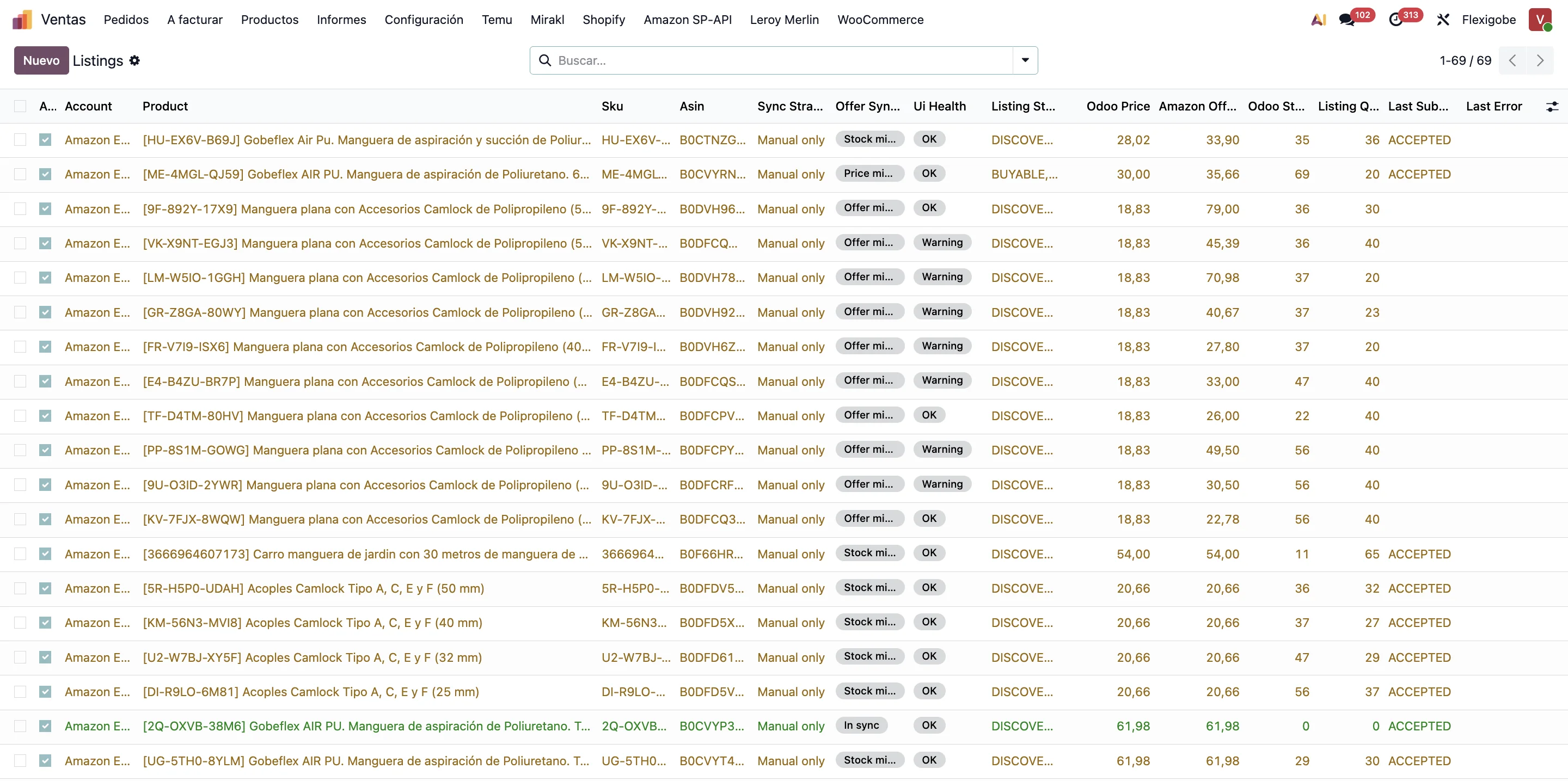
An Amazon connector for Odoo should help you sell in a more orderly way, not just import orders. If it only moves data back and forth while the team is still living between Odoo, Seller Central and side spreadsheets, the integration is incomplete.
Key idea: a good Amazon Odoo integration isn't measured by having SP-API credentials configured. It's measured by whether it reduces manual work, prevents stock errors and leaves traceability inside the ERP.
What an Amazon Odoo connector must solve
- Reliable order import and stock reservations.
- SKU, variant and listing mapping with no duplicates.
- Synchronization of statuses, tracking and confirmations.
- Pricing management, incidents and error cases.
- FBA handling when it's part of the operation.
- Logs and retries when Amazon or the internal queue fails.
Why Amazon breaks operations when Odoo isn't in charge
Amazon demands speed and consistency. If stock comes from several places, if the catalog isn't clean, or if tracking is managed outside the ERP, the team ends up in a spiral of incidents: unmapped orders, inconsistent inventory, shipping errors and more expensive after-sales support.
Start with what hurts most
Many projects don't need to launch with everything at once. The sensible move is usually to start with orders, stock and tracking, then expand into listings, pricing, FBA, returns or messaging as the business needs it.
Common mistakes in Amazon + Odoo
- Different SKUs between Amazon and Odoo with no clear binding strategy.
- Tracking sent late or from an uncontrolled flow.
- FBA mixed with owned stock with no operational criteria.
- SP-API errors with no useful logs or retries.
- Running large catalogs without validating attributes and product family.
What you should ask before buying
- Which flows are supported today and which aren't.
- How FBA, returns and error cases are handled.
- What happens if a queue or an API call fails.
- Whether the provider implements the rollout or just sells the license.
- How Amazon fits with your other current channels.
Useful links within FlexigoTech
FAQs
Should an Amazon Odoo connector handle FBA?
It depends on the business, but if you work with FBA the connector needs to account for it so inventory and operations don't end up split across systems.
Can Amazon and Odoo share tracking and statuses?
Yes, and it's one of the most important points to avoid manual work and after-sales problems.
Can you start with just orders and stock?
Yes. Many rollouts start this way and later expand into pricing, listings or returns.
What separates a serious connector from a basic one?
Traceability, logs, error handling, catalog mapping and the ability to sustain real operations.
Want to check whether Amazon should be centralized in Odoo?
We look at SKUs, stock, logistics and channels to tell you where to start without over-scoping the rollout.